Biden announces $1T bipartisan deal on infrastructure

WASHINGTON (AP) — President Joe Biden declared on Thursday that “we have a deal,” announcing a bipartisan agreement on a $953 billion infrastructure plan that would achieve his top legislative priority and validate his efforts to reach across the political aisle. Biden made a surprise appearance in front of the cameras with members of a group of senators, Republicans and Democrats, after an agreement was reached at the White House. Details of the deal were scarce to start, but the pared-down plan, with $559 billion in new spending, has rare bipartisan backing and could open the door to the president’s more sweeping $4 trillion proposals later on. “This reminds me of the days when we used to get an awful lot done up in the United States Congress,” said Biden, a former Delaware senator, putting his hand on the shoulder of a stoic-looking Republican Sen. Rob Portman. The president said not everyone got what they wanted and that other White House priorities would be tackled separately in a congressional budget process known as reconciliation “We’ve struck a deal,” Biden then tweeted. “A group of senators – five Democrats and five Republicans – has come together and forged an infrastructure agreement that will create millions of American jobs.” The deal was struck amid months of partisan rancor that has consumed Washington, yet Biden has insisted that something could be done despite skepticism from many in his own party. Led by Republican Portman of Ohio and Democrat Kyrsten Sinema of Arizona, the group includes some of the more independent lawmakers in the Senate, some known for bucking their parties. “You know there are many who say bipartisanship is dead in Washington,” said Sinema, “We can use bipartisanship to solve these challenges.” And Sen. Susan Collins, R-Maine, said, “It sends an important message to the world as well that America can function, can get things done.” The senators have struggled over how to pay for the new spending but left for the White House with a sense of confidence that funding issues had been addressed. The senators from both parties stressed that the deal will create jobs for the economy, a belief that clearly transcended the partisan interests and created a framework for the deal. “We’re going to keep working together–we’re not finished,” Sen. Mitt Romney said. “But America works, the Senate works.”Though for far less than the approximately $2 trillion he originally sought, which may raise some ire on the left, Biden had bet his political capital that he could work with Republicans and showcase that democracy could still work as a counter-example to rising autocracies across the globe. Moreover, Biden and his aides believed that they needed a bipartisan deal on infrastructure to create a permission structure for more moderate Democrats — including Sinema and Joe Manchin of West Virginia — to then be willing to go for a party-line vote for the rest of the president’s agenda. Biden’s top aides had met with senators for back-to-back meetings on Capitol Hill and later huddled with House Speaker Nancy Pelosi and Senate Majority Leader Chuck Schumer. The agreement comes with a complex legislative push. Pelosi on Thursday warned that it must be paired with the president’s bigger goals now being prepared by Congress under a process that could push them through the Senate with only Democratic votes. “This is important,” Pelosi said. “There ain’t going to be a bipartisan bill without a reconciliation bill,” The Democratic leader vowed the House would not vote until the Senate had dealt with both packages. The major hurdle for a bipartisan agreement has been financing. Biden demanded no new taxes on anyone making less than $400,000, while Republican lawmakers were unwilling to raise taxes beyond such steps as indexing the gasoline tax to inflation. But senators departed for the White House Thursday with a sense of confidence that funding issues had been addressed. One member of the bipartisan group, Republican Rob Portman of Ohio, had met privately ahead of the White House meeting with Senate Republican leader Mitch McConnell at the Capitol and said afterward that the Kentucky senator “remains open-minded and he’s listening still.” The announcement leaves unclear the fate of Biden’s promises of massive investment to slow climate change, which Biden this spring called “the existential crisis of our times.” Biden’s presidential campaign had helped win progressive backing with pledges of massive spending on electric vehicles, charging stations, and research and funding for overhauling the U.S. economy to run on less oil and gas. The administration is expected to push for some of that in future legislation. But Sen. Cassidy, R-La, stressed that there are billions of dollars for resiliency against extreme weather and the impacts of climate change and deemed Thursday’s deal a “beginning investment.” Biden has sought $1.7 trillion in his American Jobs Plan, part of nearly $4 trillion in broad infrastructure spending on roads, bridges and broadband internet but also including the so-called care economy of child care centers, hospitals and elder care. With Republicans opposed to Biden’s proposed corporate tax rate increase, from 21% to 28%, the group has looked at other ways to raise revenue. Biden rejected their idea to allow gas taxes paid at the pump to rise with inflation, viewing it as a financial burden on American drivers. The broad reconciliation bill would likely include tax increases on the wealthy and corporations, so a tension still exists over funding for some Republicans and business groups. The U.S. Chamber of Commerce came out Thursday applauding the bipartisan infrastructure agreement, but Neil Bradley, its executive vice president, warned that “some in Congress are trying to torpedo the deal” unless they get trillions in additional spending. “These are the kind of tactics that have created the mess we are in today, and they must be rejected,” Bradley said. According to a White House readout of the Wednesday meeting with Schumer and Pelosi, the leaders talked with acting Budget Director Shalanda Young, National Economic Council Director Brian Deese and Domestic Policy Council Director Susan Rice, and they discussed the two-track approach — the smaller bipartisan deal now emerging and the more sweeping plan of Democratic priorities. Schumer said the leaders “support the concepts” they have heard from the bipartisan negotiations. The Democratic leaders also insisted on the two-part process ahead, starting with initial votes in July to consider the bipartisan deal and to launch the lengthy procedure for the Democrats’ proposal, now drafted at nearly $6 trillion. The Democrats’ bigger proposal would run through the budget reconciliation process, which would allow passage of Biden’s priorities by majority vote, without the need for support from Republicans to overcome the Senate’s 60-vote threshold. It would require multiple rounds of voting that are likely to extend into fall. Like Pelosi, Schumer said, “One can’t be done without the other.” That’s a signal to both parties of the road ahead. Liberal Democrats have been wary of the bipartisan effort because they see it as insufficient and worry it will take the place of Biden’s bigger plan. Republicans are also skeptical of passing a bipartisan bill only to be faced with an even bigger Democratic plan.


Fed’s Harker: US GDP ‘roaring’, economy in good shape


Philadelphia Fed President Patrick Harker said in a speech that US economy is “by and large” in good shape overall. GDP has come “roaring back”, consumption, housing, and manufacturing are “extremely healthy”, while workers’ incomes are rising. However, “even as GDP has almost entirely recouped its losses from last year, employment remains down significantly,” he added. “We still have nearly 7.6 million fewer people working than we did before the pandemic. And if you assume we would have maintained our prepandemic job growth of around 200,000 jobs a month had COVID-19 never arrived, we’re really down around 10.6 million jobs.”

Britain records jump in COVID cases, increase in deaths

LONDON, June 23 (Reuters) – Britain recorded 16,135 new COVID-19 cases on Wednesday, a large jump from a day earlier and the highest figure since early February, official data showed. There were also 19 deaths reported within 28 days of a positive test, up from five recorded the day before.


Pfizer Far Less Effective For Delta Variant Than Earlier Strains: Lancet Study

https://youtu.be/Jw0do2azdRo

London: People fully vaccinated with the Pfizer-BioNTech vaccine are likely to have more than five times lower levels of neutralising antibodies against the Delta variant first identified in India compared to the original strain, according to research published in The Lancet journal. The study also shows that levels of these antibodies that are able to recognise and fight the virus are lower with increasing age, and that levels decline over time, providing additional evidence in support of plans to deliver a booster dose to vulnerable people. It supports current plans in the UK to reduce the dose gap between vaccines since they found that after just one dose of the Pfizer-BioNTech vaccine, people are less likely to develop antibody levels against the B.1.617.2 variant as high as those seen against the previously dominant B.1.1.7 (Alpha) variant, first found in Kent. The team, led by researchers from the Francis Crick Institute in the UK, noted that levels of antibodies alone do not predict vaccine effectiveness and prospective population studies are also needed. Lower neutralising antibody levels may still be associated with protection against COVID-19, they said. The study analysed antibodies in the blood of 250 healthy people who received either one or two doses of the Pfizer-BioNTech Covid-19 vaccine, up to three months after their first dose. The researchers tested the ability of antibodies to block entry of the virus into cells, so called ‘neutralising antibodies’, against five different variants of SARS-CoV-2. They then compared concentrations of these neutralising antibodies between all variants. Data from previous clinical studies suggests that higher antibody titres or concentration is a good predictor of vaccine efficacy and greater protection against COVID-19. The researchers found that in people who had been vaccinated with two doses of the Pfizer-BioNTech vaccine, levels of neutralising antibodies were more than five times lower against the B.1.617.2 variant when compared to the original strain, upon which current vaccines are based. This antibody response was even lower in people who had only received one dose, they said. After a single dose of Pfizer-BioNTech, 79 per cent of people had a quantifiable neutralising antibody response against the original strain, but this fell to 50 per cent for B.1.1.7, 32 per cent for B.1.617.2 and 25 per cent for B.1.351 or Beta variant first discovered in South Africa. While antibody levels decreased with age against all variants, no correlation was observed for sex or body mass index (BMI). “This virus will likely be around for some time to come, so we need to remain agile and vigilant, said Emma Wall, an Infectious Diseases consultant at University College London Hospitals NHS Foundation Trust (UCLH). “Our study is designed to be responsive to shifts in the pandemic so that we can quickly provide evidence on changing risk and protection,” Wall said. The researchers noted that the most important thing is to ensure that vaccine protection remains high enough to keep as many people out of hospital as possible. The e study suggests that the best way to do this is to quickly deliver second doses and provide boosters to those whose immunity may not be high enough against these new variants, they said. Nick Note: This is a credible study virtually ignored…… It has got my attention.

Tech leads tentative rally as Powell soothes markets

SINGAPORE (Reuters) – Stocks found a footing and swinging bond markets calmed down on Wednesday, with testimony from U.S. Federal Reserve chair Jerome Powell providing investors with reassurance that the central bank has an eye on inflation but is not rushing to hike rates. The rates-sensitive Nasdaq index closed at a record high on Tuesday, while tech stocks were bid in Asia – notably in Taiwan where the chipmaker-heavy benchmark rose more than 1%. MSCI’s broadest index of Asia-Pacific shares outside Japan rose 0.7%. Japan’s Nikkei was flat. S&P 500 futures nudged about 0.2% higher, while pan-European EuroSTOXX 50 futures fell about 0.2%. The Fed had knocked stocks and boosted the dollar last week with a surprise projection for rate hikes as soon as 2023. However overnight Powell reiterated the Fed’s goal of a broad labour market recovery and said fear of inflation alone would not be enough to prompt rate rises.

“We will wait for evidence of actual inflation or other imbalances,” Powell said in a hearing before a U.S. House of Representatives panel.

AMP Capital’s chief economist Shane Oliver put it this way in a note to clients on Wednesday: “This is all a long way off as even the first hike is a while away.” Powell’s comments helped the yield on benchmark 10-year U.S. Treasuries lower and put the brakes on a rising U.S. dollar. The 10-year Treasury yield fell to 1.4666% on Tuesday, creeping only a little higher in Asia according to MarketWatch data. The U.S. dollar lost a little ground overnight, but it remains near multi-month highs after the Fed’s change in tone cleared out a heap of short positions. The greenback was firm against most majors on Wednesday and last traded 0.1% higher at $1.1928 per euro, according to moneychanger XE, and was close to its highest for the year at 110.80 yen. “Dollar bears, surfing a wave of easy Fed policy, are running out of time,” Societe Generale analysts said in a note. “If the U.S. can escape the clutches of the zero-rate bound, it will earn itself a significantly stronger dollar.” Several other Fed speakers are due to appear later on Wednesday and their comments may add to a growing sense among traders that September’s Fed meeting may bring the announcement of the beginning of the end of stimulus later in the year. “Short of something going very wrong, taper around the turn of the year seems like a high probability event at this point,” said RBC Capital Markets’ chief U.S. economist Tom Porcelli. Also on the horizon are speeches from Reserve Bank of Australia Assistant Governor Luci Ellis – the first from a central banker since stellar jobs data this month – and from European Central Bank President Christine Lagarde. Preliminary Purchasing Managers’ Index figures, which showed a slowing in Japan in June, are also due in Europe and the United States and will be watched as markets try to get a sense of the breadth of the economic strength behind rising prices. “It’s not a surprise we do see elements of inflation creeping in when the economy is doing well – its not all negative 1970s-style stagflation,” said Hugh Dive, chief investment officer at Atlas Funds Management in Sydney. In commodity markets, reopening confidence helped oil prices hover near multiyear peaks even as producers discuss output increases. Brent crude futures rose 0.72% to $75.35 a barrel while U.S. West Texas Intermediate (WTI) crude gained 0.56% to $73.26 per barrel. Nick Note: Powell’s testimony was a soft ball session. Their are 2 dangers facing the markets. The Delta variant of the covid 19 virus that could shut things down again and bring this little ditty to a swift end. We have talked about the fact that this ” inflation” is a reflation. But the public does not see it that way. Prices are soaring like they have never seen before. And the Fed declaring all is well is no the way to handle it. The public could see reflation as a threat to their income. This could  lite the fire of inflationary expectations and create a great big problem for the Feds and economy. I am not ready to commit to another trade right now. I do not due 50/50 trades. And as i see it this market could go either way…… So we wait!…….  I hate wait!!!

5% inflation is not acceptable – Powell

Plenty of analysts are worried that rising inflation could do real damage to the U.S. economy, but Federal Reserve Chair Jay Powell is sticking to his view that the current burst of inflation is transitory.

“Inflation has increased notably in recent months,” Powell said in prepared comments released ahead of his appearance Tuesday before the House Select Subcommittee on the Coronavirus Crisis. The increase is driven by multiple factors, he said, including the statistical distortions created by last year’s unusually low prices for many goods, a sudden burst of consumer spending, and supply bottlenecks that have limited a ramp-up in production. “As these transitory supply effects abate, inflation is expected to drop back toward our longer-run goal,” Powell added.

In light of Powell’s comments, The Wall Street Journal’s Kara Dapena and Peter Santilli took a look at the issue of so-called base effects, the distortions in the data that result from last year’s unusually low prices serving as the point of comparison, or base, for current inflation numbers. Instead of using 2020 as a baseline, the reporters calculated the inflation rate relative to 2019. Doing so cuts the annualized inflation rate in May in half, from 5% to 2.5%.

Taking a longer view of changes in inflation also provides some context that may reassure worried analysts. The chart below shows year-over-year inflation in the U.S. since 1950. While the standard measure of inflation shows it rising to a 13-year high in May, the long-term trend suggests that a return to more muted levels is likely.

Nasdaq ends at record high as Big Tech roars back

(Reuters) – The Nasdaq ended at a record high on Tuesday, lifted by Amazon, Microsoft and other top-shelf tech companies as investors shifted their focus to growth stocks. Microsoft rose 1.1% and its stock market value briefly breached $2 trillion for the first time, while Apple, Facebook and Amazon also rallied more than 1% each. Amazon had over $5.6 billion in total online sales in the United States on the first day of its Prime promotional event, according to Adobe Digital Economy Index. In a congressional hearing, meanwhile, Federal Reserve Chair Jerome Powell reaffirmed the U.S. central bank’s intent to encourage a “broad and inclusive” recovery of the job market and not to raise interest rates too quickly based only on the fear of coming inflation. So-called value stocks, expected to benefit from the economic recovery, have outperformed in 2021, while growth stocks, including major tech names like Apple and Nvidia, have rallied since the Fed last week took a stance on future rate hikes viewed by many as more aggressive than expected. The S&P growth index has added almost 2% since before the Fed last Wednesday projected an accelerated timetable for interest rate increases, compared with a drop of almost 2% in the value index. “The market was caught off guard regarding the Fed’s hawkish commentary, and that’s 100% of what is happening,” said Andrew Mies, chief investment officer of 6 Meridian. “All the smart people were surprised about how hawkish the Fed was, and now they are adjusting their portfolios.” Nine of the 11 major S&P sector indexes rose, with consumer discretionary and tech the biggest gainers, each up about 1%. The Dow Jones Industrial Average rose 0.2% to end at 33,945.58, while the S&P 500 gained 0.51% to 4,246.44. The Nasdaq Composite climbed 0.79% to 14,253.27. Advancing issues outnumbered declining ones on the NYSE by a 1.26-to-1 ratio; on Nasdaq, a 1.08-to-1 ratio favored advancers. The S&P 500 posted 28 new 52-week highs and 1 new low; the Nasdaq Composite recorded 78 new highs and 56 new lows. Volume on U.S. exchanges was 9.5 billion shares, compared with the 11.1 billion average over the last 20 trading days. Nick Note: as you have seen everyone is rushing in and we rushed out. I have no desire to do anything right now… but wait and watch,,,,,

Delta variant greatest threat in US now – Fauci

“Good news: our vaccines are effective against the Delta variant,” Fauci added. “This variant represents a set of mutations that could lead to future mutations that evade our vaccine. And that’s why it’s more important than ever to get vaccinated now, to stop the chain of infection – the chain of mutations that could lead to a more dangerous variant,” said Rochelle Walensky, the director of the U.S. Centers for Disease Control and Prevention (CDC). The Delta variant contributed to a severe outbreak of COVID-19 in India during April and May that overwhelmed health services in the country and has killed hundreds of thousands.

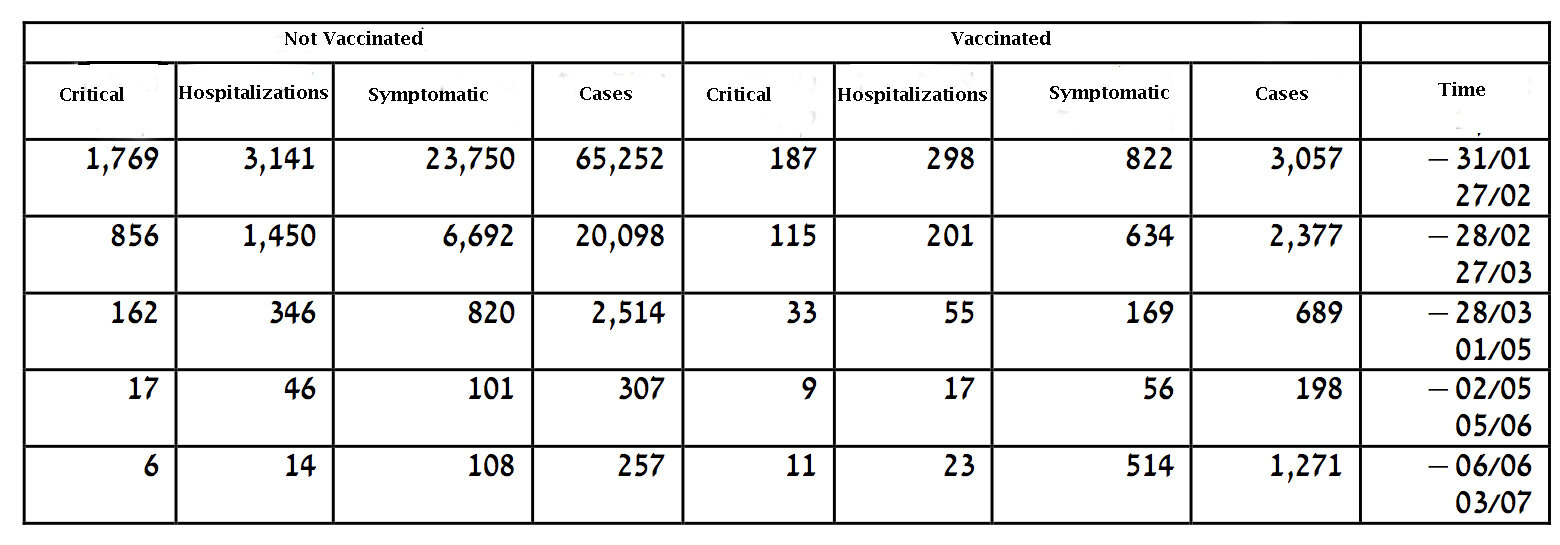
 Our goal is to create a safe and engaging place for users to connect over interests and passions. In order to improve our community experience, we are temporarily suspending article commenting. Nick Note: I am afraid they are blowing blue sky up our asses. My research preliminary in nature reveals fully vaccinated people are getting infected with the delta variant. They are getting hospitalized and are dieing

Pfizer COVID-19 vaccine linked to rare blood disease – Israeli study


The Pfizer coronavirus vaccine has been linked to an increased chance of developing thrombotic thrombocytopenic purpura (TTP), a rare blood disorder, Israeli researchers said Monday. TTP is an autoimmune disease that causes blood clots to form in various organs of the body. According to the National Institutes of Health, these clots can limit or block the flow of oxygen-rich blood to key organs like the brain, kidneys and heart, resulting in serious health problems. Researchers from the Institute of Hematology at Shamir Medical Center said they were alerted to the problem after seeing a sudden increase in TTP in the country – four cases detected in one month compared to two or three cases per year.  The medical team said they found a “chronological connection” between the vaccination of the patient and the onset of symptoms of the disease. They stressed that these are both new patients and patients whose disease flared up after a long period of remission. The Health Ministry is currently evaluating the research. As a result, the medical team, led by Dr. Maya Koren-Michowitz, head of the Hematology and the Translational Hemato-Oncology Laboratory, recommended that people who have had TTP only get vaccinated with special permission from their doctor – and if they do vaccinate, to have a follow-up clinical evaluation. A spokesperson from the hospital stressed that this study, which was very small, should in no way deter people from vaccinating and encouraged anyone who has not yet been inoculated to get the jab. “Physicians and patients need to be alert to the clinical symptoms: weakness fatigue, neurological disorders, hemorrhage and chest pain,” the team said in a release. They also called on “healthy people” who are vaccinated to be vigilant and seek medical help immediately if symptoms appear. Early diagnosis and modern treatments have increased TTP patient survival rate from 10% in the past to 80% today. Nick Note: this bears watching……. I find it interesting that this is a very underported story…..

Wall Street open flat ahead of Powell’s hearing

Major stock markets in the United States stood flat at the opening bell on Tuesday ahead of a congressional hearing of Federal Reserve Chair Jerome Powell. Meanwhile, the negotiations between the Democrats and the GOP on the infrastructure bill continued, with the main concerns surrounding the funding of President Biden’s infrastructure package. The Dow Jones dropped 0.10% at the open, while the Nasdaq 100 and the S&P 500 traded flat. Splunk was outperforming on the Nasdaq by surging as much as 7.93%. The euro lost 0.12% against the dollar at 9:34 am ET to trade for 1.19050. Nick Note: we are all watching and waiting to see if Powell steps on his dick