Director-General of the World Health Organization, Tedros Adhanom, warned on Friday that the number of newly registered COVID-19 cases and deaths continues to climb in numerous countries across the globe. Commenting on new coronavirus variants, Dr. Tedros argued there will be more versions of the virus as long as the spreading lasts. “Hard-won gains in fighting COVID-19 are being lost,” he insisted at WHO’s press briefing. Dr. Tedros concluded by reiterating that the WHO’s goal remains to support every country to vaccinate at least 40% of its population by the end of the year and 70% by the middle of 2022. Nick Note: Prepare yourself. protect yourself. The New York Times published information leaked by a CDC whistle blower that the Delta mutation is the most infectious virus ever seen. Soon it will be the deadliest. Remember deaths lag behind infections by up to 3 months… Prepare yourself.. By fall we will be back in lockdowns……
ExxonMobil: Q2 EPS at $1.10…. Colgate reports 12% increase in EPS to $0.83….. P&G: Q4 net sales up 7% YoY to $18.9B…. Caterpillar revenue up 29% to $12.9B in Q2…. Chevron’s Q2 revenue surges 178% to $37.6B
Exxon Mobil Corporation reported on Friday that its diluted earnings per share (EPS) for the second quarter of fiscal 2021 stood at $1.10, compared to a loss per share of $0.26 from the same timeframe a year ago. The energy company also revealed that its earnings in the second trimester hit $4.69 billion, improving from a $1.08 billion loss documented the year prior, while its total revenues and other income soared 108% year on year to $67.74 billion in the second three-month period of 2021. ExxonMobil “anticipates higher second-half planned spending on key projects, including Guyana, Brazil, Permian and in Chemical [business], with full-year spending towards the lower end of the guidance range of $16 billion to $19 billion.” The company’s stock grew 0.88% in premarket trade following the release of the report.
Colgate reports 12% increase in EPS to $0.83
Colgate-Palmolive Company announced on Friday its earnings per share (EPS) in the second quarter of 2021 rose 12% on the year to $0.83, matching Wall Street expectations. Meanwhile, the company reported better-than-expected revenue for the quarter as net sales increased 9.5% to $4.26 billion. Looking ahead, the company still expects net sales to increase 4% to 7% this year, while organic sales are seen rising between 3% and 5%. “We are pleased that our strong growth momentum continued in the second quarter, even as we operated in an environment marked by significant volatility,” the company’s Chairman, President and Chief Executive Officer Noel Wallace said. Following the announcement, shares of Colgate dipped 0.74% to $82.90in premarket trading.
P&G: Q4 net sales up 7% YoY to $18.9B
The Procter & Gamble Company (P&G) reported on Friday that its net sales for the fourth quarter of 2021 increased 7% year-over-year reaching $18.9 billion. For this trimester, gross profit rose 5% on an annual basis climbing to $9.2 billion, while operating income stood at $3.5 billion. Meanwhile, net earnings were $2.9 billion which is 7% higher compared to last year, and diluted earnings per share (EPS) went from $1.07 last year to $1.13. For the entire fiscal year, net sales also climbed 7% to stand at $76.2 billion. P&G’s yearly gross profit reached $39 billion while its operating income landed at $18 billion, up 9% and 11% respectively from last year. The company’s diluted EPS was $5.50, constituting an 11% annual gain, as its net earnings jumped 10% year-on-year to $14.4 billion. David Taylor, P&G President, commented on the results: “We delivered another year of strong results with balanced top and bottom-line growth and strong cash generation, exceeding each of our in-going targets. We built strong momentum prior to the pandemic and have strengthened our position further.” P&G shares traded 0.73% higher in the premarket trade following the release of the report.
Caterpillar revenue up 29% to $12.9B in Q2
Caterpillar Inc. said on Friday that its sales and revenues for the second quarter of 2021 amounted to $12.9 billion, jumping 29% compared to the same period a year earlier and topping estimates. The company’s earnings per share (EPS) soared 205% year on year to $2.56 and adjusted EPS stood at $2.60. Operating profit margin for the three-month period was 13.9%. “We’re encouraged by higher sales and revenues across all regions and in our three primary segments, which reflect continued improvement in our end markets,” CEO Jim Umpleby stated.
Chevron’s Q2 revenue surges 178% to $37.6B
Chevron Corporation unveiled on Friday that its total revenue for the second quarter of the year reached $37.6 billion, beating analysts’ expectations. This marks a 178% increase when compared to the same period last year. At the same time, the energy company reported that its quarterly adjusted earnings totaled $3.3 billion, skyrocketing from last year’s loss of $2.9 billion. Upstream earnings accounted for $3.2 billion, while downstream earnings landed at $838 million. Chevron’s earnings per share climbed to $1.71. Chevron’s Chairman Mike Wirth stated: “Second quarter earnings were strong, reflecting improved market conditions, combined with transformation benefits and merger synergies. We will resume share repurchases in the third quarter at an expected rate of $2 to $3 billion per year.” Nick Note: Rock on…. Its a hell of a party BUT when its over it really be over…
EMERGENCY! EMERGENCY! CDC calls Delta strain as contagious as chickenpox EMERGENCY EMERGENCY
July 30 (Reuters) – The U.S. Centers for Disease Control and Prevention (CDC) has described the Delta variant of the coronavirus to be as contagious as chickenpox and could cause severe illness, the New York Times reported, citing an internal CDC document.
The variant was also more likely to break through protections afforded by the vaccines, the report said, adding that the agency’s reverse course on masking guidelines for fully vaccinated Americans on Tuesday was based on this document.
However, CDC’s figures show that the vaccines are highly effective in preventing serious illness, hospitalization and death in vaccinated people, the report said, citing experts.
New research showed the vaccinated people infected with the Delta variant carried tremendous amounts of the virus in the nose and throat, CDC Director Rochelle Walensky told the Times.
The Delta variant is more transmissible than the viruses that cause MERS, SARS, Ebola, the common cold, the seasonal flu and smallpox, the report said.
The immediate next step for the agency is to “acknowledge the war has changed,” the report cited the document as saying. CDC is expected to publish additional data on the variant on Friday, the NYT said. Nick Note: Holy shit batman we are in deep shit. emergency EMERGENCY. We are in a full blown contagion that will take extraordinary measures government and people are not prepared to do until society is devastated. I am taking measures to up our game and increase our preparations…. Later today I will be doing a EMERGENCY Radio Free Wall Street with what i regard is a lifesaving announcement..
Amazon Q2 EPS top estimates at $15.12…. Gilead posts Q2 revenue at $6.2B, up 21% YoY…. Pinterest: Q2 revenue surges 125% to $613M…… T-Mobile Q2 revenue up 13% to $20B YoY
E-commerce giant Amazon.com outperformed analyst predictions on Thursday with its earnings per share (EPS) growth in the second quarter, while simultaneously missing estimates with its revenue figure. According to the update, Amazon’s EPS during the period were $15.12, rising from the $10.30 per share reported in the second quarter of 2020. However, the company posted revenue of $113.1 billion in the three months ended June 30, up 27% on the year but below expectations. Furthermore, Amazon’s guidance for the third quarter also came in weaker than projections as the company now expects sales between $106 billion and $112 billion. In reaction to the news, Amazon sank 5.33% to $3,408 per share in after-hours trading.
Gilead posts Q2 revenue at $6.2B, up 21% YoY
Gilead Sciences Inc. on Thursday announced its second-quarter revenue climbed 21% to $6.15 billion. Total costs and expenses were down 105% to $3.97 billion. Net income jumped from negative territory to $1.52 billion, while earnings per share grew to $1.21. The pharma company updated its guidance for full-year revenue to between $24.4 billion and $25.0 billion from between $23.7 billion and $25.1 billion. EPS is seen coming in between $4.70 and $5.05, compared to $4.75 to $5.45 previously. “We maintained our positive momentum in the second quarter, with both a solid financial performance and strong progress across our increasingly diverse portfolio. Our flagship HIV therapy, Biktarvy, saw continued growth and gains in market share, despite the ongoing impact of the pandemic,” CEO Daniel O’Day said.
Pinterest: Q2 revenue surges 125% to $613M
Pinterest Inc. reported on Thursday that its revenue in the second quarter of fiscal 2021 reached $613 million after soaring 125% from the same timeframe the previous year. Income from operations was $72 million, up from a $104.5 million loss from operations from the second three-month period in 2020. Net income hit $69.4 million in the second trimester of 2021, compared to a $100.7 million net loss a year ago, while diluted net income per share improved to $0.10 from diluted net loss per share of $0.17 recorded in the second quarter of 2020. “While we navigate through pandemic impacts, Pinterest is focused on building for the long-term by transforming from a place to browse, save and organize to a community of inspiring people sharing their passions and expertise,” CEO and co-founder Ben Silbermann said in a statement. Company shares plummeted 13.95% in after-hours trading following the release of the earnings report.
T-Mobile Q2 revenue up 13% to $20B YoY
T-Mobile communications company reported its financial results for the second fiscal quarter of 2021 on Thursday marking a 13% growth in revenue compared to the same period of 2020 to reach a total of $20 billion. Net income amounted to $978 million accounting for an eightfold increase from last year’s figures. The company’s earnings per share skyrocketed by 766.7% from $0.09 in the comparable period of the previous year to $0.78 per share. T-Mobile also added another 1.4 million clients this quarter, which is 107,000 accounts more year-on-year, bringing the total customer count to 104.8 million. “Stellar postpaid customer gains and industry-leading service revenue growth translated into industry-best growth in profitability and cash flow, and drove another beat and raise quarter – all fueled by unprecedented synergies that only T-Mobile can deliver,” said Mike Sievert, the CEO of T-Mobile. Following the report, T-Mobile stocks rose by 0.39% to sell for $145.20 per share in the after-hours trading. Nick Note: even though the markets dropped on Amazon earning (they usually do for a few days) all the earnings reported are big really big. Its the set the captives free. And the comparisons from last year where easy since back then it was the height of the lock downs…. I want to let this party run for a while before the run away inflation the Bubble the fed has created all come to a unfortunate end for the born again Bulls……. Of course the elephant in the room is the coming fall lockdowns as the monster Delta mutation overcomes the vaccine and they learn a paper mask is not going to stop the vapor and contact spread of this mutation….
CDC “Delta strain as contagious as chickenpox” You would be a fool not to be worried
The above headline sent chills up and down my spine. I always knew the Delta strain is a highly contagious killer… but to see it confirmed in black and white is my worst nightmare
I have already given you my nanoparticle level4 bio lab UlpA cartridge filter… the only nAno particle filter available to the public in the world
I recently gave you, in over a year in development, the CoronaVit state of the art supplements… But to my horror it’s now not enough.
Our vaccines are failing and at best it will be the end of the year before a new vaccine targeted to the Delta variant will be available. You need in the mean time to get a third booster shot of the existing vaccine. If and when you can.
What to do about the 1,000 times more infectious Delta mutation!!!!!!! I agonized day and night. Short of living in a clean room donning a hazmat suit I could not guarantee your safety.
Well it’s Sarah to the rescue, my youngest daughter. She just finished her exams and passed the most difficult algorithm exams I have ever seen.
So I offered a trip to Greece as a reward with her buddies… And she turned it down and wanted to come home to her Daddy… She sure knows how to tug on my heart strings.
And this is where one of those Zen moment, life changing events occurred. They would not let her on the plane… She had her Vaccination passport and had gotten a few days earlier a PCR test.
The airport would not accept any tests. The airlines know that they’ve got a huge Delta mutation spread problem. So at some airports the authorities instituted new guidelines. Before anyone could board the plane they had to get a new Covid-19 test. On the spot at a cost of 100 Euros.
Sarah called me upset because she was standing in a long line to get tested and she was afraid she would miss her flight. I told her Sarah, you are going to miss your flight anyway because it takes at least 24 hours to get the results back. She said, Dad it’s a new test, you get the results in 10 minutes and it identifies negative cases 99% of the time.
Well HELLO KITTY! I said Sarah get me a picture or the name of this test. I’ve got to have them. I am catching hell here. My millennial daughters and staff are in a rebellion. We came out of lock down and people were coming and going under a few conditions impossible to enforce. They can go off the reservation as long as they wear their masks, only hang with vaccinated individuals and avoid crowds, especially indoors…
Now what do you think the odds of that happening with the millennials who have developed the art of obfuscation and omission of pertinent information to an art form?
They are not going to give up frying on the beach… or the $5 chocolate flavored coffees and perish though no Sushi bar!
I have been dreading the coming lock down I was going to have to impose on the compound here. The variant has for a FACT defeated our vaccines and there is no booster shot targeting the Delta variant approved much less in production. And there will not be one until the end of the year. What to do?
A light went off in my head.
For the past 2 years we had demanded everyone coming on the compound wear a mask and we checked their temperature and blood oxygen levels at the gate… And this year we demanded a vaccine certificate.
So our solution could not be simpler. And it works in part because the Delta mutation is so infectious. The solution is:
At home testing… Or in my case at gate.
Give me $20 and ten minutes and I’ll give your life back.
The viral load of this Delta variant is 1,000 times more infectious than the Alpha variant… And it gets into your nose and throat in a matter of hours if you’re infected. So the solution is very simple.
Test everyone you’re about to let around you. And here is the really good part. You do not need to test everyone in the same household. Suppose your family is coming with the grand kids. If they all live in the same house all you need to do is test one person. Because the variant is so contagious they are either all infected, symptoms or not, or hopefully no one is infected… And these new test kits I have in stock well tell you in ten minutes.
I have purchased and committed to 1,000 test kits. And I can have them in your hands next week.
It’s the best home test kit on the market. I made a special purchase and can offer it to you at the lowest price anywhere. That is if you can find them in stock locally.
Announcing the:
Quidel QuickVue At-Home COVID-19 otc Test kit – Results in ten minutes
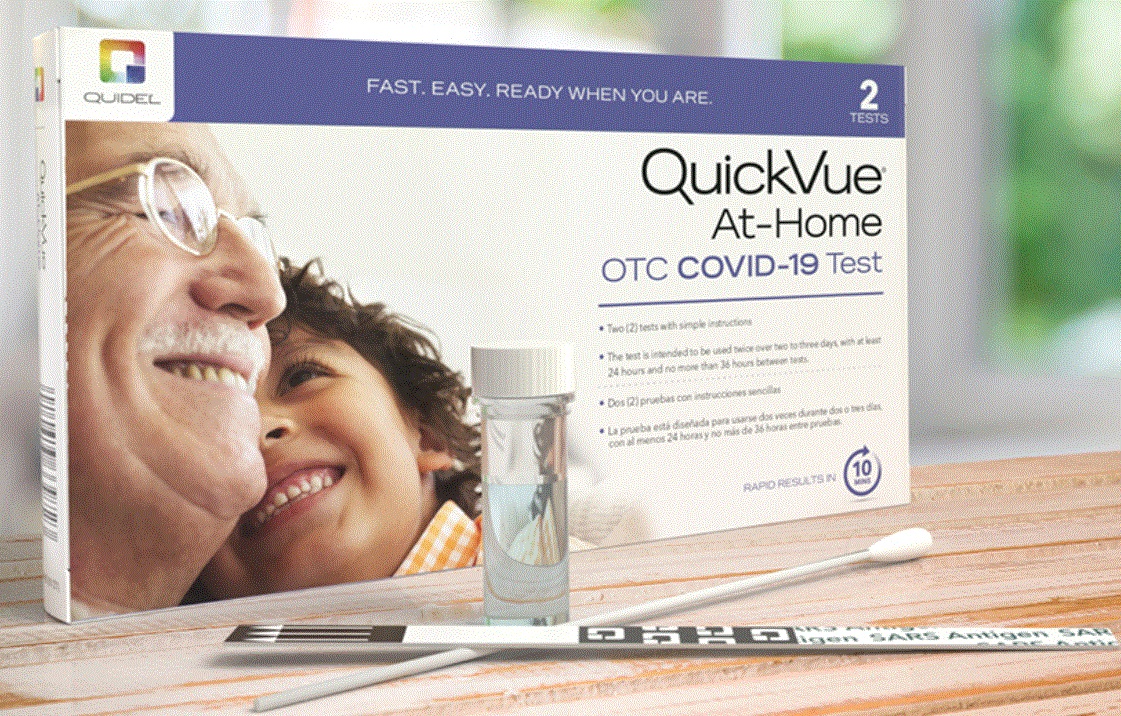
What you get:
- Two tests in each box
- Condition: New
- Brand: Quidel
- Packages/Order: 1 to 10
- Package Type: Complete Test Kit
- Order Size: Limit 10 kits x 20 tests
Introducing the QuickVue At-Home OTC COVID-19 Test available for delivery to your door – Order now and you can have it next week
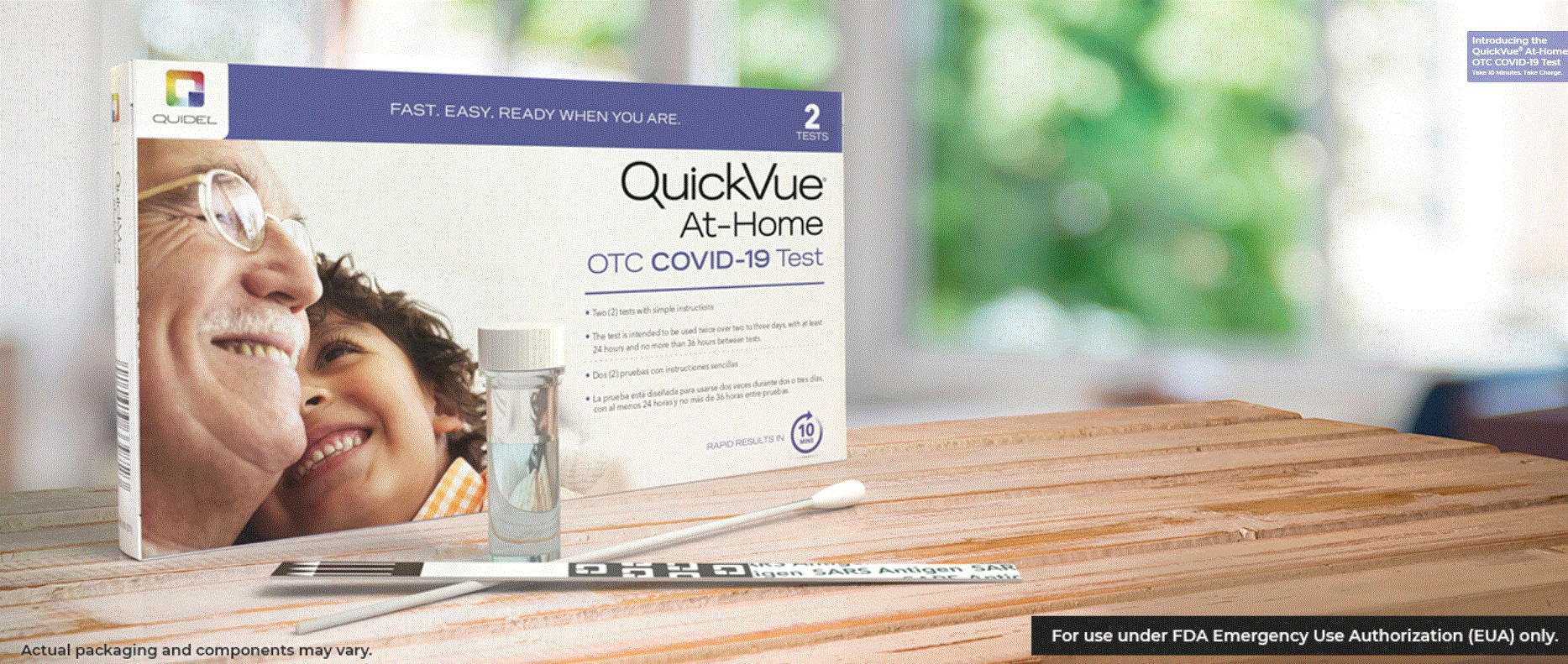
Give me 10 Minutes and $20 to change your life. No more isolation… You can safely get together with family and friends…
Fast, Easy. Ready When You Are.
We have made a special purchase. In fact we bought all our supplier had. They are now out of stock until late August.
Order now supplies are limited!
I do not know how long our supplies will last. First come first served, limit 10 test kits per person.
To Order now call Jim at: 866-924-0607
Price:
One test kit containing 2 tests at $20.00 per test: $39.99 plus shipping and handling.
Ten Test kits containing 2 tests in each box, 20 in total at a cost of $19.50 per test: $389.99 plus shipping and handeling.
Special Instructions. The way we do it is we ask anyone who wants to come on the compound to isolate the best they can for 48 hours before they show up. Therefore one test is sufficient. And we can test two people per box. If they are going to stay a week or more we do a second test.
It’s great, we are back to barbecuing and having visitors once again.
More Details:
The QuickVue At-Home OTC COVID-19 Test lets you get rapid results, in the privacy of your own home. Available direct from us at SalvaVida, everything you need is in the package and taking the test is simple.
The QuickVue At-Home OTC COVID-19 Test utilizes trusted technology used for decades by healthcare professionals and makes simple, easy-to-use COVID-19 tests easily accessible. This has been a game changer for us. Life around here is now near normal. The best it’s been in two years… Since this started.
Features/Benefits:
QUICKVUE SARS COVID19 ANTIGEN TEST
The test is authorized for home use with self-collected anterior nasal (nares) swab samples in individuals aged 2 and older. Everything you need is in the box. This test is authorized for home use and for individuals aged 2 through 14 with an adult performing the test. And for all adults.
Frequently Asked Questions
How Does the QuickVue At-Home OTC COVID-19 Test Work?
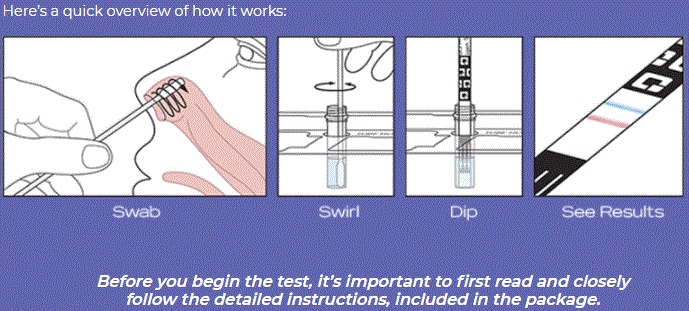
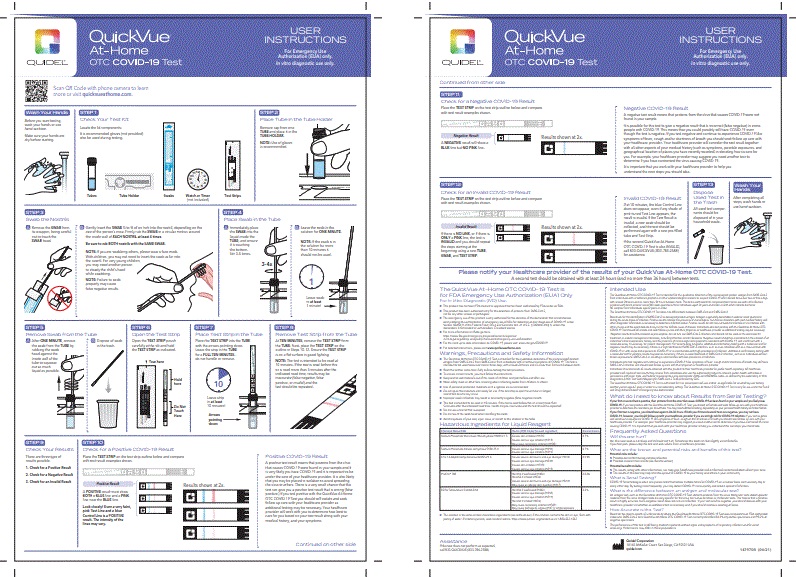
The test uses a gentle self-collected anterior nasal (nares) swab sample to determine a positive or negative COVID-19 result. The swab is swirled in a tube of reagent solution, then removed, before a test strip is inserted. After ten minutes, you can take the strip out of the tube and see your results.
Who is Quidel Corporation?
Quidel Corporation (Nasdaq: QDEL) is a leading manufacturer of diagnostic solutions at the point of care delivering a continuum of rapid testing technologies that further improve the quality of health care throughout the globe. An innovator for over 40 years in the medical device industry, Quidel pioneered the first point-of-care test for influenza in 1999 and was the first to market a rapid SARS-CoV-2 antigen test in the U.S. Under trusted brand names Sofia, Solana, Lyra, Triage and QuickVue, Quidel’s comprehensive product portfolio includes tests for a wide range of infectious diseases, cardiac and autoimmune biomarkers, as well as a host of products to detect COVID-19. Quidel’s mission is to provide patients with immediate and frequent access to highly accurate, affordable testing for the good of our families, our communities and the world.
What is the history of the QuickVue brand?
The QuickVue brand launched in 1986 with visually read rapid diagnostics focusing on women’s health and respiratory diseases. In 1999, QuickVue Influenza A+B was the first visually read rapid test approved by the FDA for professional use. QuickVue At-Home OTC COVID-19 Test utilizes the same technology used for decades by healthcare professionals and by the QuickVue SARS Antigen Test used in professional settings, receiving emergency use authorization (EUA) by the FDA in December 2020.
What is the accuracy of the test?
In a clinical study, the QuickVue At-Home OTC COVID-19 Test identified positive cases 83.5% of the time, and identified negative cases 99.2% of the time (83.5% PPA, and 99.2% NPA, respectively), when compared to PCR.
FOR FDA EMERGENCY USE AUTHORIZATION (EUA) ONLY.
The QuickVue At-Home OTC COVID-19 Test is intended for the qualitative detection of the nucleocapsid protein antigen from SARS-CoV-2 from individuals with or without symptoms or other epidemiological reasons to suspect COVID-19 when tested twice over two or three days with at least 24 hours and no more than 36 hours between tests. This home test is authorized for nonprescription home use with self-collected (unobserved) direct anterior nasal (NS) swab specimens from individuals aged 14 years and older or with adult-collected anterior NS samples from individuals aged 2 years or older. This home test has not been FDA cleared or approved, but has been authorized by the FDA under an Emergency Use Authorization (EUA) for the detection of proteins from SARS-CoV-2, not for any other viruses or pathogens. This home test is only authorized for the duration of the declaration that circumstances exist justifying the authorization of emergency use of in vitro diagnostics for detection and/or diagnosis of COVID-19 under Section 564(b)(1) of the Federal Food, Drug and Cosmetic Act, 21 U.S.C. 360bbb-3(b)(1), unless authorization is terminated or revoked sooner.
About Quidel and its QuickVue:
At-Home OTC COVID-19 Test
Quidel is a California-based leading diagnostic manufacturer focused on improving the quality of healthcare throughout the globe. As a trusted innovator in the medical device industry for over 40 years, Quidel launched the QuickVue brand in 1986 with visually read rapid diagnostics focusing on women’s health and respiratory diseases. In 1999, QuickVue Influenza A+B was the first visually read rapid test cleared by the FDA for professional use.
Experts ask to see data behind CDC new mask policy
The agency on Thursday announced that fully vaccinated individuals can ditch their masks in most settings, but some public health experts raised concerns about how to prove vaccination. The CDC on Thursday announced that fully vaccinated individuals can ditch their masks and social distancing indoors and outdoors in most settings. Masks must still be worn “where required by federal, state, local, tribal, or territorial laws, rules, and regulations, including local business and workplace guidance,” according to the guidance. There are also exceptions for correctional facilities and homeless shelters, and people who are immune compromised should speak to their doctors before abandoning their masks. CDC Director Rochelle Walensky cited declining coronavirus cases, increasing vaccine supply and emerging data on the performance of vaccines as reasons for the guidance change. States including North Carolina, Michigan, Nevada, Oregon, Pennsylvania, Minnesota, Kentucky, Washington and Kansas all announced changes to their mandates following the CDC guidance. “Today is a great day,” North Carolina Gov. Roy Cooper tweeted Thursday as he lifted most mandatory mask requirements for his state. “But the work is not yet done and people getting vaccinated will get it done. The CDC’s guidance affirms that getting vaccinated is the way through this. We can take this step today because the science shows our focus on getting people vaccinated is working.” But some public health experts were left with questions and concerns about unvaccinated people abandoning their masks. According to CDC data, just over 36% of Americans are fully vaccinated. “On one hand, people may feel more incentivized to get the vaccine if they see that by getting the vaccine, they no longer have to wear a mask and can resume pre-pandemic activities,” Rupali J. Limaye of Johns Hopkins University said in a statement. “On the other hand, it may not be enough of an incentive to get the vaccine, and may signal to people that they can go maskless while being unvaccinated, as there is no way to know who is vaccinated and who is not.” “This could lead to a situation where those that are unvaccinated may be maskless in settings where there are other unvaccinated individuals, leading to higher risk of exposure,” she continued. Leana Wen, a visiting professor at George Washington University Milken Institute School of Public Health, wrote in an opinion piece for The Washington Post that the CDC “has gone from one extreme to the other, from over-caution to throwing caution to the wind.” She said that the new guidance “would be very welcome if not for one big problem: There is no concurrent requirement for proof of vaccination.” Leading infectious disease expert Anthony Fauci acknowledged that “you’re going to be depending on people being honest enough to say whether they were vaccinated or not and responsible enough to be wearing … a mask, not only for their own protection but also for the protection of others.” The federal government has repeatedly said it will not require vaccine passports or similar certifications. But beyond concerns about putting trust in the public, questions swirled on the guidance. Could a fully vaccinated workforce go back to the office without wearing masks and social distancing? Should private businesses like grocery stores that currently implement mask mandates follow CDC guidance and shed the requirements for vaccinated people, or would that risk workers facing retaliation for implementing vaccine policing? The United Food and Commercial Workers, America’s largest union for front-line retail and grocery workers, criticized the guidance, calling it “confusing” and accusing the agency of failing “to consider how it will impact essential workers who face frequent exposure to individuals who are not vaccinated and refuse to wear masks.” Fauci told CNN that while some businesses might choose to require proof of vaccination, he does not suggest policing behaviors. “People feel very put upon if you are essentially judging them on the basis of whether they have been vaccinated,” Fauci added. “I think there is going to be a pushback against questioning somebody when they walk in.” And what about parents who are vaccinated who have young children who aren’t eligible for the shot yet – how will they convince the youngsters to keep their masks on as more and more people go without them? Fauci told CNN that children still need to wear masks “when they’re out there playing with their friends and, you know, particularly in an indoor situation.” Elementary school-aged children likely won’t be vaccinated until the end of the year, according to Fauci. That leaves parents to navigate starting the school year without vaccinations for their youngest kids, and both Walensky and Fauci have supported the idea of all schools holding in-person education five days a week by the fall. Nick Note: no matter how you dice it, how you slice it… The Delta variant is 2000 time more infection on what they faught with the leeaki weepie toilet paper masks… It takes the same masks and material used in Bio Labs…… See i want to live and preserve life and reality is we need to fight to survive…… So we mask up, vitamin up, isolate and explore anti virales
Mastercard profit jumps 36% on vaccine-fueled spending boost
July 29 (Reuters) – Mastercard Inc reported a nearly 36% jump in second quarter profit on Thursday, helped by an improvement in overall spending and a recovery in cross-border volumes. Net income, excluding exceptional items, rose to $1.9 billion, or $1.95 per share, from $1.4 billion, or $1.36 per share a year earlier. Analysts on average had expected a profit of $1.75 per share, according to Refinitiv IBES data. Nick Note: As you can see the smart money is preparing for and in essence locking down already to protect their key people…. Let the stupid celebrate their”freedom” why let them suffer… Its like the last mean before the lethal injection……. You are not coming back to finish the ice cream…..
Nouriel Roubini Says a Stagflationary Debt Crisis Is on the Way
Jul.28 — Nouriel Roubini, CEO at Roubini Macroassociates, discusses his stagflation concerns as he sees the potential for 1970’s-style inflation. He speaks on “Bloomberg Surveillance.” Nick Note: the biggest stock market wipe out ever is on the horizon and then double digit negative interest rates… And we are getting ready to have some fun…..
Twitter closes NY, SF offices over Delta variant…. Google reopening October…. LinkedIn employees to work remotely reversing course
Twitter is re-closing its New York and San Francisco offices shortly after they reopened, the company said Wednesday. The announcement comes amid a spike in COVID-19 cases due in large part to soaring Delta variant cases and rampant anti-vaccination sentiment. Many companies are slowing down their reopenings due to the Centers for Disease Control and Prevention’s updated guidelines that recommend masks indoors even for people who’ve received one of the vaccinations. “After careful consideration of the CDC’s updated guidelines, and in light of current conditions, Twitter has made the decision to close our opened offices in New York and San Francisco as well as pause future reopenings, effective immediately,” Twitter said, according to The San Francisco Chronicle. The social media company had just reopened the offices two weeks ago, the Chronicle said. Twitter was one of many tech companies to announce it was allowing workers to work remotely indefinitely. Google announced Wednesday it was pushing back its reopening until at least October and requiring employees to get vaccinated against COVID-19. Nick Note: Some of the most sophisticated companies in the world… that has high dollar workers open up their “campuses” with the juice bars and yoga studios, testing up the ass, opened for a few weeks and shut right back down….. It is a ominous sign of the hell to come. I guarantee your their data showed massive spread among their staff…….. Sorry they did not twit that inside information…….. I hoped you enjoyed this little open it up party because here is a new flash…ITS OVER. Everyone back in their cell for lockdown….
Inflation expected to remain considerably elevated – Powell
Head of the Federal Reserve Jerome Powell said on Wednesday that inflation has increased “notably” and is seen staying elevated in the upcoming months. Much of the increase in prices can be contributed to the supply bottlenecks which are limiting how quickly production can respond to increased spending, the official noted. He warned that bottlenecks, hiring difficulties, and other constraints could cause inflation to go higher and stay there longer than expected. However, indicators of long-term inflation expectations remain broadly consistent with the Fed’s goal of 2%, Powell added, stating that the central bank will adjust its policies if those expectations move “materially and persistently” beyond the 2%. Nick Note: The Fed has two mandates…… price stability and full employment. They have achieved neither. and their misguided policies have sparked off massive inflation on the consumer level and in assets like bonds and stocks. And the job market will not recover for years. It will be known as their biggest fuck up ever.