Dr, Anthony Fauci told the Daily Beast that it would be “outrageous” and “terrible” if he was featured in another Trump campaign commercial and it could “come back to backfire” on Team Trump. Explained Fauci: “By doing this against my will, they are in effect harassing me. Since campaign ads are about getting votes, their harassment of me might have the opposite effect of turning some voters off.” Nick Note: Desperate people do desperate Trumps rallies are spreading the virus infecting people people and sometimes even killing some of them.
Senate to vote on PPP funding next week – McConnell
https://youtu.be/QeLGiLKKfk0?t=29
Senate Majority Leader Mitch McConnell (R-Ky.) issued a statement on Tuesday saying that the Senate’s “first order of business” when it returns on Oct. 19 will be to vote on “targeted relief for American workers,” including new funding for the small business Paycheck Protection Program (PPP).
Why it matters: House Democrats, Senate Republicans and the Trump administration are still very far apart on key elements of a relief deal, and any push for smaller, more targeted legislation is more of a political maneuver than any thing else.
- The Senate has largely been left out of the negotiating process between House Speaker Pelosi and the White House, and any deal that results from those conversations will likely not be supported by Senate Republicans.
- This is McConnell’s way of showing Senate Republicans are still dedicated to some form of coronavirus stimulus, and could serve as a backstop in the event that a new bill is passed in the House that Republicans in the Senate deem unworkable.
Driving the news: McConnell’s statement comes one month after Senate Democrats filibustered a Republican “skinny bill” that focused on school aid, unemployment benefits and assistance for small businesses. Democrats called the package “piecemeal” and said it was “laden with poison pills Republicans know Democrats would never support.”
What they’re saying: “The PPP is a popular program that has saved tens of millions of American jobs. It is so bipartisan that its first round was replenished and extended several times by unanimous consent in both the Senate and the House,” McConnell said in a statement.
- “Democrats have spent months blocking policies they do not even oppose. They say anything short of their multi-trillion-dollar wish list, jammed with non-COVID-related demands, is “piecemeal” and not worth doing.”
- “Speaker Pelosi frequently says she feels “nothing” is better than “something.” And she has worked hard to ensure that nothing is what American families get.”
Meanwhile: President Trump, who called off stimulus negotiations with Democrats last week, tweeted on Tuesday morning, “STIMULUS! Go big or go home!!!” It’s unlikely that a package the size that Trump and Democrats are negotiating will win the support of Senate Republicans. Nick Note: Roman bread for the masses, We have come a long was from 2 chickens in every pot!
You really DO NOT want to take a monkey vaccine
Nick Note: Having a Photographic memory can be a blessing or a course. As i reviewed the Astrazennica vaccine protocols where they splice monKey DNA into the vaccine i recalled a article back from the early 2000’s A that time i was locked in a dispute because i would not allow my kids to be vaccinated. At that time home schooling was coming to a end and it was time to ingratiate them into the traditional joke school system. One of the requirements was vaccine records. The dispute was before the school board and the following article was used to present my case. By the way I won the arguments.. Happy vaccinating……. Its amazing what they forget to tell you. So maybe you should read the article below beforE you let them put a monkey on your back!!!
THE VIRUS AND THE VACCINE
On any list of medical triumphs of the 20th century, polio vaccination is sure to rate a mention. In the 1950s and early 1960s, the shot and sugar-cube vaccines of Jonas Salk, and later Albert Sabin, offered people the first opportunities to protect themselves from a scourge as feared in its day as AIDS is in our own. Few back then grasped that these vaccines might also be a huge, inadvertent, uncontrolled experiment in interspecies viral transmission. But from 1955 to 1963, according to a 1976 US National Institutes of Health (NIH)-funded study, 98 million Americans alone probably were exposed to polio vaccines contaminated with SV40—a monkey virus that can cause cancers in animals. Now, a July 7 2004 report in New Scientist has raised fears that hundreds of millions of eastern Europeans, Asians, and Africans also may have been exposed to SV40 in Soviet-made polio vaccines. Michele Carbone of Loyola University Medical Center, Chicago, USA, announced at the 2004 Vaccine Cell Substrates meeting (Rockville, MD) that the Soviet vaccine could have been contaminated until the 1980s. This is worrying since, despite 44 years of medical debate, epidemiological studies have yet to establish conclusively whether SV40 has or hasn’t caused cancers in people.
When Salk developed his vaccine, instead of using human tissues, as did the scientists who won a Nobel Prize for first growing poliovirus in tissue culture, he used minced-up rhesus macaque monkey kidneys, which were remarkably efficient poliovirus factories. Those who sought to supplant Salk’s formaldehyde-inactivated vaccine with live, attenuated oral vaccine also used monkey kidney cultures. Despite a manufacturing problem that, at best, left six children who received the vaccine paralysed in the arm, and despite concerns about wild simian viruses, Salk’s shots were declared safe and effective after 1954 field trials. The next year, after grudging approval by sceptical government regulators, free Salk shots were made available throughout the USA.
By 1960, scientists and vaccine manufacturers knew that monkey kidneys were sewers of simian viruses. Such contamination often spoiled cultures, including those of an NIH researcher named Bernice Eddy, who worked on vaccine safety. In 1959, fresh from co-reporting that the mouse polyoma virus could cause cancer in other animals, Eddy tested the rhesus monkey kidney substrate used to make polio vaccine. She injected 154 newborn hamsters with extracts of the cell cultures: 109 developed tumours. Next, she ground up three of the tumours and injected the residue into other hamsters. The animals receiving injections from two of the three tumours developed cancers. But when Eddy put the substance back into the monkey cell culture, nothing happened, and she couldn’t isolate the suspected virus.
In The Virus and the Vaccine: The True Story of a Cancer-Causing Monkey Virus, Contaminated Polio Vaccine, and the Millions of Americans Exposed, Debbie Bookchin and Jim Schumacher report that in 1960, when Eddy presented her results to her boss, a polio vaccine champion named Joe Smadel, he was livid and disbelieving: “Its implications—that something in the polio vaccine could cause cancer—was an affront to his career.” Her discovery also threatened one of the USA’s most important public-health programmes. “By 1960, tens of millions of Americans had been vaccinated against polio, and it was federal health policy that everyone should be vaccinated and continue to receive Salk booster shots.”
Continue reading “You really DO NOT want to take a monkey vaccine”
J & J Covid-19 vaccine study paused due to unexplained illness in participant
The study of Johnson & Johnson’s Covid-19 vaccine has been paused due to an unexplained illness in a study participant. A document sent to outside researchers running the 60,000-patient clinical trial states that a “pausing rule” has been met, that the online system used to enroll patients in the study has been closed, and that the data and safety monitoring board — an independent committee that watches over the safety of patients in the clinical trial — would be convened. The document was obtained by STAT. Contacted by STAT, J&J confirmed the study pause, saying it was due to “an unexplained illness in a study participant.” The company declined to provide further details. “We must respect this participant’s privacy. We’re also learning more about this participant’s illness, and it’s important to have all the facts before we share additional information,” the company said in a statement. J&J emphasized that so-called adverse events — illnesses, accidents, and other bad medical outcomes — are an expected part of a clinical study, and also emphasized the difference between a study pause and a clinical hold, which is a formal regulatory action that can last much longer. The vaccine study is not currently under a clinical hold. J&J said that while it normally communicates clinical holds to the public, it does not usually inform the public of study pauses. The data and safety monitoring board, or DSMB, convened late Monday to review the case. J&J said that in cases like this “it is not always immediately apparent” whether the participant who experienced an adverse event received a study treatment or a placebo. Though clinical trial pauses are not uncommon — and in some cases last only a few days — they are generating outsized attention in the race to test vaccines against SARS-CoV-2, the virus that causes Covid-19. Given the size of Johnson & Johnson’s trial, it’s not surprising that study pauses could occur, and another could happen if this one resolves, a source familiar with the study said. “If we do a study of 60,000 people, that is a small village,” the source said. “In a small village there are a lot of medical events that happen.” On Sept. 8, a large study of another Covid-19 vaccine being developed by AstraZeneca and Oxford University was put on hold because of a suspected adverse reaction in a patient in the United Kingdom. It’s believed that the patient had transverse myelitis, a spinal cord problem. Studies of the vaccine resumed roughly a week after it was paused in the United Kingdom, and have since been restarted in other countries as well. It remains on hold, however, in the United States. Johnson and Johnson began enrolling volunteers in its Phase 3 study on Sept. 23. Researchers planned to enroll 60,000 participants in the United States and other countries. Nick Note: Rushing vaccine trials is the equivalent of going into jiffyLube to use a grease gun when you need a enema. It may be fast but it could end up really shitty. The J&J ebloa based vaccine and the AstraZeneca monkey vaccine are both on hold. SO much for the warp speed vaccine. Its the lithium crystals overheating! I hate when that happens
Joe Biden Leads Donald Trump By 8.5 Points
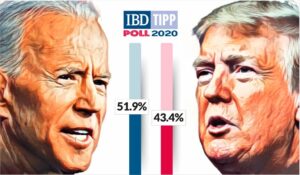
Joe Biden holds a solid 8.5-point lead over President Donald Trump, barely three weeks ahead of Election Day, the inaugural IBD/TIPP 2020 Presidential Election Tracking Poll finds.
Biden leads Trump, 51.9%-43.4%, in a four-way 2020 election poll of likely voters. Libertarian candidate Jo Jorgensen has the support of 2.4%, and Green Party candidate Howie Hawkins 0.8%.
In a head-to-head Biden vs. Trump poll, the Democratic nominee holds a commanding 10.4-point advantage, 52.7%-42.3%. Joe Biden holds a 48%-39% lead among likely independent voters. Meanwhile, Biden is having an easier time corralling Democrats than Trump is having in nailing down GOP votes. Biden leads 95%-3% among Democrats. Trump leads 90%-9% among Republicans.
In 2016, almost all presidential election polls pointed to a Hillary Clinton victory over Donald Trump. The IBD/TIPP Poll was one of only two election polls credited with predicting President Trump’s 2016 victory. TIPP, IBD’s polling partner, succeeded in picking up on the greater enthusiasm among Republicans for their candidate.
Yet the latest IBD/TIPP Trump vs. Biden poll has a few stark contrasts with the Trump vs. Clinton race. Most obviously, a majority of likely voters back Biden (51.9%). Yet Clinton’s support topped out around 45% in IBD/TIPP presidential election polls in the final weeks of the 2016 race. Further, Biden’s 9-point lead among independents in the latest IBD/TIPP 2020 election poll is a big turnaround from 2016. Trump carried independents 43%-42% in 2016, according to a postelection Pew Research survey of verified voters.The IBD/TIPP 2020 presidential election poll shows Trump winning 52%-44% among men, narrower than his 11-point advantage in 2016. Meanwhile, women favor Biden by a wide 59%-36% margin. The 23-point differential is greater than Trump’s 15-point deficit among women in 2016. White voters favor Trump, 50%-45%, but they backed him by a 15-point margin in 2016. White women plan to vote for Biden over Trump, 51%-45%, after narrowly backing the Republican in 2016. Black voters strongly back Biden, 89%-8%. However, Trump could do better among Hispanic voters than his 28%-66% deficit in 2016. He trails Biden among Hispanics, 39%-54% in the latest IBD/TIPP 2020 election poll. Biden is trouncing Trump among voters age 18-44, 62%-32%. Trump has a 51%-46% edge among voters 45-64. The two candidates are tied at 48% among voters 65 and up. Trump won among senior citizens in 2016, 53%-44%, Pew says. The RealClearPolitics average of polls shows that Biden’s lead has grown from 6.6 points before the first debate to 9.8 points currently.. President Trump is trying to shore up support among seniors, who are far more susceptible to the coronavirus and who have been critical of his handling of the pandemic. Last week, Trump pledged that he would provide free access to the Regeneron Pharmaceuticals (REGN) antibody drug that he credits with restoring him to full health. The Trump administration also is getting ready to send out drug cards worth $200 to tens of millions of seniors.
Self-described investors, with at least $10,000 in household-owned stocks or mutual funds, back Biden by the slimmest of margins, 49%-48%. The final 2016 IBD presidential election poll showed Trump winning the group, 48%-42%.
Meanwhile, noninvestors are solidly behind Biden, 57%-37%. Regardless of their own voting preferences, investors seem to be warming to a Biden presidency and potential Democratic sweep. That would likely mean higher corporate taxes and higher taxes on investment gains. Yet the stock market’s rally last week came as a Biden victory looked more likely. Wall Street may be relieved that a court fight over the election’s outcome may be avoided. But investors also are hopeful that a Democratic boost in federal spending will offset any downside from tax hikes and more regulation. Nick Note: I hate polling. Unfortunately people like me whoes job is to analyze things have got to consume them like oxygen in an election season. My sniff here is Uncle Joe’s voter tend to overstate their support for the candidate. in other words his supporters are not rock solid. Heil Trump voters tend to be fanatics fiercely loyal and understate their support for Trump. My sniff is polling may be overstating Biden’s lead and understating support for Trump. If i take out my wigiee board the buga buga tells me this is a MUCH closer election then the pools are picking up and the race is very close. Trump has six crowd fests scheduled. All will be jam packed with screaming Trump Chumps packed like sardines in a can and of course big dick real men do not wear masks. And hard nipples kick ass babes obviously do not do liposuction and they do not wear masks either.
Continue reading “Joe Biden Leads Donald Trump By 8.5 Points”
Dr. Fauci says this simple drug that’s already available might reduce coronavirus risks
- A new coronavirus study shows that vitamin D deficiency increases the risk of COVID-19 complications and deaths, echoing similar findings from earlier this year.
- Dr. Anthony Fauci has endorsed vitamin D in a recent interview, emphasizing that it might help people who are vitamin D deficient fight a potential covid infection.
- There’s no randomized clinical trial to prove the effectiveness of vitamin D therapy in COVID-19, however.
The novel coronavirus will remain a significant danger to all of us until effective vaccines and drug therapies are widely available. COVID-19 has killed more than 1 million people worldwide as of this past weekend, out of more than 33.4 million confirmed cases. While it’s true that it’s usually people who suffer from other medical issues and the elderly who are most at risk of death, there have been plenty of exceptions to that rule. Young people, including children who had no other medical problems, have died of COVID-19 complications. On top of that, many of us have preexisting conditions that we’re not even aware of. That’s why it’s so important to protect yourself as well as possible until treatments are widely available. Dr. Anthony Fauci already endorses. The best part about it is that you might not even need to take it in order to benefit from it. A study claimed a few months ago that vitamin D deficiency had been correlated with COVID-19 complications and death, and another study argued there’s no proof vitamin D can prevent or treat COVID-19. We’ve always told you that nothing is set in stone with coronavirus studies, and more research will be required to confirm early findings. When it comes to vitamin D, we already have more research that indicates sufficient levels can indeed reduce complications and death. The newest vitamin D data comes from the Boston University School of Medicine, via SciTechDaily. Doctors found that patients who were vitamin D sufficient (a blood level of 25-hydroxyvitamin D of at least 30 ng/ml) had a significantly decreased risk for complications, including unconsciousness, hypoxia, and death. People who had enough vitamin D in their systems had lower blood levels of C-reactive protein, which is a marker of inflammation that goes up when an infection is present. Lymphocyte counts were also higher. Those are the immune system cells that can fight illnesses, and which are diminished in COVID-19 cases. The doctors tested vitamin D levels in 235 COVID-19 patients and compared the outcomes of patients who were deficient to those who had sufficient vitamin D.
The researchers wrote that patients older than 40 who were vitamin D sufficient were 51.5% less likely to die from the infection.
Michael Holick, professor of medicine, physiology, biophysics and molecular medicine at Boston University School of Medicine, is one of the authors of the study. Previously, he published a paper concluding that a sufficient amount of vitamin D could reduce the risk of catching coronavirus by 54%. The risk of infection is still there, and vitamin D is not going to be a magical cure for COVID-19. However, the good news here is that vitamin D is something we already get from food. The skin even synthesizes it from sun exposure. Of course, vitamin D is also available as an over-the-counter supplement that anyone can take. Dr. Fauci also recommends vitamin D to possibly reduce the risk of infection. “If you are deficient in vitamin D, that does have an impact on your susceptibility to infection,” the health expert said during an Instagram Live chat with Jennifer Garner a few days ago. “So, I would not mind recommending, and I do it myself taking vitamin D supplements.” Testing for vitamin D deficiency might be advised before taking supplements. As CNBC points out, not all experts agree that routine testing for vitamin D is advised. It’s not just that the test results take longer to process, but they’re also costly and could lead to more people seeking vitamin D supplements. The report notes that there’s not enough scientific evidence to prove that taking vitamin D does anything helpful for people who do not have a vitamin D difficiency. Milana Frenkel-Morgenstern of Bar Ilan University told The Times of Israel on Sunday that vitamin D is “like a steroid,” after publishing what she says is the world’s largest population-based study of its kind. Her team studied a 7,807-strong sample of Israelis who were tested for the coronavirus. It found that the average vitamin D level for people who screened negative was in the internationally-accepted “adequate” range, while the average for those who tested positive fell in the “inadequate” category. Vitamin D levels of less than 20 nanograms per milliliter of blood are considered inadequate.
Steve Forbes: Markets still think Republicans can win or at least hold Senate
Steve Forbes: ‘Markets still think the Republicans can win’ presidency, Senate
Nick Note: The markets are snoozing and losing. Turmoil will be the name of Election day. And the markets are not pricing in a Trump defeat. Never mind the most contested election the world has ever seen
Trump: Dems want to steal the elections
President Donald Trump again on Saturday cast doubt about the mail-in ballot system come the November 3rd election, saying that Democrats are trying to “steal the election.” President Donald Trump again on Saturday cast doubt about the mail-in ballot system come the November 3rd election, saying that Democrats are trying to “steal the election.” Trump made the remarks at a rally in Middletown, Pennsylvania Sally, following his nomination of Judge Amy Coney Barrett to the Supreme Court. Trump has resorted to casting doubt in the U.S. voting system for weeks, going as far as refusing to commit to a peaceful transfer of power if he loses. Nick Note: This is going to be a big shit. And for us it COULD be a enormous pay day!
Hospital staff infected with coronavirus in air released from ventilator
A doctor and two nurses at Sourasky Medical Center may have been infected with the coronavirus by the aerosol coming from a ventilator being used on a patient, according to an initial investigation of the incident, Israel Hayom reported. Eight ventilators were being used in tandem at the time. After the investigation, the hospital decided to place a limit of six patients on Vapotherm ventilators in each ward. Vapotherm ventilators are devices that use a nasal cannula with high pressure air flow instead of a mask or invasive tube. The ventilators will also be placed under air vents in order to reduce the amount of aerosol in the air. The infection in coronavirus wards of medical staff, who are equipped with maximal personal protective equipment (PPE), is considered a rare occurrence. In the first wave, only a few isolated cases of medical staff who were infected with the virus were those working in coronavirus wards, according to Israel Hayom, while most who were infected were infected in other wards, by family members or at social events.
“We have almost no infections within the coronavirus wards; this is an uncommon occurrence,” Dr. Yael Paran, an expert on infectious diseases and head of Sourasky’s Traveler’s Clinic, told the newspaper. “These are departments with an air intake system and negative pressure, departments that are entered into with ‘space suits’ in a very controlled manner and with observation on protection. Therefore, we investigated in order to understand what happened this time.” She added that, “When we investigated, we found that these were employees who were very strict about the procedures even outside of work and that none of their family members became infected. This is a sequence of incidents that happened during the last week and it lit a red light for us. Infection in the coronavirus ward is something we are very afraid of.” The hospital checked the integrity of the ventilators and the staff’s attention to regulations without finding anything wrong. After checking the schedule, they arrived at the conclusion that a week before the infections, the coronavirus ward was at peak capacity, with eight patients on ventilators at once.
Paran hypothesized that “when a certain threshold of aerosol formation is exceeded, it exceeds the flow threshold of the ventilation and protection systems,” according to Israel Hayom. There is some literature that supports this hypothesis as well, she said. A hospital in northern Israel also reported a similar incident. The US Centers for Disease Control and Prevention (CDC) in an updated guidance last week said COVID-19 can spread through airborne transmission, saying some people could get infected by exposure to the novel coronavirus in small droplets and particles or aerosols that can linger in the air for minutes to hours. Aerosols lingering in the air could be a major source of COVID-19 transmission, a group of US scientists warned in an unrelated open letter published in the medical journal Science last week.
Researchers around the world have reported findings showing evidence that the virus may be airborne since as early as April, although it remains unclear how infectious airborne droplets are. Nick Note: The scandal in every hospital in America is the fact they are using the wrong filter. Both on the incubators and respirators
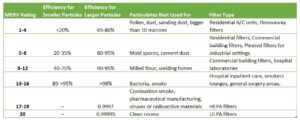
AS you can see by the Merv rating above Hospital systems need to go to filtration system of a higher magnitude filtering to 1um. The filters in their equipment only filters out AT BEST89% of particles using HEPTA H13 filters at Best with a MERV rating of 13 at best. They need to go to a MERV rating of 20 using ULPA H15 filter medium that filters out 0.9995% like my New Salvavida P3r U15 filters do. I am sending subscribers that expressed a interest a sample. And i am making them available FREE for FRONT LINE Medical workers that are getting a N95 USED toilet paper filter that has been subjected to Hydrogen Peroxide sensitization betWeen shifts. That is nothing more then a crime against humanity
Trump’s stimulus proposal draws opposition from congressional Democrats and Republicans
WASHINGTON (Reuters) – A new $1.8 trillion economic stimulus proposal from the Trump administration drew criticism from congressional Democrats and Republicans on Saturday, diminishing hopes for a coronavirus relief deal before the Nov. 3 election. In a weekly letter to Democratic colleagues, Pelosi said the Trump administration’s proposal lacked a “strategic plan to crush the virus” and gave President Donald Trump too much discretion to decide how funds were allocated. “At this point, we still have disagreement on many priorities, and Democrats are awaiting language from the Administration on several provisions as the negotiations on the overall funding amount continue,” Pelosi’s letter said.
On a conference call on Saturday morning with Treasury Secretary Steven Mnuchin and White House chief of staff Mark Meadows, multiple Republican senators criticized the price tag of the Trump administration’s proposal, a source familiar with the matter said.
Mnuchin floated the $1.8 trillion proposal in a 30-minute Friday afternoon phone conversation with Pelosi, according to the White House. The new White House package was higher than an earlier $1.6 trillion Mnuchin offer and closer to the $2.2 trillion the Democratic-controlled House of Representatives passed last week. White House spokeswoman Alyssa Farah said the administration wanted to keep spending below $2 trillion but was eager to enact a fresh round of direct payments to individuals as well as aid for small businesses and airlines. Friday marked the third straight day of talks between Pelosi and Mnuchin. Senate Majority Leader Mitch McConnell, the top Republican in Congress, said on Friday he doubted lawmakers would pass a package before Nov. 3, although he has not directly participated in the talks. “The proximity to the election and the differences of opinion over what is needed at this particular juncture are pretty vast,” McConnell told a news conference. There was no immediate comment on Saturday from the Treasury, White House, or McConnell’s office. Nick Note: This is big… People are starving. In Europe its a slam duck everyone sent home gets full pay. Something to be said for how they do things in May Pole land!