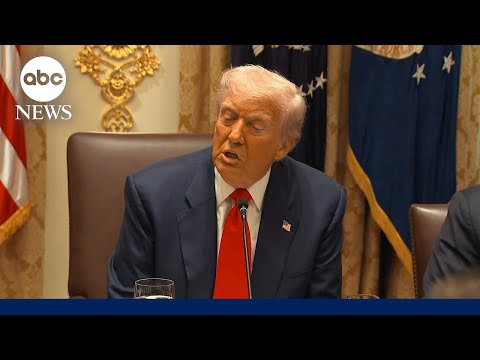
Trump: Patience with Putin running out fast

United States President Donald Trump repeated on Friday that his patience with Russian President Vladimir Putin is “running out fast.” However, he added that “it takes two to tango,” claiming that Putin and Ukrainian President Volodymyr Zelensky never agree to negotiations at the same time. Trump said the US will “have to come down very strong” on Russia, although he did not elaborate on what measures h is administration will take. He said the war in Ukraine is “a Europe problem much more than our problem” and expressed satisfaction that the US is no longer sending military support to Ukraine. He told Fox News that he “has an obligation” to end the war in Ukraine “on a human basis,” due to the high number of casualties, admitting that he thought the negotiation process would be “the easiest” of all current world conflicts.

EU extends Russia sanctions, finalizing new package….. UK imposes 100 new sanctions on Russia

European Union High Representative for Foreign Affairs and Security Policy Kaja Kallas shared on Friday that the bloc extended its sanctions against Russia. In a post on X, she further detailed that the work on the 19th sanctions package is currently being finalized. “[The EU is] looking into additional curbs on Russian oil sales, shadow oil tankers, and banks. We’ll keep choking off the cash for [Russian President Vladimir] Putin’s war,” she said. In the meantime, Ukrainian President Volodymyr Zelensky continues to insist that more pressure needs to be put on Moscow, adding that Russia needs to be deprived of its money and resources.

UK imposes 100 new sanctions on Russia

The United Kingdom announced on Friday a new package of sanctions against Russia targeting 100 entities and individuals. They include 70 ships in the so-called shadow fleet, which transports Russian oil in violation of previously imposed sanctions, as well as 30 companies and individuals in Russia, China, Turkey and Azerbaijan that supply Russia with weapon components. “In the last fortnight, Putin has again obstructed US peace efforts by launching the largest air attack of the war against Ukraine, with over 800 missiles and drones fired at the country in a single night. The numbers of Russian drones and missiles launched against Ukraine – 6,500 in July alone – are now ten times the level of a year ago,” the Foreign Office said.

Gold Surpasses Inflation-Adjusted Record High Set in 1980

gold is the biggest bubble ever

Gold has eclipsed its inflation-adjusted peak set more than 45 years ago, as growing anxiety about the US’s economic trajectory takes bullion’s blistering three-year bull run deeper into uncharted territory.

The spot price of gold has surged about 5% so far this month, with prices hitting an all-time high of $3,674.27 an ounce on Tuesday. It’s set more than 30 nominal records already in 2025, but the latest leg of the rally has also taken it through an inflation-adjusted peak set on Jan. 21, 1980, when prices topped out at $850.

Factoring in decades of consumer price increases, that equates to about $3,590 — although there are multiple methods of adjusting for inflation, and some would put the 1980 peak at lower levels. It’s a moving target, but analysts and investors are in agreement that gold has now shot firmly through it, providing a further fillip for gold’s credentials as an age-old hedge against rising prices and weakening currencies.

“Gold is a very unique asset in its historical ability over hundreds — if not thousands — of years to play that role,” said Robert Mullin, portfolio manager at Marathon Resource Advisors. “Asset allocators are entering a period where they are justifiably concerned about the levels of both deficit spending, as well as questioning central banks’ priorities and willingness to truly fight inflation.”

Gold Sets New Inflation-Adjusted Peak as Bull Run Continues

Source: Bloomberg Intelligence, Bloomberg News

Note: Based on US CPI Urban Consumers, not seasonally adjusted.

The precious metal has risen nearly 40% this year as President Donald Trump has cut taxes, expanded his global trade war, and sought unprecedented influence over the Federal Reserve. A selloff in the dollar and long-term US government bonds is highlighting eroding appetite for American assets, and fueling questions about whether the nation’s debt remains a haven in times of turmoil.

Read More: How Gold’s Safe-Haven Appeal Is Fueling Record Prices

When gold hit $850 in January 1980, the US was grappling with a collapsing currency, a spike in inflation and an unfolding recession. The price had doubled over the previous two months, after US President Jimmy Carter issued a freeze on Iranian assets in response to a hostage crisis in Tehran, raising the perceived risk of holding dollar assets for some foreign central banks.

“Gold is only reflecting the renewed awareness that inflation can be and still is a problem, but also uncertainty about the world,” said Carmen Reinhart, a former senior vice president and chief economist at the World Bank Group. Gold’s “role as an inflation hedge was a stamp of its popularity in the 70s and 80s, but you need to look before the 1980s: Gold has always played an important role when there’s uncertainty.”

Compared with the parabolic surge to the peak in 1980 — and a precipitous collapse that followed — today’s rally has unfolded with far less volatility. That’s partly because today’s market is far more liquid and accessible to investors, and also because it’s attracting a broader base of investors who are offsetting weakness in traditional areas of demand.

Thanks to the surge in prices, the value of bullion held in London vaults exceeded $1 trillion for the first time last month, and it’s also overtaken the euro as the second-largest asset in global central bank reserves.

Grant Sporre, global head of metals and mining at Bloomberg Intelligence, has overhauled his analytical models to take fuller account of the broad and diverse drivers behind gold’s stellar rally. They suggest gold is over-priced relative to historical norms except in one crucial aspect: Compared to US stocks, gold still looks cheap, and he says prices could vault higher still if equity markets start to creak.

“Gold’s eye-wateringly expensive, but the market is happy to pay the price in order to secure that insurance,” Sporre said.

London’s Gold Stash Passes the $1 Trillion Milestone

The value of gold in LBMA vaults has soared during bullion’s rally

Source: London Bullion Market Association

Note: September 2025 value based on spot value of inventories at end of August.

Gold’s Comeback

It’s a striking comeback for an asset that was derided by central bankers throughout the 1990s and 2000s, as the end of the Cold War, the birth of the eurozone, and China’s accession to the World Trade Organization ushered in a new era of globalization underpinned by the dollar. As stock markets took off, many private investors turned their back on gold too.

This time, many central banks are again buying gold to diversify their foreign exchange holdings from the dollar, and insulate themselves from sanctions targeting America’s adversaries. Prices have almost doubled since Russia’s invasion of Ukraine and a resulting freeze on the Kremlin’s overseas assets, with the rally broadening out as institutional investors started loading up in the wake of Trump’s inauguration.

Sporadic buying sprees in China and a resurgence in the popularity of exchange-traded funds — which have made gold more accessible to retail investors — have also lent support along the way.

“The movement from a unipolar world to a multipolar world I think has accelerated the view of gold as being an asset that central banks want to own,” said Greg Sharenow, a portfolio manager at Pacific Investment Management Co. “High net worth individuals have been viewing it similarly, and gold has been a big beneficiary of the broadening and the diversification of assets.”

Over the past two weeks, prices have erupted higher again, shooting clear of all-time nominal highs set in April after a spell of range-bound trading. The latest breakout has come as investors across financial markets bet that the Fed will soon start lowering interest rates off to head off a slowdown in hiring and and a potential economic downturn.

Historically, rate cuts have boosted gold’s appeal relative to yield-bearing assets like Treasuries, while also putting pressure on the dollar. And with Trump staging an unprecedented assault on the Fed’s independence, gold bulls are also increasingly alert to the possibility that the central bank could be compelled to cut rates aggressively even in the face of rising inflation risks.

Trump’s Attack on the Fed Fires Up Gold Bulls Betting on Crisis

When similar dynamics took hold in the early 1970s — with the dollar slumping as then-President Richard Nixon pressured the Fed to keep rates low in the face of inflation risks — it helped kick-start a colossal rally in gold, with the twin oil shocks of that decade helping to ultimately lift it to its $850 peak.

“I could read what was happening in the world: Every country was building up huge debt, every country was printing money and debasing their currency,” said Jim Rogers, the co-founder of the Quantum Fund alongside George Soros, who began buying bullion in the early 1970s. “And I also read enough to know that gold and silver were a way to protect yourself in times like that.”

NN: This will be one of the all time great shorts

IEA raises 2025 global oil demand growth forecast

The International Energy Agency (IEA) estimated on Thursday that the global oil demand will grow by 740,000 barrels per day (bpd) in 2025, up from a forecast of 680,000 bpd in its previous monthly report. The demand growth projection for 2026 was left unchanged at 700,000 bpd. Meanwhile, oil supply is seen rising by 2.7 million bpd in 2025 after OPEC+ decided to increase production by 137,000 bpd in October. However, the IEA estimated the September-October OPEC+ output will add around 40,000 bpd due to some members reaching the limit of their capacity. The agency warned that the oil market is affected by several factors, “with the potential for supply losses stemming from new sanctions on Russia and Iran coming against a backdrop of higher OPEC+ supply and the prospect of increasingly bloated oil balances.”

NN: Sanctions are coming on Russian, Venezuelan and Iranian oil.

Poland calls Russian drones ‘attack on NATO, EU’

Polish Foreign Minister Radoslaw Sikorski said on Wednesday that drones that breached Poland’s airspace represent an attack on NATO and the EU as well. “We have no doubt that this was not an accidental event. There were 19 breaches and it simply defies imagination that that could be accidental … We are dealing with an unprecedented attack not only on Polish territory, but also on NATO and EU territory,” Sikorski stated at a press conference and shared that Polish Prime Minister Donald Tusk asked the country’s military and its allies to strengthen Polish air defense. “I would like to emphasize that Poland and NATO will not be intimidated,” the foreign minister concluded.

NN:  Game on

Tusk: Poland is the closest to conflict since World War II

Polish Prime Minister Donald Tusk said that Poland is now the closest it has come to armed conflict since World War II, but there is no reason to say the country is in a state of war, while speaking in the Polish parliament on Wednesday. “There are no reasons to claim that we have found ourselves in a state of war, but there is no doubt that this provocation is incomparably more dangerous from Poland’s point of view than the previous ones.” According to Tusk, Poland shot down about four Russian drones and recorded 19 intrusions into its airspace overnight, with a large portion of these drones arriving from Belarus. In a move that he and President Karol Nawrocki agreed upon, Tusk stated that Poland invoked Article 4 of NATO to request a formal consultation within the alliance. Since NATO’s founding in 1949, Article 4 has only been used seven times, most recently in 2022, right after Russia launched a full-scale invasion of Ukraine.

NN: NATO did nothing in 2022 and Russia is convinced  they will do nothing today. Russia is probing for its next attack

Tusk: Airspace violated by huge number of Russian drones

Polish Prime Minister Donald Tusk took to X on Wednesday to reaffirm that his country’s airspace was “violated” by multiple Russian drones. The event resulted in a two-hour closure of the airspace over Chopin Airport. “Last night the Polish airspace was violated by a huge number of Russian drones. Those drones that posed a direct threat were shot down. I am in constant communication with the Secretary General of NATO and our allies,” Tusk wrote. According to Ukrainian President Volodymyr Zelensky, Russia fired around 455 drones and missiles at Ukraine overnight, of which at least “eight strike drones aimed toward Poland.” The Operational Command of the Polish Armed Forces said it had detected drones in its airspace during a Russian attack on Ukraine and scrambled its NATO air defenses to shoot them down. This marks the first time in the war that Poland has directly engaged with Russian assets in its airspace since Moscow’s invasion began in 2022.

NN: NATO is caught sleeking again. Poland will be the next domino to fall to Putin. NATO needs to take aggressive military action. The lefties won’t let them It’s the lead up to war in Europe all over again1

Poland weighed NATO Art. 4 after Russian drones

Polish President Karol Nawrocki stated on Wednesday that Warsaw considered invoking NATO’s Article 4 following Russia’s overnight drone incursion on its territory. Nawrocki noted that the National Security Bureau “discussed the possibility of invoking Article 4 of the North Atlantic Treaty,” as it was convened after he visited the Armed Forces Operational Command Center at dawn, where he met with Prime Minister Donald Tusk and senior generals. Further deliberations will take place at the National Security Council within 48 hours. Nawrocki called the incident “an unprecedented moment” for both NATO and Poland.

NN: Time to send Polish pretty girls to school in America and brush up on their Russian.

Israel targets Hamas leadership in Qatar

The Israel Defense Forces (IDF) announced on Tuesday that they conducted a strike against the “top leadership” of Hamas in Qatar’s capital of Doha. They claimed the targeted officials are “directly responsible for carrying out the October 7 massacre and managing the war against the State of Israel.” The IDF added that it took steps to minimize harm to civilians, “including the use of precision weaponry and additional intelligence information.” There is currently no information on casualties.

Trump said to have greenlit Israel’s Qatar op

United States President Donald Trump greenlit Israel’s plan to strike Hamas leadership in Qatar before it materialized, Channel 12 reported on Tuesday, citing an Israeli official. The source added that Hamas Political Bureau Chairman Khaled Mashal was among the group’s delegates present in Qatar at the moment of the strike. Israel previously tried to assassinate Mashal in Jordan in 1997, during his first tenure as the organization’s head. After conducting the strike, the Israel Defense Forces (IDF) insisted that the targets were “directly responsible for carrying out the October 7 massacre and managing the war against the State of Israel.” Previously, Trump warned Hamas to accept a new ceasefire deal with Israel, labeling it as his “last warning.”

NN: Message to Hamas never overplay a losing hand 

Oil climbs 1% on reports of EU’s sanctions on China

Crude oil prices increased by more than 1% on Tuesday after a report claimed that the European Union is pondering new sanctions on China for buying oil and gas from Russia. The report follows United States President Donald Trump’s warnings that he is “ready” to increase the sanctions against Russia after the latest attacks on Ukraine. Investors also digested the Organization of the Petroleum Exporting Countries and its partners’ (OPEC+) recent output hike that was more modest than expected. The West Texas Intermediate (WTI) for deliveries in October rose by 1.38% at 4:31 am ET, going for $63.05 per barrel. Meanwhile, Brent for November’s settlements climbed by 1.24%, selling at $66.84 a barrel at 4:32 am ET.

Trump ready for ‘phase two’ of Russia sanctions over Ukraine conflict

WASHINGTON, Sept 7 (Reuters) – U.S. President Donald Trump said on Sunday he is ready to move to a second phase of sanctioning Russia, the closest he has come to suggesting he is on the verge of ramping up sanctions against Moscow or its oil buyers over the war in Ukraine. Trump has repeatedly threatened Moscow with further sanctions but withheld them as he pursued peace talks. The latest comments suggest an increasingly aggressive posture, but Trump stopped short of saying he was committed to such a decision or what a second phase might entail. Asked by a reporter at the White House if he is ready to move to “the second phase” of sanctions against Russia, Trump responded, “Yeah, I am.” He did not elaborate. Trump has been frustrated by his inability to bring a halt to the fighting after he initially predicted he would be able to end the war in Ukraine swiftly when he took office in January. The White House did not immediately respond to an email on Sunday seeking comment about what steps Trump was contemplating. The exchange was a follow-up to Trump’s comments on Wednesday defending the actions he had taken already on Russia, including imposing punitive tariffs on India’s U.S.-bound exports last month. India is a major buyer of Russia’s energy exports, while Western buyers have cut back in response to the war. “That cost hundreds of billions of dollars to Russia,” Trump said on Wednesday. “You call that no action? And I haven’t done phase two yet or phase three.” Treasury Secretary Scott Bessent said on Sunday that the U.S. and the European Union could heap “secondary tariffs on the countries that buy Russian oil,” pushing the Russian economy to the brink of collapse and bringing Russian President Vladimir Putin to the negotiating table.