MOSCOW (Reuters) – Global oil demand could fall by 9-10 million barrels per day (bpd) this year due to impact of the COVID-19 pandemic, Russian Energy Minister Alexander Novak said on Friday, adding prices had room to recover further. That’s in line with last month’s forecast by the Organization of the Petroleum Exporting Countries, which saw world oil demand tumbling by 9.06 million bpd this year.
Demand for oil has been hit by the pandemic, which has forced lockdowns across the globe and led to a steep decline in consumption of the fuel.
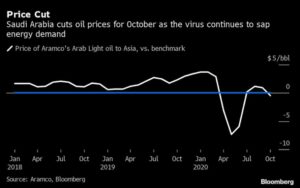
Speaking at an online conference, Novak also said oil prices could potentially rise to around $65 per barrel next year, but that he expected them to be volatile. Brent crude is currently trading around $44 per barrel, after slumping to a 21-year low below $16 in April at the height of restrictions to contain the pandemic. Asked by the conference moderator if he agreed with Goldman Sachs’s forecast that the oil price could reach $65 per barrel, Novak said it was possible, but that he was more cautious. “I have a rather more modest forecast, comparing to Goldman Sachs, for 2021. In my opinion, again, speaking about the average price per year, we could be in a corridor of $50 to $55 per barrel. But the volatility might be there,” he said via an interpreter. The world remains inundated with crude and fuel despite supply cuts by the Organization of the Petroleum Exporting Countries (OPEC) and its allies, known as OPEC +, and government efforts to boost oil production. global economy and demand for oil. As a result, refiners have cut back on fuel production, prompting oil producers like Saudi Arabia to cut prices to offset the drop in demand for crude. Monday’s Labor Day holiday marks the traditional end of the peak summer demand season in the United States and has renewed investor attention to the current lackluster fuel demand of the world’s largest oil user. world. China, the world’s largest importer of oil, which has supported prices with record purchases, slowed consumption in August and increased exports of products, customs data showed Monday. “There are so many uncertainties about the Chinese economy and its relationship with major industrialized countries, with the United States and nowadays, even Europe,” Keisuke Sadamori, director of markets for the United States, told Reuters. energy and security at the International Energy Agency. Saudi Arabia, the world’s largest oil exporter, has lowered the official October selling price of Arab Light crude it has been selling to Asia since May, indicating that demand remains weak. Asia is Saudi Arabia’s largest market by region.
Nick Note: If Novak predicts $50 YOU CAN EXPECT OIL UNDER $30. Brent is already in the lower forties… I could see oil in the twenties as the next wave of the coronavirus sucks shut the global economy…… again!