TECHNOLOGY UPDATE
Elon Musk, Starlink, and the science-fiction future that could move artificial intelligence and cloud data centers into outer space
By Nick Guarino · November 10, 2026
THE WORLD IS BUILDING YESTERDAY’S ANSWER TO TOMORROW’S TECHNOLOGY
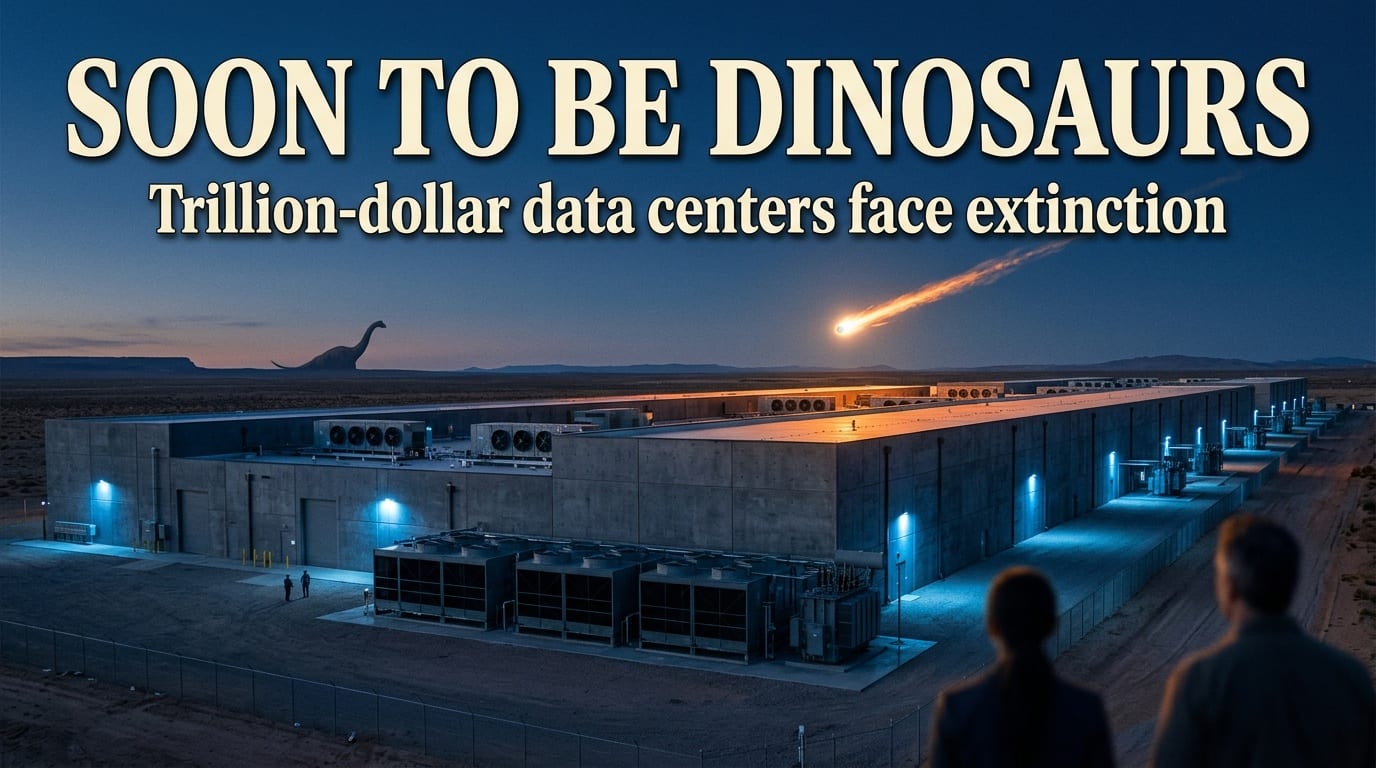
The biggest technology companies on Earth are racing to spend staggering sums of money on giant data centers. Concrete, steel, land, substations, state of the art CPU processors. Electric transmission lines, Fiber optic internet cable backbone bundles. Water systems and cooling plants: all of this in the name of artificial intelligence. They may be building the most expensive dinosaurs in industrial history.
My prediction is within five years, the economics of computing could begin to turn against these terrestrial mega projects costing trillions in borrowed money. Not because artificial intelligence fails, but because it succeeds so spectacularly that the infrastructure supporting it must be reinvented.
And the man best positioned to do that reinvention work is Elon Musk. He has launch vehicles, electric vehicles, a global satellite network and a direct interest in the future of AI. Put those pieces together and a radical new technology emerges: the AI data centers and the cloud could literally move into the heavens.
THE EARTHBOUND PROBLEM
A modern AI campus consumes land, water and electrical power on a scale that would have been unimaginable for an ordinary office building. Its processors turn nearly all the electricity they use into heat. That heat has to be removed continuously, using pumps, fans, liquid loops, chillers, heat exchangers and, in some designs, water-intensive cooling towers.
Then come the arguments. Who builds the power plants? Who pays for the transmission lines? Who supplies the water? Who wants an industrial-scale computing complex nearby? Environmental objections and local political resistance can slow construction and raise costs. Some concerns are real, while others become convenient slogans. Engineering questions deserve engineering answers, not political theater.
In the not too distant future, the winning answer is not to find a more cooperative town. It is to leave the town – and the planet – behind.
STARLINK IS THE FIRST HALF OF THE PUZZLE
Starlink has already demonstrated the appeal of a constellation of low-Earth-orbit communications satellites. Optical laser intersatellite links allow equipped satellites to relay traffic through space rather than relying on a ground station at every hop. That is a remarkable starting point for a new network architecture.
Now imagine its descendants: far more capable satellites, faster optical links, sophisticated routing, and user devices that communicate more directly with orbiting infrastructure. A request leaves a device, travels through a space based satellite network, reaches an orbital AI cloud computing facility, and returns back to Earth with the answer in seconds.
In this scenario, much of the computing is no longer concentrated in giant buildings on the ground. The network and the processing plant become parts of one orbital system. No Fiber optic cables to link data centers with users. No cell phone towers. No relying upon water resources or the electric grid.
THE COMPUTING FACTORY ABOVE THE CLOUDS
Imagine modular orbital data centers assembled from launchable units: powered by solar arrays, AI accelerators, communications terminals, batteries, shielding, radiators and robotic servicing systems. They would be deployed, expanded and eventually replaced like components of an industrial fleet.
Their attraction is obvious. Sunlight supplies free electrical energy without a terrestrial grid connection. Radiators in the near zero vacuum in space can expel the waste heat from the processor chips without cooling towers or water. There is no neighborhood zoning fight over a server farm land grab.
That does not mean power is free. Launches, spacecraft, solar arrays, energy storage, replacement hardware and operations all cost money. And the vacuum of space is not an effortless refrigerator: with no air to carry heat away, a powerful computer needs extensive radiator surfaces to shed its waste heat as infrared radiation. Those are formidable engineering challenges, not minor details. Both well within reach of current technology.
But the world once considered reusable orbital-class rockets fanciful. The purpose of a technological vision is to ask which apparent impossibilities can become routine engineering.
WHY MUSK COULD HAVE AN ADVANTAGE
Most cloud companies buy launch services from somebody else. Most satellite operators do not design the chips and AI services that would occupy a computing platform. Musk’s business interests bring several of those capabilities unusually close together.
A reusable launch system makes frequent delivery and replacement conceivable. A communications constellation could provide the data transport layer back to users on Earth. AI development has created enormous demand for data centers. And that demand will be met by orbital processing centers in outer space. Musk is building a vertically integrated system: launch, power, networking, computing and delivery to the customer.
It is a master plan of commercial and technical feasibility. Space based AI processing centers operating with an incredible cost advantage on AI campuses in orbit.
THE POLITICAL AND ECONOMIC EARTHQUAKE
As orbital computing becomes available with a great cost advantage for at first even a portion of AI workloads, what happens to the companies that committed fortunes to land, transmission infrastructure and giant cooling plants?
The answer will be a dramatic repricing of infrastructure. Most all terrestrial data centers would go broke. Especially where low latency, high bandwidth, data sovereignty and where physical proximity to users matters. The most expandable categories of compute could begin migrating upward in the next few years.
Today’s terrestrial fiber networks, undersea cables, Wi-Fi and cellular systems will simply be rendered unnecessary by satellite based systems. Capacity, physics, latency, spectrum and economics will favor space based networks for many uses. My analysis imagines a world in which future satellite generations of space based data centers will destroy land based infrastructure much faster than anyone presently expects.
THE FIVE-YEAR WAGER
Here is the wager: the real breakthrough will not be a faster processor inside a larger building. It will be a more cost effective place to put the processor – and a new way to connect it to the world.
My timeline: in five years, orbital computing will serve the bulk of AI and cloud computing and storage.
Today’s trillion-dollar borrowed money earth based data centers construction race represents the dumbest investments of our time. The next generation of data centers will not have a street address at all.
The future belongs to the company that can put a computing factory in orbit, power it with limitless sunlight, cool it for free in the vacuum of space, connect it with lasers, service it with rockets and deliver its intelligence directly to users anywhere on Earth. Get this faster, more reliably and cheaper than anyone else.
When that happens, the trillion dollar concrete dinosaurs we are building today will be monuments to a technological age that ended almost as soon as it began. With the biggest loss to investors ever.
RESEARCH DOSSIER
THE FUTURE IS NOT THAT FAR OFF
I am publishing my research documents to prove to you how close this is.
SpaceX orbital data centers, FCC filings, Starlink optical links, and direct-to-device systems. Starlink’s purchase of radio spectrum
Research updated: November 9, 2026
Scope and verification
These are my research discoveries on SpaceX and Starlink’s progress on AI data centers in outer space. Including Filing dates, numbers and regulatory actions. Data was taken from identified primary FCC documents where available. Proposed satellite quantities are application ceilings, not satellites actually launched or approved. The research distinguishes filing, acceptance for filing, grant, and operational service.
1 | SpaceX orbital data-center system: primary filing
| Applicant | Space Exploration Holdings, LLC (SpaceX). Application submitted January 30, 2026; FCC Space Bureau public notice released February 4, 2026. FCC file: SAT-LOA-20260108-00016; call sign S00798; public notice DA 26-113. |
| Proposed constellation | up to 1,000,000 non-geostationary satellites, in orbital shells from approximately 500 km to 2,000 km, with 30-degree and sun-synchronous orbital inclinations. The proposal describes high-bandwidth optical intersatellite links, including potential connections to SpaceX first- and second-generation Starlink systems. Requested radio links include portions of the 18.3–19.3 GHz and 28.6–29.1 GHz bands. |
| Regulatory status established by primary notice | ACCEPTED FOR FILING, not granted. FCC comments/petitions were due March 6, 2026; responses March 16; replies March 23. No final authorization for the million-satellite orbital-data-center system is established by the February notice. An acceptance notice establishes that the application can be reviewed, not that all technical, spectrum, environmental, and orbital-safety issues have been resolved. |
| Primary source | FCC, DA 26-113 (Feb. 4, 2026) |
| Contemporary reporting | Reuters, Jan. 31, 2026, “SpaceX seeks FCC nod for solar-powered satellite data centers for AI” |
2 | Existing Starlink Gen2 broadband constellation
| FCC announcement January 9, 2026 | authorization for 7,500 additional Gen2 Starlink satellites, bringing the authorized total to 15,000 for that system. The FCC describes new orbital shells approximately 340–485 km, advanced spacecraft forms, and Ku-, Ka-, V-, E-, and W-band operations. This is a broadband/satellite communications authorization, separate from the one-million-satellite orbital-data-center application. |
| Status | FCC authorization GRANTED for the specified additional Gen2 spacecraft; this does not imply all 15,000 are operational. |
| Primary source | FCC, “FCC Approves Next-Gen Satellite Constellation,” Jan. 9, 2026 |
3 | Starlink optical intersatellite links
Laser or optical intersatellite links enable satellites to pass traffic between spacecraft, reducing dependence on immediate terrestrial gateways along every route. The orbital-data-center filing explicitly contemplates optical links between its proposed compute satellites and SpaceX Gen1/Gen2 Starlink spacecraft. The engineering proposition is to combine transport and orbital processing, but a laser network does not by itself eliminate all Earth gateways, local Wi-Fi, fiber backbones, undersea cables, or cellular towers.
| Source | FCC DA 26-113, above, particularly its description of the optical links and interconnection with Starlink systems. |
4 | Direct-to-device / Starlink Mobile
SpaceX began deploying Direct to Cell spacecraft in January 2024. Its February 2025 service report described cooperation with mobile network operators, including use of terrestrial LTE spectrum and direct satellite-to-phone service. The 2025 Starlink progress report reported more than 650 first-generation Direct to Cell satellites and deployments spanning six continents (company-reported figures).
On October 6, 2026, the FCC issued Order DA 26-1078 in docket 25-340 approving a separate SpaceX non-geostationary mobile satellite service system. Industry coverage on October 7 described authority for up to 15,000 direct-to-device satellites, with conditions relating to acquired EchoStar spectrum. This Starlink Mobile system is distinct from the 15,000-satellite Gen2 broadband authorization and the proposed million-satellite orbital-data-center constellation.
| Regulatory status | direct-to-device system APPROVED, subject to stated license and spectrum conditions; that is not evidence that the whole constellation is deployed or that all terrestrial cell towers will disappear. |
| Sources |
5 | Starlink licensing of radio frequencies
When I heard that SpaceX was acquiring 800 MHz radio spectrum I put the pieces together. It’s past the concept phase. Musk is starting to build out space based data centers.
SpaceX is acquiring licensed spectrum rights. Those rights allow satellite transmissions in designated frequency bands, subject to regulatory approval.
The 800 MHz range is particularly valuable because lower-frequency signals do not require satellite antennas, penetrate buildings and obstacles better than higher-frequency signals.
SpaceX’s major spectrum acquisitions
The latest developments are even larger than the original EchoStar agreement.
| ~$20 billion EchoStar agreement |
~$8 billion Reported 800 MHz agreement |
Transaction values, not completed cash purchases.
| Frequency band | Spectrum involved | Purpose |
| AWS-4 | 2000–2020 and 2180–2200 MHz | Satellite-to-phone communications |
| H-Block | 1915–1920 and 1995–2000 MHz | Additional cellular capacity |
| AWS-3 | 1695–1710 MHz, up to 15 MHz | Additional spectrum resources |
| 800 MHz | Nationwide low-band portfolio | Better coverage and building penetration |
The first three bands are part of the EchoStar transaction, which received FCC approval on May 12, 2026. The final transfer to SpaceX is targeted for November 30, 2027.
The 800 MHz acquisition, reported October 8, 2026, involves spectrum from Grain Management. Reuters reported an estimated $8 billion price, with FCC approval still required.
The important point of my research is that SpaceX could eventually control the entire communications chain and computer internet, data processing space: the radio frequencies, satellites, intersatellite laser connections, computing infrastructure, and return path to the customer.
That is a much bigger business opportunity than simply selling satellite internet access.
How the system will work
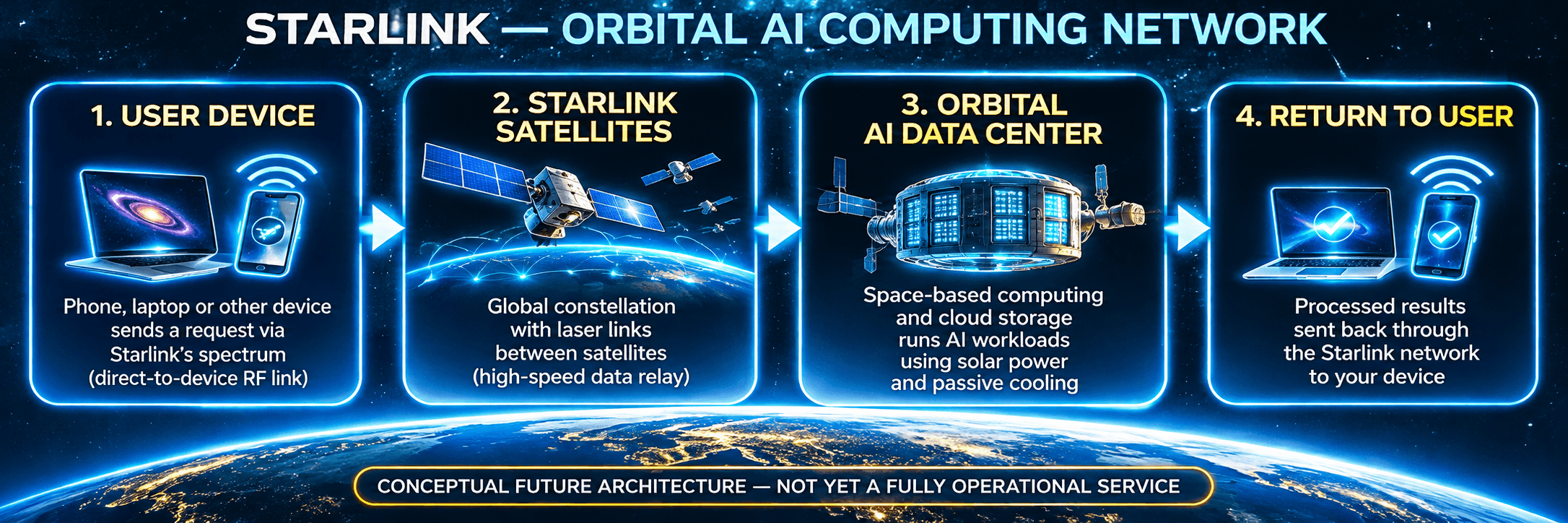
The spectrum purchases primarily help with the first and last legs of this chain: transmitting information between devices and satellites. Laser links would handle high-capacity communications between satellites and orbital computing facilities.
The FCC approved the EchoStar spectrum assignments on May 12, 2026. EchoStar reports that 50 MHz of AWS-4 and H-Block spectrum, plus 5–15 MHz of AWS-3 spectrum depending on geographic area, are involved. The initial transfer to a trust occurred May 22, with the final SpaceX transfer targeted for November 30, 2027.
SpaceX also filed an application for up to one million orbital data-center satellites, at altitudes of 500–2,000 kilometers. The FCC accepted that application for review on February 4, 2026, under filing SAT-LOA-20260108-00016. Acceptance for review does not constitute approval to deploy the constellation.
SpaceX is pursuing two complementary capabilities: direct-to-device spectrum and orbital computing infrastructure. Together, they could eventually allow AI requests to travel from a phone to an orbital processor and back without relying on a conventional terrestrial data center for that particular computation.
That is a credible technological direction. Terrestrial data centers, fiber networks or cellular towers will become obsolete within five years.
Spectrum ownership could give SpaceX the first and last links in the chain, connecting phones to satellites without cell towers or satellite antennas. Then the Starlink laser links could carry signals between satellites and, eventually, computing cloud and AI platforms in orbit. SpaceX could eventually control spectrum, satellites, and computing infrastructure as one integrated system. That could let a phone or desktop computer send an AI request to an orbital processor and receive the result without using a terrestrial data center for that particular calculation. It’s not ready yet, but it’s definitely the direction the technology will take.
6 | Other orbital-data-center proposals and competing filings
An October 1, 2026 legal review identified four FCC-accepted orbital-data-center proposals involving approximately 1,000,000, 88,000, 51,600 and 100,000 satellites, respectively. These are proposed constellation sizes; the review states that all four were under agency review at that time. The 88,000-satellite proposal is associated with Starcloud, and the 51,600-satellite proposal with Blue Origin.
| Primary regulatory report references |
|
| Legal analysis | WilmerHale, October 1, 2026, “Not Just Science Fiction: The Legal Reality of Orbital Data Centers” |
| Sector overview | Secure World Foundation, May 21, 2026, discusses SpaceX, Blue Origin, Axiom Space, Starcloud, Google/Planet, Nvidia and Chinese projects. |
7 | What has actually flown?
Demonstrations of computing in orbit are not equivalent to large commercial orbital AI data centers. Axiom Space, Starcloud and other operators have pursued or flown small computing payloads. Some 2026 trackers list additional experiments, but operational status and hardware specifics are trade secrets.
| Potential advantages |
|
| Material constraints |
|
| Crucial distinction | space is cold in the sense of low background radiation temperature, but it is a vacuum and cannot cool chips by air convection. Heat must be conducted to a radiator and emitted as thermal radiation. |
8 | Editorial interpretation versus established fact
| Established | SpaceX formally applied for an orbital-data-center constellation in January 2026; the FCC accepted it for filing in February; its proposal explicitly invokes optical intersatellite links and Starlink integration. The FCC separately approved expansions of Starlink broadband and direct-to-device communications in 2026. |
| Not established | that the proposed orbital-data-center system has been approved; that one million satellites will be launched; that Starlink will eliminate fiber, undersea cables, terrestrial cellular systems or Wi-Fi; that orbital cooling requires no thermal-management hardware; or that Earth-based data centers will be obsolete in five years. |
| Editorial scenario | Elon Musk may be unusually well positioned to combine launch, satellites, laser networking, solar energy and AI compute. |
9 | Starlink video
Starlink system explainer:
REFERENCE MATERIAL AND EDITORIAL NOTES
- Starlink explainer video
- Background topics: SpaceX/Starlink FCC filings; optical intersatellite links; space-based solar power; radiative thermal management; orbital debris and collision risk; launch economics; satellite-to-device capacity.