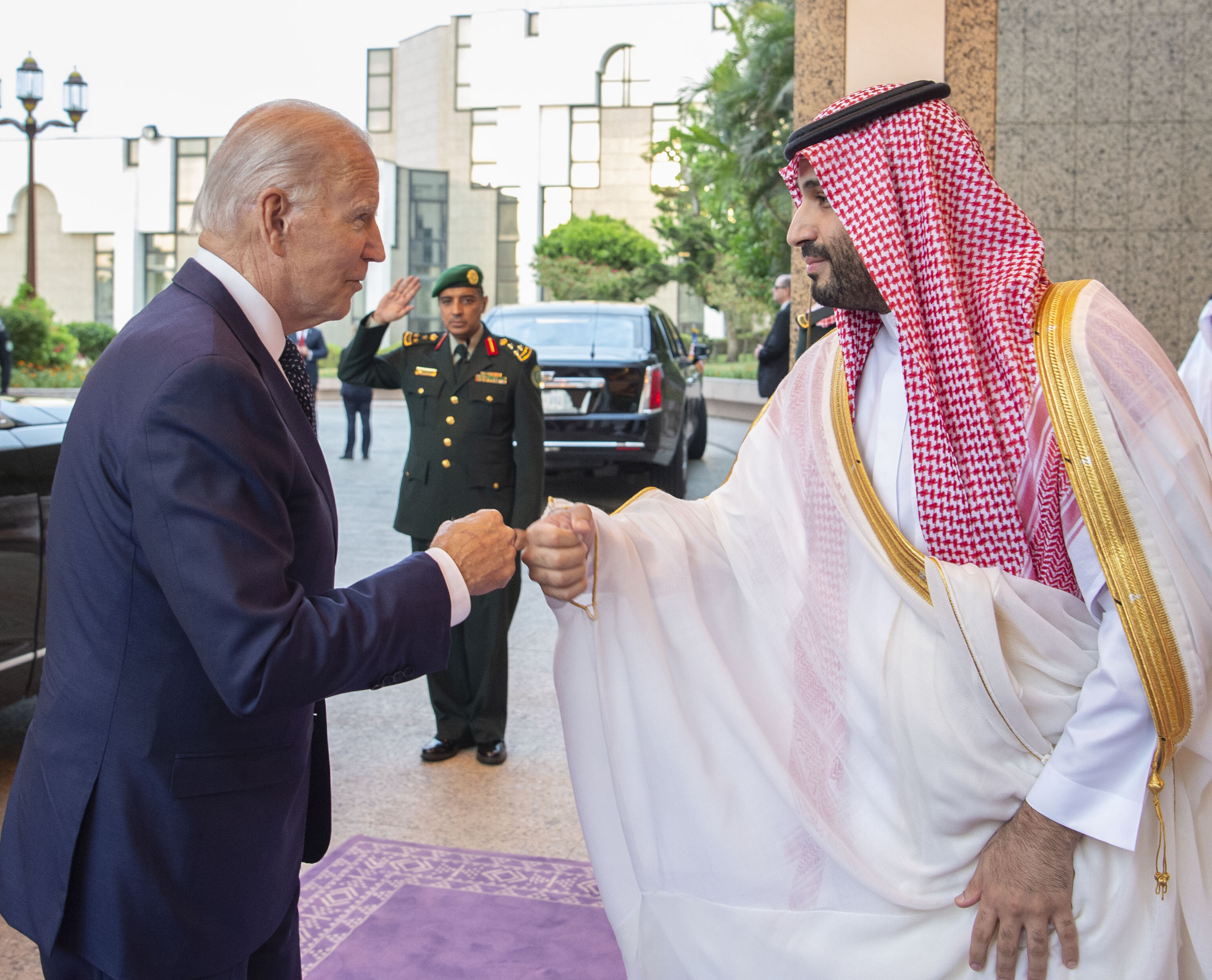
- Plan would offer incentives for Israel to end war with Hamas
- Accord would pave the way for Saudis to get advanced weapons
The US and Saudi Arabia are nearing a historic pact that would offer the kingdom security guarantees and lay out a possible pathway to diplomatic ties with Israel if its government brings the war in the Gaza Strip to an end, people familiar with the matter said. The agreement faces plenty of obstacles but would amount to a new version of a framework that was scuttled when Hamas’s Oct. 7 attack on Israel triggered the conflict in Gaza. Negotiations between Washington and Riyadh have sped up in recent weeks, and many officials are optimistic that they could reach a deal within weeks, according to the people, who asked not to be identified discussing private deliberations. Such an agreement would potentially reshape the Middle East. Beyond bolstering Israel and Saudi Arabia’s security, it would strengthen the US’s position in the region at the expense of Iran and even China. The pact may offer Saudi Arabia an arrangement strong enough to need the US Senate’s approval and even give the world’s biggest oil exporter access to advanced US weapons that were previously off-limits. Crown Prince Mohammed bin Salman would agree to limit Chinese technology from his nation’s most sensitive networks in exchange for major US investments in artificial intelligence and quantum-computing, and get American help to build out its civilian nuclear program. Once the US and Saudi Arabia settle their agreement, they would present Israeli Prime Minister Benjamin Netanyahu with a choice: either join the deal, which would entail formal diplomatic ties with Saudi Arabia for the first time, more investment and regional integration, or be left behind. The key conditions for Netanyahu would be no small feat — ending the Gaza war and agreeing to a pathway for Palestinian statehood.
The proposal is fraught with doubt and may not come to fruition, which people familiar with the planning readily acknowledge.
Getting American lawmakers to approve a deal that commits the US to protecting Saudi Arabia militarily would be a daunting prospect for the White House, especially if Israel opts not to join it. Many lawmakers remain wary of Prince Mohammed, the kingdom’s 38-year-old de facto ruler, after the killing of Washington Post columnist Jamal Khashoggi by Saudi agents in 2018. They’re also uneasy about the Saudi strategy of lowering oil production, along with other members of the OPEC+ cartel, to prop up prices. From the Israeli side, Netanyahu leads the most right-wing government in the country’s history and has all but ruled out a two-state solution. His coalition says it still plans to attack the Gazan city of Rafah, which the US and Arab states fear would lead to thousands more deaths among Palestinian civilians. Such an attack would also jeopardize prospects for a short-term cease-fire that US Secretary of State Antony Blinken — who met Netanyahu in Jerusalem on Wednesday — says is a priority for President Joe Biden. Still, the leaders of the three countries have plenty of incentives to reach an agreement soon. For Biden, it’s a chance for a foreign policy victory before the US presidential election in November. The crown prince would avoid the uncertainty about whether former President Donald Trump would accept a deal if he wins that race, even though Trump’s administration initiated the Abraham Accords that envisioned such alliances between Israel and its neighbors. Netanyahu, the biggest wild card, could take credit for normalizing relations with the biggest economy in the Middle East and guardian of Islam’s holiest sites — a goal he’s long covet For Netanyahu, another advantage is that a pact would help counter Iran’s aggression. Since the war in Gaza erupted, Israel and Iran have exchanged their first-ever direct fire against one another and Tehran’s proxy militias such as Hezbollah have regularly attacked the Jewish state.