US and Saudis Near Defense Pact Meant to Reshape Middle East

  • Plan would offer incentives for Israel to end war with Hamas
  • Accord would pave the way for Saudis to get advanced weapons

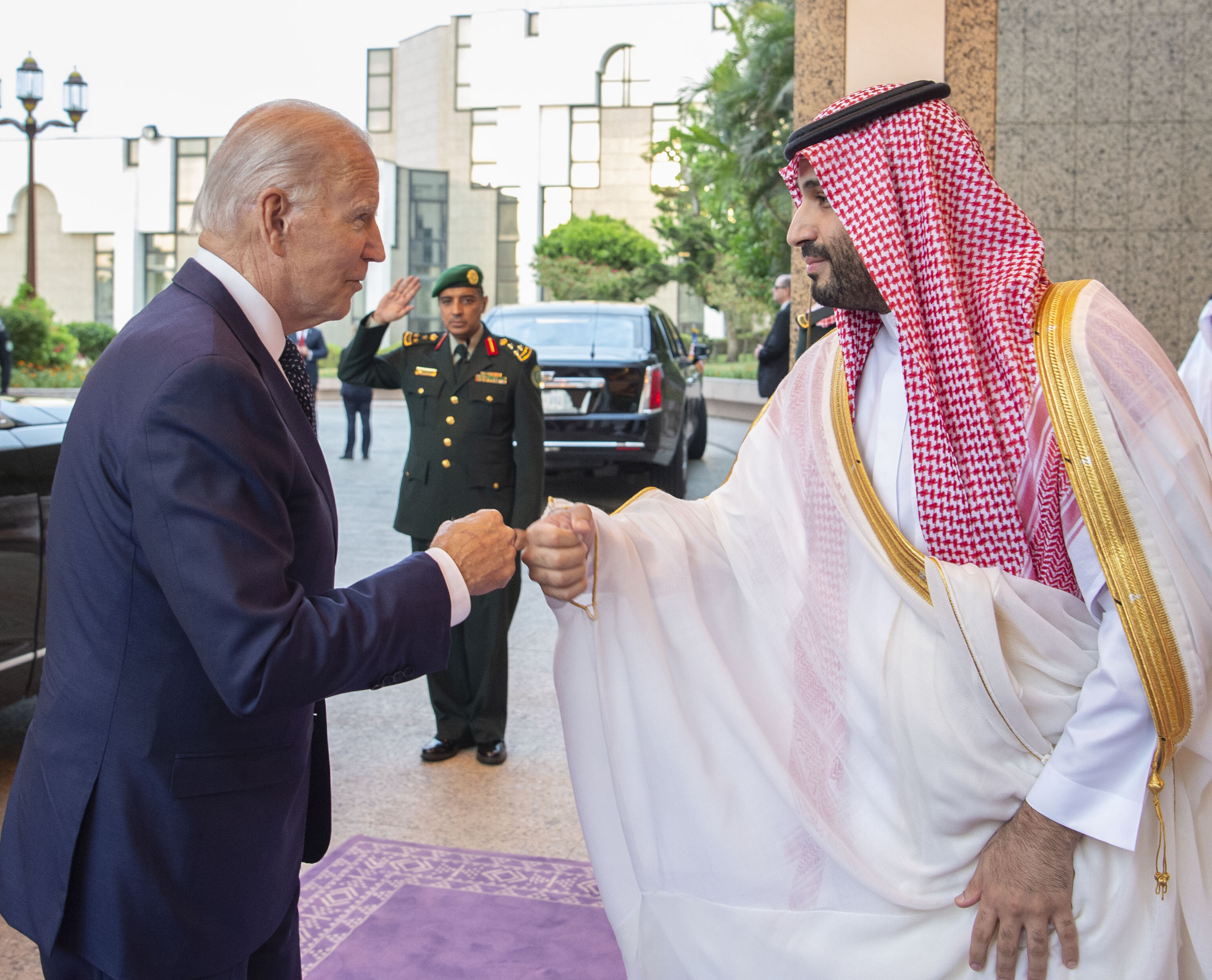
The US and Saudi Arabia are nearing a historic pact that would offer the kingdom security guarantees and lay out a possible pathway to diplomatic ties with Israel if its government brings the war in the Gaza Strip to an end, people familiar with the matter said. The agreement faces plenty of obstacles but would amount to a new version of a framework that was scuttled when Hamas’s Oct. 7 attack on Israel triggered the conflict in Gaza. Negotiations between Washington and Riyadh have sped up in recent weeks, and many officials are optimistic that they could reach a deal within weeks, according to the people, who asked not to be identified discussing private deliberations. Such an agreement would potentially reshape the Middle East. Beyond bolstering Israel and Saudi Arabia’s security, it would strengthen the US’s position in the region at the expense of Iran and even China. The pact may offer Saudi Arabia an arrangement strong enough to need the US Senate’s approval and even give the world’s biggest oil exporter access to advanced US weapons that were previously off-limits. Crown Prince Mohammed bin Salman would agree to limit Chinese technology from his nation’s most sensitive networks in exchange for major US investments in artificial intelligence and quantum-computing, and get American help to build out its civilian nuclear program. Once the US and Saudi Arabia settle their agreement, they would present Israeli Prime Minister Benjamin Netanyahu with a choice: either join the deal, which would entail formal diplomatic ties with Saudi Arabia for the first time, more investment and regional integration, or be left behind. The key conditions for Netanyahu would be no small feat — ending the Gaza war and agreeing to a pathway for Palestinian statehood.

The proposal is fraught with doubt and may not come to fruition, which people familiar with the planning readily acknowledge.

Getting American lawmakers to approve a deal that commits the US to protecting Saudi Arabia militarily would be a daunting prospect for the White House, especially if Israel opts not to join it. Many lawmakers remain wary of Prince Mohammed, the kingdom’s 38-year-old de facto ruler, after the killing of Washington Post columnist Jamal Khashoggi by Saudi agents in 2018. They’re also uneasy about the Saudi strategy of lowering oil production, along with other members of the OPEC+ cartel, to prop up prices. From the Israeli side, Netanyahu leads the most right-wing government in the country’s history and has all but ruled out a two-state solution. His coalition says it still plans to attack the Gazan city of Rafah, which the US and Arab states fear would lead to thousands more deaths among Palestinian civilians. Such an attack would also jeopardize prospects for a short-term cease-fire that US Secretary of State Antony Blinken — who met Netanyahu in Jerusalem on Wednesday — says is a priority for President Joe Biden. Still, the leaders of the three countries have plenty of incentives to reach an agreement soon. For Biden, it’s a chance for a foreign policy victory before the US presidential election in November. The crown prince would avoid the uncertainty about whether former President Donald Trump would accept a deal if he wins that race, even though Trump’s administration initiated the Abraham Accords that envisioned such alliances between Israel and its neighbors. Netanyahu, the biggest wild card, could take credit for normalizing relations with the biggest economy in the Middle East and guardian of Islam’s holiest sites — a goal he’s long covet For Netanyahu, another advantage is that a pact would help counter Iran’s aggression. Since the war in Gaza erupted, Israel and Iran have exchanged their first-ever direct fire against one another and Tehran’s proxy militias such as Hezbollah have regularly attacked the Jewish state.
Israel allegedly believes Hamas won’t accept hostage offer…….. UNRWA: It’ll be hard to evacuate Rafah ‘quickly’

Israeli leadership believes that Hamas will reject the latest offer on hostages that it was presented to it earlier, The Times of Israel reported on Thursday citing an Israeli official. According to the official, the country’s war cabinet is discussing such an outcome and a potential full-on attack on Rafah. Meanwhile, previously, Hamas said in a statement it would be sending its delegation to Egypt again so that the ceasefire talks could continue

UNRWA: It’ll be hard to evacuate Rafah ‘quickly’

United Nations Relief and Works Agency (UNRWA) spokesperson Adnan Abu Hasan told RIA Novosti on Thursday that should Israel conduct its military operation in Rafah, it will be difficult for the agency to carry out evacuations “quickly.” “The process of evacuating the city of Rafah is very dangerous since we are talking about 1.4 million Palestinians in this small, very densely populated area. We do not see the opportunity to quickly carry out evacuation due to the lack of transport, tents etc.,” the spokesperson explained. They shared that the agency has no information on when the operation could take place, adding that Israel’s strike would likely leave thousands dead and injured.

Ukrainian Drones Hit Major Rosneft Refinery in Russia

Ukrainian drones hit the primary refining unit of Russia’s third-largest refinery southeast of Moscow more than 800 miles from the front line, Reuters reported on Tuesday. The Taneco refinery of Russian company Tatneft in Tatarstan, an industrialized region southeast of Moscow, was attacked by Ukrainian drones in the latest such attack from Ukraine on Russian refining infrastructure. The refinery has a capacity to process 340,000 barrels per day (bpd) of crude. Its primary refining unit, with a capacity to process about 155,000 bpd, was hit in Tuesday’s attack, according to pictures seen by Reuters. The unit caught fire, which was swiftly extinguished, Russian media report. They also quote Ramil Mullin, the mayor of the city of Nizhnekamsk, where the refinery is located, as saying that there have been no injured people in the attack.“ There are no injuries or serious damage,” Mullin wrote on Telegram. “The technological process of the enterprise has not been disrupted,” the mayor added. A source with the Ukrainian intelligence in Kyiv told Reuters that Ukraine hit a major Russian oil facility in Tatarstan to reduce Russian oil revenues. Ukraine has stepped up attacks on oil refineries in Russia in recent weeks, which have reduced Russian refining capacity, and which, reportedly, have the White House concerned about rising international prices. The United States has repeatedly urged Ukraine to halt its drone attacks on Russian oil refineries due to Washington’s assessment that the strikes could lead to Russian retaliation and push up global oil prices, the Financial Times reported last month, citing sources familiar with the exchange. According to Reuters estimates, the amount of Russian oil refining capacity that has been taken offline due to Ukrainian drone strikes is 14% of Russia’s total refining capacity. Calculations show that 900,000 bpd of refining capacity have been taken offline by drone strikes, Reuters reported last week.

Blinken, Netanyahu start private meeting in Jerusalem

Prime Minister Benjamin Netanyahu and US Secretary of State Antony Blinken begin their private meeting in Jerusalem. That meeting will be followed by a broader discussion with their respective staffs. On the Israeli side, Netanyahu will be joined by Strategic Affairs Adviser Ron Dermer, National Security Adviser Tzachi Hanegbi, Military Secretary Avi Gil, Political Adviser Ophir Falk, Chief of Staff Tzachi Braverman, and Ambassador to Washington Michael Herzog. Blinken will be joined by Ambassador Jack Lew, Special Envoy for Middle East Humanitarian Affairs Lisa Grande, and Assistant Secretary of State for the Middle East Barbara Leaf. NN: Their will be no deal. Hamas just needs to set back and wait for the world to force Israel to back down.

OPEC’s Oil Production Falls in April

OPEC’s crude oil production fell in April, according to a new Reuters survey, with news of the fall likely to add support to falling oil prices. According to the survey, the results of which were released on Tuesday, OPEC’s crude oil production fell to 26.49 million barrels per day—that’s a 114,000 bpd drop from the levels OPEC produced in March, according to OPEC’s official March figure. According to revised Reuters figures for March production, the group’s ouput sagged by 99,000 bpd in April. The survey is based on shipping data and “information from industry sources,” according to Reuters. In March, Iraq, Nigeria, Venezuela, the UAE, and Libya all saw production decreases, according to OPEC’s secondary sources, with Nigeria seeing the biggest dip. Saudi Arabia and Iran saw the largest production increases.  OPEC’s official Monthly Oil Market Report covering the month of April will be released on May 14, according to OPEC’s published schedule. The OPEC+ coalition, spearheaded by the largest producers in the group, Saudi Arabia and Russia, had initiated additional production cuts at the beginning of 2024 to mitigate the risk of a global oil surplus, and in March, the group agreed to extend those cuts until the end of June. Iraq and Kazakhstan had previously pledged to “achieve full conformity” and compensate for their overproduction. They submitted detailed plans today to do just that. The next JMMC meeting is scheduled for June 1. Saudi Arabia previously referred to the decision to extend output cuts into the end of June as “precautionary,” aimed at “supporting the stability and balance of oil markets.” Saudi Arabia has said that when it is time to roll back the production cuts, it will be done gradually “subject to market conditions.”

Blinken says US wants ceasefire deal ‘now’….. Want and Get are 2 Different Things

TEL AVIV, Israel (AP) — U.S. Secretary of State Antony Blinken was meeting with Israeli leaders on Wednesday in his push for a cease-fire deal between Israel and Hamas, saying “the time is now” for an agreement that would free hostages and bring a pause in the nearly seven months of war in Gaza. He has said Hamas would bear the blame for any failure to get a deal off the ground. Blinken is on his seventh visit to the region since the war erupted in October in his bid to secure what’s been an elusive deal between Israel and Hamas that could avert an Israeli incursion into the southern Gaza city of Rafah, where hundreds of thousands of Palestinians are sheltering. The current round of talks appears to be serious, but the sides remain far apart on one key issue — whether the war should end as part of an emerging deal. “We are determined to get a cease-fire that brings the hostages home and to get it now, and the only reason that that wouldn’t be achieved is because of Hamas,” Blinken told Israel’s ceremonial President Isaac Herzog at a meeting in Tel Aviv. “There is a proposal on the table, and as we’ve said, no delays, no excuses,” he said. The deal would also allow much needed food, medicine and water to get into Gaza, Blinken said.As part of his visit, Blinken will meet Israeli Prime Minister Benjamin Netanyahu. According to the State Department, he will also meet with the families of hostages and visit an Israeli port where aid for Gaza is entering. Blinken’s comments came on the last leg of his regional visit, with previous stops in Saudi Arabia and Jordan, where he urged Hamas to accept the latest proposal, calling it “extraordinarily generous” on Israel’s part. But the United States has also criticized Israel for its plan to invade Rafah, Gaza’s southernmost city where some 1.5 million Palestinians are sheltering from fighting elsewhere, saying that any major offensive there would bring potential harm to civilians and should be avoided.

Netanyahu has repeatedly vowed to invade Rafah, which he says is Hamas’ last stronghold, and on Tuesday’s pledged to do so “with or without” a cease-fire deal.

The current deal that is being discussed — with brokering by the U.S., Egypt and Qatar — would see the release of dozens of hostages in exchange for a six-week halt in fighting as part of an initial phase, according to an Egyptian official and Israeli media. Hundreds of Palestinian prisoners held by Israel would also be released, including some serving long sentences. But a sticking point remains over what happens next. Hamas has demanded assurances that an eventual release of all hostages will bring a complete end to Israel’s nearly seven-month assault in Gaza and a withdrawal of its troops from the devastated territory.

Israel has offered only an extended pause, vowing to resume its offensive once the first phase of the deal is over. The issue has repeatedly obstructed efforts by the mediators during months of talks.

NN: I am betting their will be o deal1!!

Israel Won’t Join Truce Talks Until Hamas Responds, Kan Says

  • Hamas is believed to be weighing fresh proposal: state media
  • Israel remains committed to invasion of Rafah, Netanyahu says

Israel will consider joining cease-fire talks with Hamas only when the militant group responds to the latest internationally mediated proposal for a temporary truce and hostage release, state-run Kan News reported. Citing an unidentified political official, Kan said the Israeli government is expecting an answer from the Iran-backed militant group on Wednesday evening. Under the latest terms for a pause in hostilities, Israeli forces have agreed to withdraw from parts of Gaza, according to Kan. Israel has been waging a military campaign against Hamas in response to the Oct. 7 invasion by militants on southern communities, in which more than 1,200 people were killed and some 250 were taken hostage. Israeli forces have laid waste to much of Gaza during the near seven-month conflict, with the ultimate aim of destroying Hamas and preventing a repeat attack. More than 34,000 Palestinians have been killed since the beginning of Israel’s air and ground assault on the strip, according to the Hamas-led health ministry, while many more are struggling for food and health care. Hamas released about 105 hostages during a November cease-fire, and it’s not known how many of the rest are still alive. Israel has said it needs to invade the southern Gaza city of Rafah to complete the job of eliminating Hamas militants, a prospect that’s raised concern internationally due to the more than 1 million Palestinians taking refuge there. The plan remains in place regardless of whether a truce deal is agreed, Prime Minister Benjamin Netanyahu said Tuesday. “The idea that we will halt the war before achieving all of its goals is out of the question,” he told the families of hostages and those of soldiers killed in the fighting. “We will enter Rafah and we will eliminate the Hamas battalions there – with or without a deal, in order to achieve the total victory.” The US and its allies are concerned that truce efforts could be scuppered by the International Criminal Court, which people familiar with the matter have said may issue arrest warrants for Israeli officials, including Netanyahu, for their war conduct. Netanyahu said he wants “leaders of the free world” to intervene in the ICC’s decision and make sure the warrants aren’t issued, according to a statement from his office. Under the latest cease-fire proposal, displaced Palestinians who need to return to their homes in northern Gaza after being forced to take refuge in the south won’t be inspected by Israeli forces, Kan said. Only Egypt and other countries will carry out that task. Israel will still be allowed to “track” Palestinians returning to northern Gaza using “other tools,” Kan said, without giving more details. On Monday, US Secretary of State Antony Blinken urged leaders of Hamas, which is designated a terrorist group by the US and European Union, to quickly reach a decision on Israeli conditions for a temporary cease-fire. Israel has been “extraordinarily generous” with proposals made during talks mediated by Qatar and Egypt, Blinken said in Riyadh. He wasn’t more specific about the offer on the table. Israeli Finance Minister Bezalel Smotrich, who’s also leader of the right-wing Religious Zionism party that is part of Netanyahu’s coalition, said he would oppose the deal currently on the table.  “A government that submits to international pressure, stops the war in the middle, avoids immediate entry into Rafah and returns to Egyptian mediation proposals that leave Hamas existing in any configuration, will at that moment lose its right to exist,” Smotrich said.

Israel to reportedly invade Rafah if no deal is reached………..Netanyahu: Rafah op coming soon

Israel will be launching an operation in Rafah should there be no progress made on the hostage deal in the coming days, GLZ Radio reported on Tuesday citing security officials. Previously, Ynet News reported that Israel’s Defense Forces Chief of Staff General Herzi Halevi greenlighted the final plans for the military operation. According to the news outlet, numerous Israeli tanks have lined up on the Gaza border and are waiting for an order to begin the action should the hostage negotiations fall through yet again. The order could be given in the next 48 to 72 hours, as per Ynet.

Netanyahu: Rafah op coming soon

Israeli Prime Minister Benjamin Netanyahu reiterated on Tuesday that the goals of the war remain unchanged, Sky News Arabia cited him as saying.

Netanyahu stressed that the Rafah military operation “will be taking place soon,” insisting that “it is out of the question” to stop until Hamas brigades in the area are eliminated. He repeated that Israel wouldn’t be surrendering to the militant group and added that the order would be given regardless of what happens in hostage negotiations.

The prime minister also remarked that the process of evacuating Rafah commenced. Earlier, Israeli military radio shared that the invasion of the region could happen in the next 48 to 72 hours, should there be no progress on hostage talks.

NN: Audio File


Hamas: No ceasefire if Israel fails to meet demands

The Palestinian militant group Hamas spokesman Abd al-Latif al-Qanou emphasized on Monday that unless Israel fulfills the demands of the group, there will be no agreement for a ceasefire or the release of hostages. “Without fulfilling the just demands of our people for a permanent ceasefire, withdrawal of forces, and the return of displaced persons, no agreement with the occupation will succeed,” he added. According to a previous report by AFP, the militia is set to provide its response to the Israeli counterproposal today. The group had previously indicated its readiness to disarm on the condition that a Palestinian state is established. Israeli Foreign Minister Israel Katz said that if a deal is reached, Israel will “suspend” the Rafah operation.

UK’s Cameron calls on Hamas to accept ceasefire deal

United Kingdom Foreign Secretary David Cameron on Monday expressed hope that the Palestinian militant group Hamas will agree to the Israeli proposal that would secure the potential 40-day ceasefire in the Gaza Strip in exchange for the release of hostages.

Speaking at the World Economic Forum in Riyadh, Cameron stated that it is crucial to establish a political future in the Gaza Strip without Hamas in order to build the ground for a two-state solution. “I don’t believe that even if there was a Palestinian state created tomorrow, that Iran and its leaders would say: “That’s all fine now”,” Cameron stated, highlighting that Tehran believes in the “destruction” of Israel as a state and that attempting to do so through Hamas, Hezbollah, and Houthis.

The British foreign secretary noted that Iran’s support for the militant groups in the region is “deeply troubling” and “destabilizing” for the region.

Oil prices fall 1% amid Israel-Hamas peace talks…….Oil Drops as Progress on Cease-Fire in Gaza Shrinks Risk Premium

Prices of crude oil for front-month contracts decreased on Monday amid the ongoing Israeli-Hamas negotiations that could de-escalate the crisis in the Middle East by potentially securing a temporary ceasefire in the Gaza Strip and the release of hostages held by the militant group in the enclave. European Union High Representative for Foreign Affairs and Security Policy Josep Borrell previously shared that several member states in the bloc plan to formally recognize Palestinian statehood by the end of May. West Texas Intermediate (WTI) for June deliveries fell 1.28% to sell at $82.68 per barrel at 10:41 am ET. For the same month’s settlements, Brent declined 1.20% to trade at $88.28 a barrel.

Oil Drops as Progress on Cease-Fire in Gaza Shrinks Risk Premium

Momentum toward a cease-fire has been building, with US Secretary of State Antony Blinken saying he will step up his push to secure a truce in Gaza during a visit to the region. The White House said Israel has agreed to hear out its concerns and hold off invading Rafah until meeting with the Americans. Still, the gap between the two nearest Brent contracts was about $1 a barrel in backwardation, a bulllish indicator that signals tight near-term supply. Benchmark North Sea crudes have also seen a spate of buying in recent days. Crude has risen this year on OPEC+ supply cuts and heightened tensions in the Middle East.