Federal Reserve Chair Jerome Powell insisted on Wednesday, when asked whether the latest “deep” interest rate cut had any “political motivation” given that elections are coming in November, that the United States central bank doesn’t take such things into consideration when making these decisions. “This is my fourth presidential election at the Fed and it’s always the same. We are always going into this meeting in particular and asking what’s the right thing to do for the people we serve. We make a decision as a group and then announce it. It’s never about anything else. Nothing else is discussed,” he underlined. He also reminded the audience that whatever the Fed does, affects the economy with a lag. Powell reiterated that everything done is in the interest of the American people. “We don’t put up any other filters. If you start doing that I don’t know where you’d stop,” he concluded. NN: Its all about the elections and his job. Trump said he would fire his punk ass. Do you remember transitory inflation? Debt is out of control. The Fed balance sheet is all used up. They cannot monetize (print money) the debt because it will crash the dollar. Last option….. after the elections raise rates…
Standard Chartered, JP Morgan Look at Oil Price Moves
It has been several weeks since oil price movements have told us anything significant about changes in fundamentals.That’s what analysts at Standard Chartered Bank, including Commodities Research Head Paul Horsnell, said in a report sent late Tuesday. “A period of price undershooting, exacerbated by a magnetic storm of top-down macroeconomic fears, fed momentum-following algorithms,” the analysts stated in the report.
“This resulted in an extended price fall exacerbated by a final stage of gamma hedging as banks sought to cover the risk from options they had sold to producers,” they added.
“The negative feedback loop seems to have been reinforced by an unusually high degree of groupthink among hedge funds and other speculative flows led by a (usually unquantified) market narrative of a current or impending supply glut,” they continued. “The overwhelming (and surprisingly uniform) bearishness among money managers has taken positioning in crude oil and oil products to the most bearish extreme since the start of the Global Financial Crisis (GFC) in 2008,” the analysts went on to state. In the report, the Standard Chartered Bank representatives said obtaining a clear short-term directional signal from fundamentals is almost impossible in such a dislocated market.
“Extreme positioning, groupthink, and algorithmic trading strategies are still generating far too much noise,” they warned.
“However, we think there will be two key price drivers when dislocations ease.
First, there is no supply glut; indeed September looks like being the tightest month of the year due to seasonal demand strength and supply outages in Libya and the U.S. Gulf,” they added.
“Second, no supply glut is likely in at least Q4-2024 and H1-2025 if OPEC+ producers keep to their commitments. We think the actions of a small group of producers, particularly Iraq, will be the key factor for prices but the market appears some way from focusing on this,” they continued.
In a research note sent t by the JPM Commodities Research team on Tuesday, J.P. Morgan analysts said they believe the market is currently overemphasizing bearish drivers and highlighted that they see today’s global crude markets as tight. “Global crude inventories are below last year’s levels, when Brent was trading at $92, and at 4.42 billion barrels are the lowest on record since Kpler began tracking data in January 2017,” the J.P. Morgan analysts said in the note. “Meanwhile, both OECD crude and liquids inventories sit below their five-year range and five-year averages and oil stocks at Cushing are severely depleted by the standards of the last 15 years,” they added. “It is these draws out of oil inventories that are influencing our pricing model to show that Brent’s fair value today is $82 per barrel, $10 above the spot price,” they continued. The J.P. Morgan analysts said in the research note that they believe the decline in prices “is due to an expected glut in the market in 2025, as reflected in the curve structure, and concerns that OPEC and its allies will hike production into the surplus”. “To calm the market, key coalition members announced on September 5 that they won’t increase production by 180,000 barrels per day in October and November. Yet their longer-term plan to revive 2.2 million barrels per day of idle supplies gradually over the course of 12 months remains in place, with the completion date pushed back two months to December 2025,” they added. “While the announcement stabilized Brent in low $70s, the decision to prolong supply restraint for another two months may only defer rather than resolve the challenge for OPEC to next year,” they warned.
A Rystad Energy oil macro update from Rystad Energy Senior Analyst Svetlana Tretyakova, which was also sent on Tuesday, noted that, despite ongoing concerns over weak demand, global liquids and crude balances are expected to remain tight through the end of 2024, with stock draws anticipated. “On crude, supply is notably constrained, with the year over year change in crude and condensate supply expected to turn negative for the first time since 2020,” the update stated. “Global crude oil supply is expected to decline by 220,000 barrels per day year on year in 2024, primarily due to extended OPEC+ cuts, reduced Libyan output, and weaker performance from non-OPEC+ producers,” it added. “OPEC+ members, including Saudi Arabia and Russia, are maintaining voluntary cuts of 2.2 million barrels per day until November 2024, with the potential for further extensions. U.S. oil supply growth has been revised down to 280,000 barrels per day, reflecting a decline in Bakken output and modest Permian growth,” it continued. “Libyan production has dropped sharply due to political disruptions, while Brazil’s output is projected to recover in the second half of the year, and Nigeria’s production outlook is improving with steady growth,” it noted. “Additionally, our preliminary estimate indicates Hurricane Francine might result in a 1.8-million-barrel production loss in the Gulf of Mexico over two and a half days,” the update went on to state.
More devices explode in several Lebanese towns
More pagers and other telecommunications devices exploded in Lebanon a day after 12 people were killed and thousands injured in a series of similar blasts. Several people were wounded on Wednesday in the Bekaa area east of Beirut and in a southern town, state-run National News Agency reported. The blasts took place after an audacious attack in Lebanon on Tuesday via the devices widely used by the Hezbollah militant group. The Iran-backed organization and the Lebanese government have blamed Israel for carrying out the operation, raising concerns about an escalation of regional violence.
EIA Weekly Petroleum For September 13, 2024

U.S. commercial crude oil inventories (excluding those in the Strategic Petroleum Reserve) decreased by 1.6 million barrels from the previous week. At 417.5 million barrels, U.S. crude oil inventories are about 4% below the five year average for this time of year. U.S. crude oil refinery inputs averaged 16.5 million barrels per day during the week ending September 13, 2024, which was 283 thousand barrels per day less than the previous week’s average. Refineries operated at 92.1% of their operable capacity last week. Gasoline production increased last week, averaging 9.7 million barrels per day. Distillate fuel production decreased last week, averaging 5.1 million barrels per day. U.S. crude oil imports averaged 6.3 million barrels per day last week, decreased by 545 thousand barrels per day from the previous week. Over the past four weeks, crude oil imports averaged about 6.4 million barrels per day, 7.1% less than the same four-week period last year. Total motor gasoline imports (including both finished gasoline and gasoline blending components) last week averaged 467 thousand barrels per day, and distillate fuel imports averaged 138 thousand barrels per day. Total motor gasoline inventories increased by 0.1 million barrels from last week and are slightly below the five year average for this time of year. Finished gasoline inventories increased, while blending components inventories decreased last week. Distillate fuel inventories increased by 0.1 million barrels last week and are about 9% below the five year average for this time of year.
Propane/propylene inventories increased by 2.3 million barrels from last week and are 11% above the five year average for this time of year. Total commercial petroleum inventories increased by 3.4 million barrels last week.
Total products supplied over the last four-week period averaged 20.3 million barrels a day, down by 2.7% from the same period last year. Over the past four weeks, motor gasoline product supplied averaged 8.9 million barrels a day, up by 1.1% from the same period last year. Distillate
fuel product supplied averaged 3.8 million barrels a day over the past four weeks, down by 0.9% from the same period last year. Jet fuel product supplied was down 1.4% compared with the same four-week period last year. NN: Inventories are till DROPPNIG.
Oil Consumers Hedged in Droves as Prices Fell Below $70
Oil consumers posted one of the largest hedging additions on record when prices briefly fell below $70 a barrel last week. The number of long contracts held by swap dealers on global benchmark Brent jumped by almost 50,000 lots last week, the most since March 2023 and the third-largest increase on record. For Europe’s diesel benchmark, swap dealer longs were the highest since 2020. Swap dealer positions are often seen as a proxy for the hedges of industrial consumers like airlines and shipping companies, as they show where banks and other dealers lay off the risk they take on in over-the-counter trades. Consumers generally buy derivatives that would profit from higher prices to protect against spikes in the cost of their real-world fuel bills. When the pandemic hit in 2020, many lost billions of dollars on those positions and have spent the years since rebuilding their hedge books as travel returned to normal. Over-the-counter derivatives transactions and swaps flows all showed heavy volumes of consumer buying over the last couple of weeks, according to Nicky Ferguson, head of quantitative research at Energy Aspects Ltd. Traders and brokers said that consumer activity picked up significantly on the drop in prices to the lowest level since 2021. In contrast, flows from producers were far more limited, they added. The scale of consumer flows also showed up in moves on the price curve. A handful of longer-dated timespreads briefly dipped into a contango structure last week as consumer buying meant that prices further out were falling at a slower pace than those at the front of the curve.
API Crude Oil, Product Inventories Climb

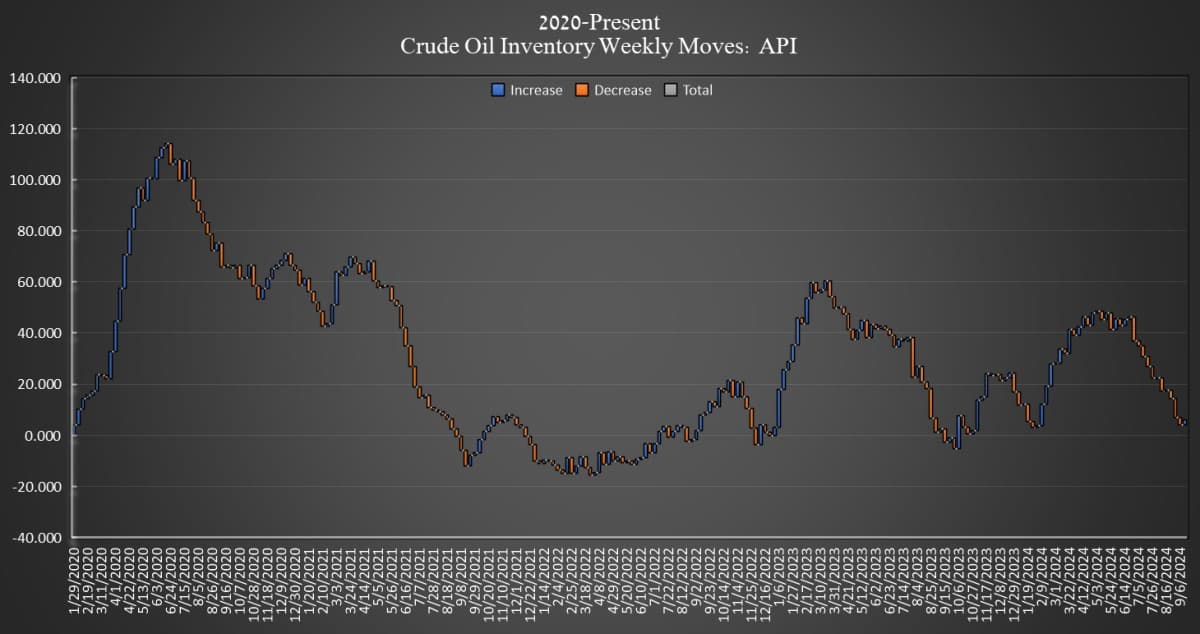
Crude oil inventories in the United States rose by 1.96 million barrels for the week ending September 13, according to The American Petroleum Institute (API). Analysts had expected a 100,000-barrel drop. For the week prior, the API reported a 2.79-million-barrel decrease in crude inventories.
So far this year, crude oil inventories are 10.9 million barrels under where they were at the start of the year, according to API data.
On Tuesday, the Department of Energy (DoE) reported that crude oil inventories in the Strategic Petroleum Reserve (SPR) rose by 0.6 million barrels as of Sept 13. Inventories are now at 380.6 million barrels. The SPR is now up nearly 34 million from its multi-decade low last summer, although still down 254 million from when President Biden took office. Oil prices rose on Wednesday ahead of the API data release. At 2:31 pm ET, Brent crude was trading up +$0.87 (1.20%) on the day at $73.62—up nearly $4 from this time last week. The U.S. benchmark WTI was also trading up on the day by $1.07 (+1.53%) at $71.16—up nearly $5 per barrel from last Tuesday as the market waits nervously for a decision from the Fed on interest rates. Gasoline inventories rose this week, by 2.34 million barrels, more than offsetting last week’s 513,000-barrel decrease. As of last week, gasoline inventories are 1% below the five-year average for this time of year, according to the latest EIA data. Distillate inventories rose by 2.3 million barrels, adding onto last week’s smaller 191,000-barrel increase. Distillates were already about 8% below the five-year average for the week ending September 6, the latest EIA data shows. NN: I want to see todays EIA data
Pagers that exploded made by BAC Consulting in Budapest
TAIPEI, Taiwan (AP) — Taiwanese company Gold Apollo said Wednesday that it authorized its brand on the pagers that exploded in Lebanon and Syria but that another company based in Budapest manufactured them. Pagers used by the militant group Hezbollah exploded near-simultaneously Tuesday in Lebanon and Syria, killing at least nine people, including an 8-year-old girl, and wounding nearly 3,000. Hezbollah and the Lebanese government blamed Israel for what appeared to be a sophisticated remote attack.
The AR-924 pagers were manufactured by BAC Consulting KFT, based in Hungary’s capital, according to a statement released Wednesday by Gold Apollo.
“According to the cooperation agreement, we authorize BAC to use our brand trademark for product sales in designated regions, but the design and manufacturing of the products are solely the responsibility of BAC,” the statement read. Gold Apollo chair Hsu Ching-kuang told journalists Wednesday that his company has had a licensing agreement with BAC for the past three years, but did not provide evidence of the contract. At about 3:30 p.m. Tuesday, as people shopped for groceries, sat in cafes or drove cars and motorcycles, the pagers in their hands or pockets started heating up and then exploding — leaving blood-splattered scenes and panicking bystanders. It appeared that many of those hit were members of Hezbollah, but it was not immediately clear if non-Hezbollah members also carried any of the exploding pagers. The blasts were mainly in areas where the group has a strong presence, particularly a southern Beirut suburb and in the Beqaa region of eastern Lebanon, as well as in Damascus, according to Lebanese security officials and a Hezbollah official. The Hezbollah official spoke on condition of anonymity because he was not authorized to talk to the media. Hezbollah, which has pointed the blame at Israel, said in a statement Wednesday morning that it would continue its normal strikes against Israel “as in all the past days” as part of what it describes as a support front for its ally, Hamas, and Palestinians in Gaza. “This path is continuous and separate from the difficult reckoning that the criminal enemy must await for its massacre on Tuesday that it committed against our people, our families and our fighters in Lebanon,” it said. “This is another reckoning that will come, God willing.” At hospitals in Beirut on Wednesday, the chaos of the night before had largely subsided, but relatives of the wounded continued to wait. Lebanon’s Health Minister Firas Abiad told journalists during a tour on hospitals Wednesday morning that many of the wounded suffered “severe injuries to the eyes” and others had limbs amputated. Journalists were not allowed to enter hospital rooms or film patients. The health minister said that the wounded had been distributed among all the area hospitals to avoid any single facility being overloaded and added that Turkey, Iraq, Iran, Syria and Egypt offered to help in treating the patients. Earlier Wednesday, an Iraqi military plane landed in Beirut carrying medical equipment, airport officials said. Abiad said the plane was carrying 15 tons of medicine and medical equipment. Experts believe explosive material was put into the pagers prior to their delivery and use in a sophisticated supply chain infiltration. The AR-924 pager, advertised as being “rugged,” contains a rechargeable lithium battery, according to specifications once advertised on Gold Apollo’s website before it was apparently taken down Tuesday after the sabotage attack. It could receive texts of up to 100 characters. It also claimed to have up to 85 days of battery life. That would be crucial in Lebanon, where electricity outages have been common after years of economic collapse. Pagers also run on a different wireless network than mobile phones, making them more resilient in emergencies — one of the reasons why many hospitals worldwide still rely on them. Hezbollah, the militants also looked at the pagers as a means to sidestep what’s believed to be intensive Israeli electronic surveillance on mobile phone networks in Lebanon.
2,750 wounded when Hezbollah members’ pagers explode across Lebanon
More than 2800 injured in Lebanon exploding pager blasts……… Hezbollah blames Israel for pager blasts, vows retaliation
Lebanon’s acting Health Minister Firas Abiad said in a press conference on Tuesday that more than 2800 persons were wounded and 8 killed in a series of pager blasts across Lebanon. According to Abiad, a child was among those killed, confirming a previous statement by Hezbollah in which the militant organization called on the Lebanese to resist Israeli attempts at psychological warfare, adding it is investigating the causes of the explosions. The ministry stated the highest number of injuries were in the hand, adding hospitals continue to receive the wounded.
Hezbollah blames Israel for pager blasts, vows retaliation
Hezbollah issued a statement on Tuesday blaming Israel for pager blasts across Lebanon which resulted in 8 deaths and more than 2800 injuries, vowing retaliation for what it referred to as a “sinful aggression.” “Our martyrs and wounded are the title of our jihad and sacrifices on the road to Jerusalem, a victory for our honorable people in the Gaza Strip and the West Bank, and continuous field support, and our position of support and support for the valiant Palestinian resistance,” the militant organization stated. Lebanon’s Ministry of Foreign Affairs and Emigrants condemned Israel for a “cyber attack that led to the explosion of a large number of Pagers communication devices in several Lebanese regions,” accusing Tel Aviv of “dangerous and deliberate escalation.”
Netanyahu could fire armed forces chief of staff
Israeli Prime Minister Benjamin Netanyahu could replace Israel Defense Forces (IDF) Chief of Staff Herzi Halevi (pictured), Israeli media reported on Tuesday. According to sources, Netanyahu agreed to appoint a different military leader in discussions with the potential new Defense Minister Gideon Sa’ar. Netanyahu is rumored to be planning to sack current Defense Minister Yoav Gallant and replace him with Sa’ar, although the timing of the decision is unknown. It is also unclear whether Netanyahu and Sa’ar would dismiss Halevi or let him resign.