The Yemeni Houthis reportedly hit two tankers in the Red Sea on Monday, one of them Saudi-flagged. According to a Reuters report citing U.S. military sources, which said one of the targets hit on Monday was a Panama-flagged vessel named Blue Lagoon I and the other was Saudi-flagged Amjad. The Houthis took responsibility for the Blue Lagoon I hit, Reuters reported, but made no mention of the Saudi-flagged vessel. According to an AP report, Blue Lagoon I had been traveling to an undisclosed location from the Russian port of Ust Luga, broadcasting that it carried Russian crude on board. The Houthis had previously said they would not target Russian or Middle Eastern ships. There was no major damage to either of the tankers, which were close to each other when they were hit. Both were able to continue on their way after the strikes. The Saudi-flagged vessel has a capacity for up to 2 million barrels of crude while Blue Lagoon I can carry up to 1 million barrels. The AP cited the Joint Maritime Information Center, a unit set up to track the Houthis’ activity in the Red Sea and led by the U.S. Army, as saying that the Blue Lagoon I tanker “was targeted due to other vessels within its company structure making recent port calls in Israel.” “These reckless acts of terrorism by the Houthis continue to destabilize regional and global commerce, as well as put the lives of civilian mariners and maritime ecosystems at risk,” the U.S. Central Command said, as quoted by the AP. The Houthis have been targeting vessels passing through the Bab el Mandeb strait since last November in reaction to Israeli bombings of Gaza. Initially, the group said it would only target Israeli ships and those sailing under flags of Israeli allies but it has since expanded its campaign. An attempt by the U.S. and some European allies to put an end to the attacks has so far failed to produce any results. NN: The only way to end terrorists attacks is to end the terrorists, Ask Ben Laden.
US may withdraw from Gaza ceasefire talks….. Must See Video Hamas To Kill Remaining Hostages
The United States may withdraw from Gaza ceasefire negotiations if an agreement is not reached within the next two weeks, a high-ranking official within the Turkish Foreign Ministry informed RIA Novosti on Tuesday, speaking on condition of anonymity. According to the source, Washington seems to be making a sincere effort to secure a ceasefire agreement given the upcoming presidential elections and the security situation in the region but is not applying pressure on Israel. “This is an extremely dangerous decision because we will return to the starting point,” the unnamed insider emphasized. Israeli Prime Minister Benjamin Netanyahu previously reiterated his commitment to securing the hostage agreement. However, he blamed the Palestinian militant group Hamas for the lack of progress in the negotiations. NN video above is a must see.
Oil extends losses, down 4%
Crude oil dropped further on Tuesday, with both Brent and West Texas Intermediate (WTI) futures plunging over 4%. Concerns over demand in the Eurozone and China are likely to be compounded with the release of manufacturing activity data for the United States. The S&P Global and Institute for Supply Management reports found that the sector remained in contraction territory in August, dragging on the US economy as a whole. WTI for deliveries in October dropped $3.47 to sell at $70.57 per barrel at 10:30 am ET. Brent for November settlements fell by $3.24 going for $74.09 a barrel.
Netanyahu promises to target Hamas after captives deaths
Israeli Prime Minister Benjamin Netanyahu vowed to target Hamas leaders responsible for the deaths of six Israeli captives. Netanyahu emphasized Israel’s determination to hold the perpetrators accountable and secure the release of any remaining hostages. The captives’ bodies were found in a Gaza tunnel on Saturday and a senior Hamas official claimed the captives were killed due to ongoing Israeli airstrikes, noting that seven captives had previously died from similar attacks earlier this year. NN: If Israel wants peace it must finish this war and not only defeat Hamas but humiliate them and like Hirohito Sinwar must surrender a jailed or blown to bit like Ben Laden.
Israeli army finds hostages bodies in Gaza…… Hamas blames Israel for death of captives in Gaza tunnel
The Israel Defense Forces (IDF) discovered several bodies in the Gaza Strip amid ongoing military operations. “At this time, the troops are still operating in the area and carrying out a process to extract and identify the bodies, which will last several hours,” the IDF stated Saturday night on Telegram. While the identities of the bodies remain uncertain, local media reported that they could belong to Israeli hostages and the military has urged the public to avoid spreading unverified rumors during this time and to rely only on official information. The news come a day after the IDF declared the end of its operations in southern Gaza. During the day, Israeli citizens took part in another massive protest near Tel Aviv, calling for the immediate release of the Israeli hostages held by Hamas.
Hamas blames Israel for death of captives in Gaza tunnel
Senior Hamas official Izzat Al-Rishq accused Israel of killing six Israeli captives in southern Gaza. He claimed that the captives, who were found dead in a tunnel, lost their lives due to Israeli military actions. The group official also criticized the United States for its support of Israel, labeling it as biased and complicit in the ongoing conflict. Al-Rishq emphasized that Hamas values the lives of its prisoners more than US President Joe Biden does, noting that Hamas had agreed to a proposal put forward by Washington, while Israeli Prime Minister Benjamin Netanyahu rejected the agreement. Among the six dead captives were a dual US-Israeli citizen as well as a Russian-Israeli citizen.
NN Audio File:
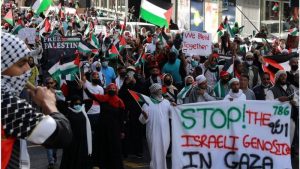
why are they not demonstrating against the Hamas terrorists
Harris Dominates New Round of Polls, Beating Or Tying Trump In Every Major Swing State
A new round of polls from Morning Consult and Bloomberg News suggests that Vice President and Democratic presidential nominee Kamala Harris is beating or tied with former President Donald Trump in every major swing state. According to the survey of 4,962 registered voters conducted between August 23 and 27, Harris leads by 2 points in Georgia and North Carolina, 3 points in Michigan, 4 points in Nevada and Pennsylvania, a whopping 8 points in Wisconsin, and tied with Trump in Arizona. In July, the same poll found that Trump boasted a lead over President Joe Biden in all of those states except for Michigan and Wisconsin.
The results come as welcome news going into Labor Day weekend and the home stretch of the campaign. Harris’s lead in Pennsylvania is particularly noteworthy given the state’s outsized importance in the Electoral College. On Thursday, elections analyst Nate Silver’s electoral forecast model shifted to favor Trump for the first time since August 3, giving the former president a 52.4% chance of reclaiming the White House. He called Pennsylvania the “one big reason” for the shift, noting that it is “the tipping-point state more than one-third of the time” in his model “and where it’s been quite a while since we’ve seen a poll showing Harris leading (including two new polls today).” “The model puts a lot of weight on this recent data because of all the changes in the race,” he wrote. “And you can see why it thinks this is a problem for her: if she’s only tied in Pennsylvania now, during what should be one of her stronger polling periods, that implies being a slight underdog in November.”
NN Audio Note:
Mssss Harris Moving on up
Trump ‘looks forward to exposing’ Harris in debate
Republican nominee for the United States presidential election, former US President Donald Trump, said on Saturday that he “looks so forward” to the upcoming debate with his Democratic opponent, Vice President Kamala Harris and to “exposing her for the fraud she is.” The debate will take place on September 10 and will be hosted by ABC. Trump claimed Harris has “changed every one of her long-held positions, on everything,” previously citing her stance on fracking. While she was in favor of banning the practice when campaigning for the Democratic nomination in 2019, now she said she would not ban it. She defended the change by saying it is “important to build consensus” and insisted that her values have not changed. NN: This will be Trumps ZEN MOMENT.
Israel: Hezbollah fired 40 rockets from Lebanon…… Israel says it struck Hezbollah rocket launchers
The Israel Defense Forces (IDF) said on Saturday that Hezbollah fired around 40 rockets from southern Lebanon. While some were intercepted, others hit northern Israel, although no casualties were reported. The IDF said it employed fighter jets to target Hezbollah’s rocket launchers. The military did not share details on the extent of damage dealt to Hezbollah’s equipment.
Israel says it struck Hezbollah rocket launchers
Israel Defense Forces (IDF) announced on Friday it successfully struck several Hezbollah rocket launchers in southern Lebanon. The military said fighter jets from the Northern Command were used in the attack and the launchers were ready to fire missiles, presumably at targets in northern Israel. The IDF said Hezbollah’s rocket launchers were destroyed in the area of Marimin and Yaron, in the southern regions of Lebanon. Artillery was also used against Hezbollah during the day, Israel’s military said in a post published on X.
US kills 15 IS operatives in Iraq raid…… At least 7 US personnel injured in Iraq IS raid
The United States Central Command (CENTCOM) said it carried out a raid in western Iraq with the Iraqi Security Forces on August 29, killing 15 operatives of the Islamic State (IS). According to the US, the fighters were armed with numerous weapons, grenades, and explosive “suicide” belts. CENTCOM said the operation was carried out with the goal of disrupting the militant group’s ability to “plan, organize, and conduct attacks against Iraqi civilians, as well as US citizens, allies, and partners throughout the region and beyond.” It added that the raid resulted in no known civilian casualties and that the Iraqi Security Forces continue to further exploit the locations raided.
At least 7 US personnel injured in Iraq IS raid
At least seven United States personnel were injured in a raid in western Iraq, officials told US media. 15 Islamic State (IS) operatives were killed in the operation, US Central Command said. The military officials said five personnel were wounded, with one being evacuated for further treatment, according to ABC News. Two others were “injured from falls,” one of whom was evacuated. None of the injuries are life-threatening, according to reports.
OPEC+ expected to hike oil output from October
Organization of the Petroleum Exporting Countries (OPEC) and non-OPEC oil-producing nations are mulling to proceed with planned gradual oil production increase from October, Reuters reported on Friday, citing six delegates. Namely, in October, eight members of OPEC+ are scheduled to increase their output by 180,000 barrels per day as part of a strategy to gradually reverse the recent cuts of 2.2 million bpd. However, they will still maintain other reductions until the end of 2025. According to the insiders, the intention to raise production remains unchanged because of the tightening market caused by decreased Libyan output and growing optimism that the US Federal Reserve will implement interest rate cuts in September. NN: Not going to happen.
Israel kills a top militant in its deadliest West Bank raids since the Gaza war began
TULKAREM, West Bank (AP) — The Israeli military said it killed five more West Bank militants, including a local commander, as it pressed ahead Thursday with its deadliest operation in the occupied territory since the start of the war in Gaza. Israel says the raids across the northern West Bank — which have killed a total of 16 people, nearly all militants, since late Tuesday — are aimed at preventing attacks. The Palestinians see them as a widening of the war in Gaza and an effort to perpetuate Israel’s decades-long military rule over the territory.
The raids drew alarm from the United Nations and neighboring Jordan, as well as from British and French leaders, who stressed the urgency of cease-fire in Gaza after nearly 11 months of fighting between Israel and Hamas. Medics at al-Awda Hospital in central Gaza said Thursday nine Palestinians from the same family — including two women and five young children — were killed in an Israeli strike on an apartment building in the Nuseirat refugee camp. Israel did not immediately offer comment on the intended target of its attack. Beginning Sunday, Israel will pause some military operations in Gaza to allow health workers to begin administering polio vaccines to some 650,000 Palestinian children, the U.N. World Health Organization said Thursday. A case was discovered earlier this month for the first time in 25 years. In the West Bank, the Islamic Jihad militant group confirmed that Mohammed Jaber, known as Abu Shujaa, was killed during a raid in the city of Tulkarem. He became a hero for many Palestinians earlier in the year when he was reported killed in an Israeli operation, only to make a surprise appearance at the funeral of other militants, where he was hoisted onto the shoulders of a cheering crowd. Israel said he was killed Thursday along with four other militants in a shootout after the five had hidden inside a mosque. It said Abu Shujaa was linked to numerous attacks on Israelis, including a deadly shooting in June, and was planning more. The army also said it uncovered caches of weapons, explosive devices and other military equipment inside a mosque in Fara’a and arrested another militant in Tulkarem, where a member of Israel’s paramilitary Border Police was lightly wounded. Israel’s latest operation in the West Bank began late Tuesday in several locations, and Hamas confirmed 10 of its fighters were killed. The Palestinian Health Ministry reported an 11th death on Wednesday, without saying whether he was a fighter or a civilian. The overall toll of 16 killed in less than two days makes it the deadliest Israeli operation in the West Bank since Hamas’ Oct. 7 attack into Israel that ignited the war. The raids have focused on refugee camps that date back to the 1948 war surrounding Israel’s creation, in which around 700,000 Palestinians fled or were driven out of what is now Israel. Many of the camps are militant strongholds. Hamas repeated its calls for Palestinians in the West Bank to rise up, calling the raids part of a larger plan to expand the war in Gaza. The militant group has urged security forces loyal to the Western-backed Palestinian Authority, which cooperate with Israel, to “join the sacred battle of our people.”