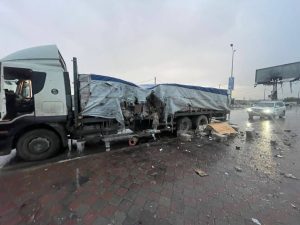
The Israeli Defense Forces (IDF) said that it carried out a strike on armed men who hijacked an aid convoy in the southern part of the Gaza Strip on Thursday, the Times of Israel reported. A convoy from the American Near East Refugee Aid (Anera), with IDF coordination, entered southern Rafah before “armed men took over a vehicle at the front of the convoy (a jeep) and began to lead it.”. Shortly after, the IDF established that it could attack the car containing the armed men without damaging the rest of the convoy and carried out the strike. “There was no damage to the other vehicles in the convoy and it reached its destination according to the plan. The attack on the armed men removed the threat of them taking over the humanitarian convoy,” the IDF said, adding that Anera confirmed that all of its members were left unharmed.
NN: The sold out press published pictures of the IDF shot up aide truck. They forgot to mention it was hijacked by Hamas blood thirty savages so they could sell the cargo
LONDON (AP) — The baby in Gaza who was recently paralyzed by polio was infected with a mutated strain of the virus that vaccinated people shed in their waste, according to scientists who say the case is the result of “an unqualified failure” of public health policy. The infection, which marked the first detection of polio in the war-torn Palestinian territory in more than 25 years, paralyzed the lower part of one leg in the unvaccinated 10-month-old child. The baby boy was one of hundreds of thousands of children who missed vaccinations because of the fighting between Israel and Hamas.
Scientists who have been monitoring polio outbreaks said the baby’s illness showed the failures of a global effort by the World Health Organization and its partners to fix serious problems in their otherwise largely successful eradication campaign, which has nearly wiped out the highly infectious disease. Separately, a draft report by experts deemed the WHO effort a failure and “a severe setback.”
The polio strain in question evolved from a weakened virus that was originally part of an oral vaccine credited with preventing millions of children worldwide from being paralyzed. But that virus was removed from the vaccine in 2016 in hopes of preventing vaccine-derived outbreaks.
Public health authorities knew that decision would leave people unprotected against that particular strain, but they thought they had a plan to ward off and quickly contain any outbreaks. Instead, the move resulted in a surge of thousands of cases.
“It was a really horrible strategy,” said Columbia University virologist Vincent Racaniello, who was not involved with the report or the WHO. “The decision to switch vaccines was based on an incorrect assumption, and the result is now we have more polio and more paralyzed children.”
A draft copy of the report commissioned by the WHO and independent experts said the plan underestimated the amount of the strain in the environment and overestimated how well officials would be able to squash outbreaks.
The plan led to vaccine-linked polio outbreaks in 43 countries that paralyzed more than 3,300 children, the report concluded.
Even before the Gaza case was detected, officials reviewing the initiative to tinker with the vaccine concluded that “the worst-case scenario has materialized,” the report said. The report has not yet been published, and some changes will likely be made before the final version is released next month, the WHO said. The strain that infected the baby in Gaza had lingered in the environment and mutated into a version capable of starting outbreaks. It was traced to polio viruses spreading last year in Egypt, according to genetic sequencing, the WHO said.
In 2022, vaccine-linked polio viruses were found to be spreading in Britain, Israel and the U.S., where an unvaccinated man was paralyzed in upstate New York.
Scientists now worry that the emergence of polio in a war zone with an under-immunized population could fuel further spread. Racaniello said the failure to track polio carefully and to sufficiently protect children against the strain removed from the vaccine has had devastating consequences. “Only about 1% of polio cases are symptomatic, so 99% of infections are silently spreading the disease,” he said.
The oral polio vaccine, which contains a weakened live virus, was withdrawn in the U.S. in 2000. Doctors continued to vaccinate children and eventually moved to an injected vaccine, which uses a dead virus and does not come with the risk that polio will be present in human waste. Such waste-borne virus could mutate into a form that triggers outbreaks in unvaccinated people.
The report’s authors faulted leaders at the WHO and its partners, saying they were unable or unwilling “to recognize the seriousness of the evolving problem and take corrective action.”
WHO spokesman Oliver Rosenbauer acknowledged that the vaccine strategy “exacerbated” the risk of epidemics linked to the vaccine. He said in an email that immunization “was not implemented in such a way to rapidly stop outbreaks or to prevent new strains from emerging.” Rosenbauer said not hitting vaccination targets was the biggest risk for allowing vaccine-linked viruses to emerge. “You need to reach the children with the vaccines … regardless of which vaccines are used,” he said.
The WHO estimates that 95% of the population needs to be immunized against polio to stop outbreaks. The U.N. health agency said about 90% of Gaza’s population was vaccinated earlier this year.
To try to stop polio in Gaza and the wider region, the WHO and its partners plan two rounds of vaccination campaigns later this week and next month, aiming to cover 640,000 children. Authorities will use a newer version of the oral polio vaccine that targets the problematic strain. The weakened live virus in the new vaccine is less likely to cause vaccine-derived outbreaks, but they are still possible. The WHO said Thursday that it had reached an agreement with Israel for limited pauses in fighting in Gaza to allow for the vaccinations. The agency’s representative in the Palestinian territories said the first three-day pause would start Sunday in central Gaza. That will be followed by another three-day pause in southern Gaza and then another in northern Gaza. The pauses were to last eight or nine hours each day.
Racaniello said it was “unethical” that the WHO and its partners were using a vaccine that is unlicensed in rich countries precisely because it can increase the risk of polio in unvaccinated children.
The oral polio vaccine, which has reduced infections globally by more than 99%, is easy to make and distribute. Children require just two drops per dose that can be administered by volunteers. The oral vaccine is better at stopping transmission than the injected version, and it is cheaper and easier to administer. But as the number of polio cases caused by the wild virus have plummeted in recent years, health officials have been struggling to contain the increasing spread of vaccine-linked cases, which now comprise the majority of polio infections in more than a dozen countries, in addition to Afghanistan and Pakistan, where transmission of the wild virus has never been stopped. “This is the result of the Faustian bargain we made when we decided to use” the oral polio vaccine, said Dr. Paul Offit, director of the Vaccine Education Center at the University of Philadelphia. “If we really want to eradicate polio, then we need to stop using the vaccine with live (weakened) virus.”
NN Audio File
don’t blame israel
Picture of “Israeli” polio victim. No mass media pictures of the 3000 Egyptian polio victums.
Oil prices jumped on robust US economic data and worsening supply disruptions in Libya.Brent rose 1.6% to settle just below $80 a barrel after losing more than 3% over the previous two sessions. West Texas Intermediate ended the session near $76 a barrel, close to its 200-day moving average, which has recently acted as a ceiling. The US economy grew at a slightly stronger pace in the second quarter, lifting equities. Prices surged further as Libya suspended oil exports from five eastern ports while the country’s output dipped further amid an escalating stalemate over who controls the central bank. Oil output has more than halved this week to less than 450,000 barrels a day since the disruption began.
“A continued outage from Libya will all but erase the expected fourth-quarter stock build and generate a draw, which will put stocks at perilously low levels,” said Scott Shelton, an energy specialist at TP ICAP Group Plc.
Another driver for the rally in oil prices is the continued risk that Israel’s conflict with Hezbollah or Iran will escalate, said Robert Yawger, director of the energy futures division at Mizuho Securities USA. Over the weekend, 100 Israeli warplanes swooped over southern Lebanon, taking out thousands of Hezbollah missile launchers in what was called a preemptive strike. Although tensions deescalated on Monday, the risk of a region-wide war is still present. Global benchmark Brent is still on track for a small decline this month, even after repeated drops in US stockpiles that are tightening global supplies. Worries about growth in China are also persistent as it is likely to miss its GDP growth target this year, according to a Bloomberg survey, undermining demand in Asia’s biggest economy. Goldman Sachs Group Inc. and Morgan Stanley have cut their 2025 oil price forecasts in recent days, with both expecting a surplus next year as China’s recovery loses steam.
Still, crude is modestly higher for the year as expectations of lower interest rates in the US and OPEC+ supply discipline counter lackluster Chinese demand. The possibility of the cartel boosting output from October is hanging over the market, however. Traders are split on whether the planned increases will go ahead, according to a Bloomberg survey.
“The flagging economic data out of China remains a headwind, and if the Middle East situation can resolve or signal that it will resolve, I expect prices to resume their downward trajectory,” said John Kilduff, co-founder of Again Capital LLC.
Israeli Foreign Minister Israel Katz on Thursday accused Iran of smuggling weapons into the West Bank via Jordan in order to establish “an eastern terror front against Israel.” In a post on X, Katz said that Iran is trying to “turn the Israel-Jordan border from a peaceful one into a volatile front.” He further noted that weapons from Jordan are being transferred to Palestinian refugee camps in the West Bank “where an Iranian-Hamas terror infrastructure is being established,” adding that the Palestinian Authority is unable to cope with “this threat.” Katz pointed out that Israel has to “act decisively” in order to “prevent an influx of advanced Iranian weapons” into the West Bank and urged Western countries to help Jordan to defend its borders.
VIENNA (AP) — Iran has further increased its stockpile of uranium enriched to near weapons-grade levels in defiance of international demands, a confidential report by the United Nations’ nuclear watchdog said Thursday. The report by the International Atomic Energy Agency, seen by The Associated Press, said that as of Aug. 17, Iran has 164.7 kilograms (363.1 pounds) of uranium enriched up to 60 %. That’s an increase of 22.6 kilograms (49.8 pounds) since the IAEA’s last report in May.
Uranium enriched up to 60% purity is just a short, technical step away from weapons-grade levels of 90%. By IAEA’s definition, around 42 kilograms (92.5 pounds) of uranium enriched to 60% is the amount at which creating one atomic weapon is theoretically possible — if the material is enriched further, to 90%.
The IAEA chief, Rafael Mariano Grossi, has previously warned that Tehran has enough uranium enriched to near-weapons-grade levels to make “several” nuclear bombs if it chose to do so. He has acknowledged the U.N. agency cannot guarantee that none of Iran’s centrifuges may have been peeled away for clandestine enrichment. Thursday’s report is the latest low in spiraling relations between Tehran and the IAEA. It follows a June 6 resolutionby the 35-member IAEA Board of Governors that censured Iran for failing to cooperate fully with the Vienna-based agency. Iran’s mission at the United Nations in New York did not immediately respond to a request from the AP for comment. There were also no immediate comments from Tehran on the IAEA report. Iran’s 2015 landmark nuclear deal with world powers had put limits on its nuclear program — which the West fears could be used for making nuclear weapons and Tehran insists is only for peaceful purposes — while lifting punitive economic sanctions imposed on Iran.But the deal collapsed after the Trump administration in 2018 pulled the United States out of the agreement, leading Iran to abandon all limits the deal had put on its program, and enrich uranium to up to 60% purity. Meanwhile, surveillance cameras installed by the IAEA have also been disrupted and Iran has barred some of the Vienna-based agency’s most experienced inspectors. Iranian officials also have increasingly threatened that they could pursue atomic weapons. The IAEA report further says that Tehran has also not reconsidered its September decision to ban the agency’s inspectors from monitoring its nuclear program and that IAEA surveillance cameras remain disrupted. The IAEA said it had requested in an Aug. 8 letter that Iran provide access to a centrifuge manufacturing site in the city of Isfahan, to enable the agency to service its cameras, but received no reply. Additionally, the report says Iran has still not provided answers to the nuclear watchdog’s years-long investigation about the origin and current location of man-made uranium particles found at two locations that Tehran has failed to declare as potential nuclear sites, known as Varamin and Turquzabad.
The IAEA report comes just days after Iran’s supreme leader opened the door to renewed negotiations with the United States over his country’s rapidly advancing nuclear program, declaring there was “no harm” in engaging with the “enemy.”
Aug. 29 (UPI) — Ukraine said Thursday that it had used domestically manufactured drones to expand strikes against strategic Russian oil facilities overnight and target field artillery infrastructure just across the border inside Russia. The General Staff of the Ukrainian Armed Forces said that following an attack on an oil depot in Rostov province Wednesday morning, Ukrainian forces had hit an oil storage facility in the Kirov region, northeast of Moscow and more than 900 miles inside Russia and an artillery ammunition dump in the Rossosh district of Voronezh region, about 35 miles from the border with Ukraine. Confirming the attacks in a social media post, the General Staff said the strike on the Atlas oil depot in Rostov caused explosions and set storage tanks ablaze, but the full extent of the damage inflicted there and in Kirov and Voronezh was “currently being clarified.” It said the missions were carried out by special operations forces and the Intelligence Directorate of the Defense Ministry, in cooperation with other branches of the military. Both the Rostov plant in Molodezhnyi, just east of occupied Luhansk province, which belongs to Russia’s Federal Agency for State Reserves, and the Kirov facility were targeted for their roles in keeping Russia’s armed forces supplied. Russian media reported fresh, powerful explosions at the Rostov plant late Wednesday where firefighters were still fighting fires from the earlier attack. Kirov. Gov. Alexander Sokolov confirmed a blaze near the Zenit oil products depot in Kotelnich that he said was started when three of five drones targeting the facility fell nearby after being downed by Russian air defenses. The Kyiv Independent reported a source as saying the Zenit oil depot was a “facility of the enemy military-industrial complex and provides fuel to the Russian occupation forces.” The General Staff pledged more attacks as part of continuing measures to “undermine the military and economic potential of the Russian occupiers and stop Russia’s armed aggression against Ukraine.” Ukraine has mounted at least 64 drone strikes against Russian refineries, storage and other oil infrastructure either in Russia or Ukrainian territory occupied by Russia, the BBC’s Russian service reported Wednesday.
The prices of oil futures extended their gains on Thursday following a report that Iraq suspended the spot cargo of a million barrels in August to lower the volume of its exports. Earlier, the Houthi movement targeted the Greek tanker Sounion in the Red Sea and Lybia temporarily halted its production and exports due to the ongoing political conflict. West Texas Intermediate for October’s settlements jumped by 3.07% at 10:16 am ET to sell for $76.77 per barrel. Simultaneously, Brent for the same month’s deliveries soared by 2.61% to go for $80.65 per barrel.
Tulkarem, West Bank (AP) — The Israeli military said it killed five more militants, including a local commander, early Thursday in the West Bank as it pressed ahead with what appeared to be the deadliest military operation in the occupied territory since the start of the war in Gaza. Israel says the simultaneous raids across the northern West Bank — which have killed a total of 16 people, nearly all militants, since late Tuesday — are aimed at preventing attacks. The Palestinians see them as a widening of the Israel-Hamas war aimed at perpetuating Israel’s decades-long military rule over the territory. The Islamic Jihad militant group confirmed that Mohammed Jaber, known as Abu Shujaa, was killed during a raid in the city of Tulkarem. He became a hero for many Palestinians earlier in the year when he was reported killed in an Israeli operation, only to make a surprise appearance at the funeral of other militants, where he was hoisted onto the shoulders of a cheering crowd. The military said he was killed early Thursday along with four other militants in a shootout with Israeli forces after the five had hidden inside a mosque. It said Abu Shujaa was linked to numerous attacks on Israelis, including a deadly shooting in June, and was planning more. Israel launched a large-scale operation in the West Bank overnight into Wednesday. Hamas said 10 of its fighters were killed in different locations, and the Palestinian Health Ministry reported an 11th death, without saying whether he was a fighter or a civilian. The overall toll of 16 killed in less than two days would make it the deadliest Israeli operation in the West Bank since Hamas’ Oct. 7 attack out of Gaza ignited the war there. The raids have focused on refugee camps that date back to the 1948 war surrounding Israel’s creation, in which around 700,000 Palestinians fled or were driven out of what is now Israel. Many of the camps are militant strongholds.
Hamas repeated its calls for Palestinians in the West Bank to rise up, calling the raids part of a larger plan to expand the war in Gaza. The militant group has called on security forces loyal to the Western-backed Palestinian Authority, which cooperate with Israel, to “join the sacred battle of our people.” Palestinian Authority President Mahmoud Abbas has also condemned the Israeli raids, but his forces were not expected to get involved. NN This is adding more fuel to the fire.
Exxon predicts a future oil shortage if investment in new production doesn’t increase, despite forecasts of declining demand due to electric vehicles.
The company argues a rapid decline in production, especially from unconventional sources like shale, could lead to severe energy shortages and price hikes.
Exxon’s warnings contrast with forecasts from the IEA and others who see lower oil demand in the future but raise questions about the long-term security of energy supplies. Traders and analysts have been overwhelmingly bearish on oil in the past few months. With a few exceptions, everyone seems to expect dwindling demand and falling prices. Yet it might turn out that the opposite will happen. OPEC has been warning about this for years. Various officials from the cartel have been sounding the alarm that insufficient investment in new oil supply would eventually turn into a future supply squeeze that will push prices significantly higher. Exxon is now joining OPEC in those warnings. In the new edition of its Global Outlook, the U.S. supermajor predicted that both oil and gas will continue to be vital elements of the world’s energy mix in 2050, with demand for oil remaining at above 100 million bpd after growth peaks and gas demand also remaining strong—because electricity use in Exxon’s forecast will be 80% higher in 2050 than it is now. Perhaps the most disheartening prediction made by Exxon concerns EVs and their effect on oil demand. Here’s what Exxon said about electric vehicles:
“If every new car sold in the world in 2035 were electric, oil demand in 2050 would still be 85 million barrels per day. That’s the same as it was in 2010.”
This stands in stark contrast with virtually every other forecast about electric vehicles and their impact on oil demand, which those other forecasters see as devastating—even though the major growth in EV sales so far, even in China, has not really arrested oil demand growth. A shortage of oil and gas would be very welcome to Exxon and OPEC alike. Shortages tend to drive prices higher, and higher prices invariably mean greater profits, as we saw in 2022. The other thing shortages lead to, however, is political and social instability, and that would not be welcome to large businesses such as Exxon—hence the warning, and it is a grim one. According to the supermajor, global oil production is facing a natural decline at a rate of some 15% annually over the next 25 years. For context, the IEA sees the rate of natural decline at 8% annually. Exxon points out, however, that the faster decline rate is a result of the shift towards shale and other unconventional oil production, where depletion happens faster than it does in conventional formations. “To put it in concrete terms: With no new investment, global oil supplies would fall by more than 15 million barrels per day in the first year alone.” This is a scary prospect because “At that rate, by 2030, oil supplies would fall from 100 million barrels per day to less than 30 million – that’s 70 million barrels short of what’s needed to meet demand every day.” In other words, if investment in new oil and gas production dries up, the world will soon face not just a supply squeeze but the mother of all supply squeezes. Per Exxon’s report, the effects of that squeeze will feature severe energy shortages and disruption to daily lives, with oil prices potentially rising by as much as 400%–twice as much as they jumped during the Arab oil embargo in the 1970s. This would, in turn, lead to higher unemployment, where rates could reach 30%, Exxon also said.
Ukraine’s permanent mission to the international organizations in Vienna said in a letter sent to the International Atomic Energy Agency (IAEA) published on Thursday that the threat Russia could attack the former country’s nuclear facilities remains. “The Russian Federation continues to deliberately target Ukraine’s energy infrastructure, intending to disrupt the operation of the country’s nuclear power plants, which provide most of Ukraine’s electricity,” the mission’s letter read. It added that on August 26, Russia attacked its energy infrastructure, which resulted in several nuclear power plants or their parts being disconnected from the grid. Ukraine urged the agency to forward the notice to the IAEA’s members and help de-escalate the situation.
Ukraine launches drone strikes on Russian oil facilities
Aug. 28 (UPI) — Ukrainian officials said they struck a Russian oil depot with drones about 10 miles outside of its border in the Rostov Oblast on Wednesday morning. Oil tanks were set a blaze at the FDKU Atlas oil facility, located near the town of Kamensk-Shakhtinsky, east of the border with Russian-controlled parts of the Luhansk Oblast, a Ukrainian military intelligence source told the Kyiv Independent. Three oil tankers were on fire as of 4 a.m. local time, an hour after two drones “fell” on the oil facility, the Russian Telegram channel Baza reported.