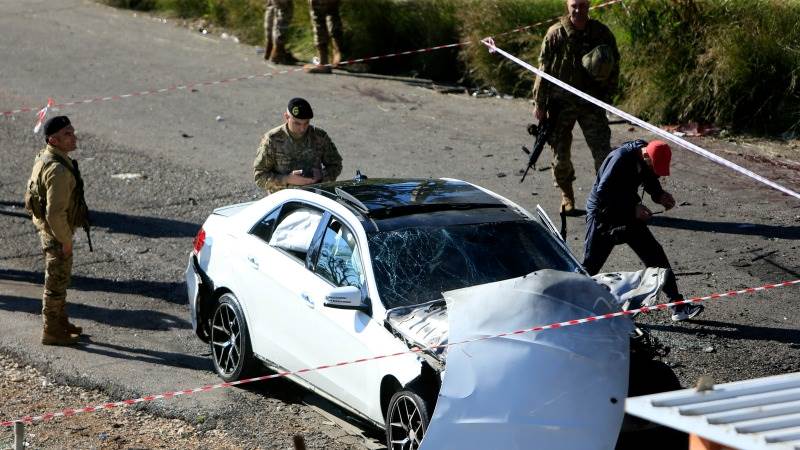
Israel says Al-Hudaydah port still burning

Doron Kadosh, a correspondent for Israeli Army Radio, shared on Sunday in a social media post that the Al-Hudaydah port in Yemen, which Israel struck earlier as a response to Houthis’ attacks on Tel Aviv, was still burning with the fire expected to “continue in the coming days as well.”

Meanwhile, mentioning the results of an initial investigation, Kadosh detailed that Houthis flew their drone through “civilian flight paths” in order to remain hidden, which might have led Israel to believe that the object was “non-hostile.” Israel hit two locations in the port, more specifically its energy infrastructure and goods unloading capabilities, according to the radio.

A senior security official told the radio that although Israel is aware the recent targeting of Yemen could further prolong the conflict in the area, it had to strike in order to deter others from potentially attacking its soil. The official went on to say that the country might have to hit Yemen “several more times soon.”

NN: Red line crossed in the Middle East. See BlackMask Market News and Commentary  Titled: Crashing Into The Gates of Hell

Oil Posts Second Weekly Loss Amid Listless Trade

The air is being sucked out of the oil market, with prices collapsing on Friday in the face of dwindling volume and volatility — the lifeblood of crude traders.  West Texas Intermediate fell to near $80 a barrel, posting the biggest one-day loss since early June. Futures capped a second straight weekly decline. Volatility has remained near multi-year lows, while volumes were lower than the 10-day average, according to data compiled by Bloomberg. Bearish sentiment across the broader commodity markets also weighed on oil.

Still, WTI’s prompt spread — the price difference between its two nearest contracts — is in backwardation. The bullish pattern signals demand is outweighing supply in the short term.

Crude is still higher this year, aided by OPEC+ supply restraint, a recent decline in US stockpiles, and expectations for lower interest rates from the Federal Reserve. In the near term, traders are also tracking wildfires in Canada that have threatened some supply and supported prompt pricing, though headline futures prices have struggled for direction of late.

  • WTI for August delivery fell 3.2% to settle at $80.13 a barrel in New York.
  • Brent for September settlement fell 2.9% at $82.63 a barrel.

NN: Trade reco stands. Buy the dips. Red line crossed in the Middle East. See BlackMask Market News and Commentary  Titled: Crashing Into The Gates of Hell

Blinken: We’re inside 10-yard line in hostage negotiations

United States Secretary of State Antony Blinken remarked on Friday that the relevant parties are “inside the 10-yard line and driving toward the goal line on getting an agreement that would produce a ceasefire, get the hostages home and put us on a better track to trying to build lasting peace and stability.” Speaking at the Aspen Security Forum, Blinken reminded the audience that both Israel and Hamas greenlighted a framework for a deal presented by Washington., and are currently working out the remaining problems. Even though the deal seems to be within reach, Blinken cautioned that “the last 10 yards are often the hardest.”

Possibilty of a Second Shooter…….. 3D Analysis

Catalin Grigoras and Cole Whitecotton said

An audio forensic analysis conducted by experts from the National Center for Media Forensics at the University of Colorado in Denver suggests the possibility of a second shooter in the incident that took place in Butler. Catalin Grigoras and Cole Whitecotton said, “The first three shots were consistent with alleged weapon A, the next five were consistent with alleged weapon B, and the final ‘acoustic impulse’ was emitted by a possible weapon C.” While one of the shooters has been identified and another was a Secret Service sniper, the identity of the third potential shooter remains unknown. As per a substack by Stephen Bryen, former deputy undersecretary of defense, despite the FBI’s assertion that the identified shooter acted alone, this controversial audio forensic analysis raises questions that warrant further investigation and peer review. Beyond the audio forensics, other aspects of the incident require attention.

The initial burst of gunfire originated from the identified shooter’s location. A second burst was detected from an unclear location, distinct from the first. Additionally, there may have been a third shooter who fired a single shot. Forensic acoustic experts propose the involvement of at least two shooters, excluding the Secret Service snipers, Bryen wrote in his substack “Weapons and strategy”. Moreover, the exact number of shots fired by the Secret Service snipers on the rooftop behind Trump is unknown. Most reports indicate that it took only one shot to neutralize the shooter. The agents, equipped with sophisticated sniper weapons—one mounted on a tripod and another on a small stand for a prone shot—are believed to have fired after the shooter initiated gunfire. However, this sequence does not entirely match the acoustic evidence. The evidence suggests that the final single shot, if confirmed, may have been fired by the snipers, resulting in the shooter’s death by a single headshot, Bryen said. “The Secret Service sniper(s) did their job, but there are still questions about the timing as the threat could have been eliminated much sooner and lives perhaps could have been saved. Bullets flying around the shooter but not instantly killing him also could have been a partial deterrent,” Bryen wrote. A solid FBI investigation with Congressional oversight is necessary to ensure a thorough and unbiased investigation. The FBI possesses the forensic capabilities required to conduct a proper investigation, but strong leadership and oversight are essential to prevent a sloppy or politically biased review.

Shocking Video Shows Trump Miracle….. Trump’s Hit Man Thomas Crooks flew drone over Pa. rally site

Trump Turned his head to look at this immigration poster.

Please note: The Biden Bullseye hitman shot at Trump 3 times hitting his ear and missed twice more.

Trump’s would-be assassin Thomas Crooks flew drone over Pa. rally site hours before deadly shooting

Donald Trump’s 20-year-old would-be assassin  used a drone to aerially scope out the Pennsylvania fairgrounds ahead of the Republican presidential nominee’s speech hours as part of his sinister plot last weekend, according to a report. Shooter Thomas Matthew Crooks programmed the drone to fly over the Butler Farm Showgrounds before his assassination attempt on the former president, 78, law enforcement officials briefed on the incident said. Investigators also believe he flew the remotely piloted aircraft around the campaign rally site more than once as he mapped out the course of the attack, further adding to the Secret Service’s stunning failure to protect Trump. He had reportedly staked the farm out days before Trump arrived and is believed to have also used a bike to explore the vast grounds of the Butler County Farm Show.

Investigators later found a pair of homemade bombs fitted with a receiver that appeared to be designed to be set off via remote control in his car parked close to the grounds, along with a ballistic vest and three 30-round magazines in it.

Police became suspicious of Crooks more than an hour earlier when they saw him milling about the edge of the crowd with a range finder and a backpack, with the Secret Service designating him as a “threat” 10 minutes before Trump took the stage.

Despite being labeled as a “character of suspicion,” and people screaming and reporting  to police  a man with gun on the unprotected roof top the former president was still allowed to speak.

NN: It was a Hit….. Obviously a inside job.

JP Morgan Says Global Oil Inventories Continue to Record Strong Draws

In a research note by the JPM Commodities Research team late said global observable oil inventories continue to record strong draws in July.

“Global observable oil inventories (crude and products) drew by 18 million barrels in the second week of July, driven by a 30 million barrel draw in crude while product inventories built by 12 million barrels,” the analysts stated in the research note.

“Through the first two weeks of July, global observable oil inventories have drawn by 32 million barrels, more than three times faster than our implied balances show for the month,” they added. “The acceleration is likely helping to offset our miss in June, where oil inventories built by 19 million barrels vs an implied draw of 31 million barrels,” the analysts went on to state. In the note, the J.P. Morgan analysts highlighted that, “reported visible OECD commercial oil stocks (U.S., Europe, Japan, and Singapore) … reported a slight build of two million barrels during the second week of July”. The analysts stated that an outsized build of 15 million barrels in U.S. products, driven by travel disruption from hurricane Beryl, offset draws that occurred in every other reported figure for the week. “Despite the build, reported OECD inventories are now fully aligned with our implied OECD commercial oil inventories for the month of July,” the analysts went on to state.

In a research note  on July 10, J.P. Morgan analysts said global observable oil inventories drew by four million barrels in the first week of July, “with an eight million barrel draw in crude somewhat offset by a four million barrel build in products”.​​ “Within the crude draw, the U.S. and China were responsible for a combined 19 million barrel draw in the first week of July,” the analysts said in that note. Also in that note, the J.P. Morgan analysts revealed that, “reported visible OECD commercial oil stocks (U.S., Europe, Japan and Singapore) … built by six million barrels in the first week of July”. “By split, crude oil inventories built by three million barrels while products built by an additional three million barrels, countering our expectations of stock draws continuing throughout July,” the analysts added. “While this is only the first week of reported data for the month, sizeable crude builds of 4.2 million barrels in Japan and a U.S. product build of six million barrels drove a majority of the overall build across reported OECD oil inventories,” they continued. In this note, the J.P. Morgan analysts said that, “despite draws starting to materialize in weekly inventory data, overall June oil inventory stock changes reflect mixed results”. “For the month of June, OECD commercial oil stocks drew by 14 million barrels, in line with our expectations of a 13 million barrel draw,” they added. “Meanwhile, global observable oil inventories built by 11 million barrels vs our expectations of a 34 million barrel draw, largely driven by Chinese re-stocking of 26 million barrels,” they went on to state. In a note on June 26, J.P. Morgan analysts noted that global observable oil inventories drew by 27 million barrels in the third week of June, “turning June’s total stock change to a net 2.5 million barrel draw through three weeks of reported data”. “By split, global crude stocks declined by 29 million barrels week over week last week, while product inventories built by two million barrels. Global crude oil inventories have drawn by a combined 64 million barrels since April, in line with our expectations of global refinery runs increasing by 3.5 million barrels per day from April through August,” they added. “With that, global oil stocks have now fully aligned with our implied balances for June,” they went on to note. The J.P. Morgan analysts highlighted in that research note that OECD commercial oil inventories continued to run above their implied balances, “the majority of that in the United States”. “Reported visible OECD commercial oil stocks (U.S., Europe, Japan and Singapore) built by 6.9 million barrels in the third week of June, as U.S. oil inventories swelled by 8.2 million barrels and now sit at the highest level since February 2021,” they added. “U.S. Gulf Coast accounted for about 40 percent of the build, with crude exports falling by 500,000 barrels per day week over week, impacted by the storm [tropical storm Alberto],” they continued.

Israeli army identifies 65 projectiles fired from Lebanon

Nearly 65 projectiles have been fired from Lebanon toward Israeli areas during Friday, the Israel Defense Forces (IDF) said. According to the IDF in Telegram, some of the rockets were intercepted by the aerial defense system, while others fell in open areas. As a response, the Israeli army responded hitting the identified sources from where the projectiles were allegedly launched. There were no injuries reported. In addition, the IDF damaged a Hezbollah rocket launcher in Abirim, two military structures in Ayta ash Shab and Houla and a weapon storage facility in southern Lebanon.

Israel believes drone used by Houthis Iranian-made

Israeli Defense Forces (IDF) spokesperson Daniel Hagari claimed on Tuesday that the drone used by Yemeni Houthis in the recent assault in central Israel’s Tel Aviv was an Iranian Samad-3 UAV that had been upgraded to be able to fly from Yemen to Israel. “Our defense is not airtight,” he said while adding that another drone had been intercepted by the joint American-Israeli task force. However, Hagari mentioned that the IDF is investigating why the other unmanned aerial vehicle (UAV) was not recognized as a threat. “The signs are increasing as to the success of the elimination of Muhammed Deif [Hamas No. 2],” he concluded.

Energy Trading Hit by Worldwide IT Outage

Energy trading in London and Singapore was affected on Friday morning by a massive worldwide outage, which also affected banks, airlines, airports, and media organizations. The news services platform of the London Stock Exchange, airlines, banks, and media organizations went down in the early hours of Friday, reportedly due to a failure in Microsoft 365 and Azure services. NN: Our trading platform are up and running. 


France, Germany join worldwide airline ground stop

Air France joined American carriers on Friday in the global airline ground stop seemingly triggered by a software outage linked to Microsoft systems. Similarly, the Berlin airport encountered disruptions across all its services due to an IT failure. “We’re investigating an issue impacting users’ ability to access various Microsoft 365 apps and services,” Microsoft 365 Status posted on X. The cyber outage affected businesses worldwide, including airlines, banks, supermarkets, media outlets and even the London Stock Exchange, which faced disruptions in its regular trading activities. Major companies, such as McDonald’s Corp., reported various communication issues in their customer service departments and 911 emergency services were affected in multiple states in the US. NN: This is a global cyber attack  on the world wide web. Of course they will not admit it. I caution  you it may effect the electric grid… Unless your smart enough to have your own grid as in solar and generators.