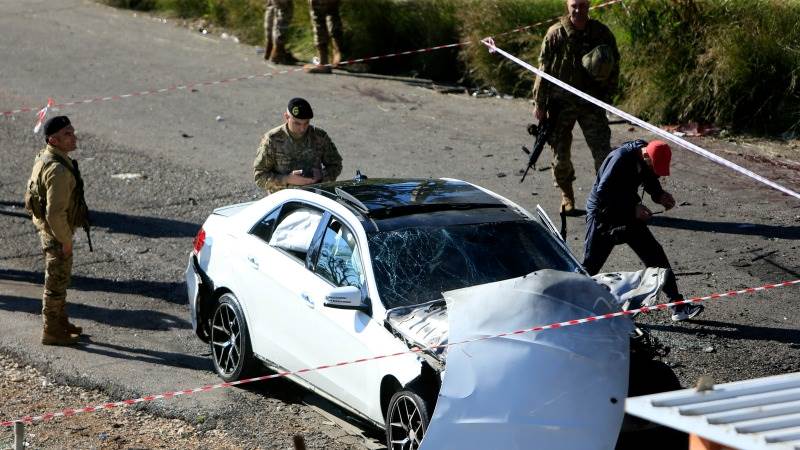
A Hamas official was eliminated after Israel reportedly launched a drone attack on Lebanon’s southern city of Sidon on Friday, AFP reported, citing unnamed sources. “An Israeli strike targeted a Hamas movement security official from the Ain al-Helweh [refugee] camp while he was inside his vehicle in the city of Sidon,” the source said. Additionally, an AFP correspondent claimed to have seen emergency personnel removing a carbonized body from the vehicle while soldiers cordoned off the area.
WASHINGTON, Aug 9 (Reuters) – The Biden administration has decided to lift a ban on U.S. sales of offensive weapons to Saudi Arabia, three sources familiar with the matter told Reuters on Friday, reversing a three-year-old policy to pressure the kingdom to wind down the Yemen war.
The administration briefed Congress this week on its decision to lift the ban, a congressional aide said. One source said sales could resume as early as next week, while another said deliberations on timing were still under way. “The Saudis have met their end of the deal, and we are prepared to meet ours, returning these cases to regular order through appropriate congressional notification and consultation,” a senior Biden administration official said. Under U.S. law, major international weapons deals must be reviewed by members of Congress before they are made final. Democratic and Republican lawmakers have questioned the provision of offensive weapons to Saudi Arabia in recent years, citing issues including the toll on civilians of its campaign in Yemen and a range of human rights concerns. But that opposition has softened amid turmoil in the Middle East following Hamas’ deadly Oct. 7 attack on Israel and because of changes in the conduct of the campaign in Yemen. The threat level in the region has been heightened since late last month, with Iran and Lebanon’s powerful Iran-backed Hezbollah group vowing to retaliate against Israel after Hamas’ political chief Ismail Haniyeh was killed in Tehran. The Biden administration also has been negotiating a defense pact and an agreement for civil nuclear cooperation with Riyadh as part of a broad deal that envisions Saudi Arabia normalizing ties with Israel, although that remains an elusive goal. Since March 2022 – when the Saudis and Houthis entered into a U.N.-led truce – there have not been any Saudi airstrikes in Yemen and cross-border fire from Yemen into the kingdom has largely stopped, the administration official said. Biden adopted the tougher stance on weapons sales to Saudi Arabia in 2021, citing the kingdom’s campaign against the Iran-aligned Houthis in Yemen, which has inflicted heavy civilian casualties. Yemen’s war is seen as one of several proxy battles between Iran and Saudi Arabia. The Houthis ousted a Saudi-backed government from Sanaa in late 2014 and have been at war against a Saudi-led military alliance since 2015, a conflict that has killed hundreds of thousands of people and left 80% of Yemen’s population dependent on humanitarian aid.
Vice President Kamala Harris is ahead of former President Donald Trump by five points, a new Ipsos poll showed on Thursday. The survey, conducted from August 2 to 7, shows Harris at 42% support compared to Trump’s 37%, with 4% backing independent candidate Robert Kennedy Jr. The previous poll from July 22-23 had Harris leading Trump 37% to 34%. The Ipsos poll, conducted online with 2,045 US adults and a margin of error of around three percentage points, indicates Harris has gained momentum since entering the race on July 21. President Joe Biden endorsed Harris after suspending his campaign following a poor debate performance on June 27. Harris also leads Trump 42% to 40% in the seven battleground states that were closely contested in 2020: Arizona, Georgia, Michigan, Nevada, North Carolina, Pennsylvania, and Wisconsin. NN: If Mssssss Harris wins we are DOOMED!!
BEIRUT (AP) — Hamas named Yahya Sinwar, its top official in Gaza who masterminded the Oct. 7 attacks in Israel, as its new leader in a dramatic sign of the power of the Palestinian militant group’s hardline wing after his predecessor was killed in a presumed Israeli strike in Iran. The selection of Sinwar, a secretive figure close to Iran who worked for years to build up Hamas’ military strength, was a defiant signal that the group is prepared to keep fighting after 10 months of destruction from Israel’s campaign in Gaza and after the assassination of Sinwar’s predecessor, Ismail Haniyeh. It is also likely to provoke Israel, which has put him at the top of its kill list after the Oct. 7 attack, in which militants killed 1,200 people in southern Israel and took about 250 as hostages.
The announcement comes at a volatile moment. Fears are high of an escalation into a wider regional war, with Iran vowing revenge against Israel over Haniyeh’s killing and Lebanon’s Hezbollah threatening to retaliate over Israel’s killing of one of its top commanders in an airstrike in Beirut last week. American, Egyptian and Qatari mediators are trying to salvage negotiations over a cease-fire and hostage release deal in Gaza, shaken by Haniyeh’s killing.
Hamas said in a statement it named Sinwar as the new head of its political bureau to replace Haniyeh, who was killed in a blast that Iran and Hamas blamed on Israel. Israel has not confirmed or denied responsibility. Also last week, Israel said it had confirmed the death of the head of Hamas’ military wing, Mohammed Deif, in a July airstrike in Gaza. Hamas has not confirmed his death.
In reaction to the appointment, Israeli military spokesman Rear Adm. Daniel Hagari told Saudi-owned Al-Arabiya television, “There is only one place for Yahya Sinwar, and it is beside Mohammed Deif and the rest of the October 7th terrorists. That is the only place we’re preparing and intending for him.”
Israel’s killings of multiple senior officials in Hamas over recent months left Sinwar as the most prominent figure in the group. His selection signals that the leadership on the ground in Gaza — particularly the armed wing known as the Qassam Brigades — has taken over from the leadership in exile, which has traditionally maintained the position of the overall leadership to navigate relations with foreign allies and diplomacy. Hamas’ allies Iran and Hezbollah issued statements praising Sinwar’s appointment. As Hamas’ leader inside Gaza since 2017, Sinwar rarely appeared in public but kept an iron grip on Hamas’ rule over the territory. Close to Deif and Qassam Brigades, he worked to build up the group’s military capabilities. In one of his few appearances, Sinwar ended a public speech in Gaza by inviting Israel to assassinate him, proclaiming, “I will walk back home after this meeting.” He then did so, shaking hands and taking selfies with people in the streets. NN: Sin War needs to go get his virgins. He needs to hurry before they run out.
Iran and Hezbollah have vowed revenge for assassinations
Military, hospitals on high alert
Residents told to stay near protected areas
(Reuters) – Israel’s ambulance service has stocked blood supplies in a fortified underground center, factories have moved out hazardous materials and municipal authorities are checking bomb shelters and water supplies as the country waits for a threatened attack from Iran and its proxies. Israel has been fortifying its home front for months and many preparations have been in place since the start of the war in Gaza last October, when thousands of Hamas-led gunmen carried out a devastating cross-border attack on Israeli communities. But the urgency has risen sharply over the past 10 days as a relatively contained conflict with the Iranian-backed Hezbollah movement in southern Lebanon has threatened to spiral into an all-out regional war. “I know that the citizens of Israel are on alert, and I ask of you one thing – keep patient and cool,”
Prime Minister Benjamin Netanyahu said on Wednesday while meeting new army recruits. “We are prepared for both defense and attack, we are striking our enemies and are also determined to defend ourselves,” he said. Israel now finds itself facing the threat of a multifront war, confronting a clutch of militant movements – Hamas, Hezbollah, the Houthis in Yemen, all backed and funded by its longstanding enemy Iran.
An attack is expected in the coming days following vows from Iran and Hezbollah to retaliate for the assassinations last week of Hamas leader Ismail Haniyeh in Tehran and Hezbollah military commander Fuad Shukr in Beirut. After months of alarm and an attack by hundreds of Iranian missiles in April that was thwarted by Israel’s air defences and the help of international allies, Israelis have become used to the crisis. Tens of thousands of people were evacuated from northern areas in range of Hezbollah rockets at the start of the war and many border areas now have a ghostly, abandoned air. But a prolonged bombardment from Hezbollah’s rocket arsenal could reach deeper into the country to sensitive targets like the port city of Haifa in northern Israel, which is well in range. The city’s Rambam Hospital has been on alert since last October and has readied its three-floor, fortified underground facility to treat patients. “We’re waiting to see what happens,” said David Ratner, a hospital spokesperson. The military is on high alert and last weekend it augmented its nationwide system of air raid sirens and broadcast alerts to include real-time text messages to be sent to residents in targeted areas. Many local councils have advised residents to reduce non-essential activity, stay near protected areas and avoid large gatherings. In Haifa, public bomb shelters have been equipped with digital systems so they can be unlocked remotely during an attack, said Yair Zilberman, director of the city’s security and emergency services department. They are also being equipped with generators. A number of underground parking lots have been approved as makeshift shelters with enough space for thousands of residents if needed, Zilberman said. In the city of Ramla in central Israel, national ambulance service Magen David Adom (MDA) has been collecting blood donations in a subterranean service center, shielded with extra-thick concrete walls, blast doors and airlocks. “We’ve got the threats from Iran, we’ve got threats from Hezbollah,” said MDA’s Aryeh Myers. “Massive rocket attacks, massive threats to the state of Israel and we want to make sure that we are ready for anything.” Last Thursday, the Environmental Protection Ministry held a situational assessment to decide how best to protect factories with inventories that could be dangerous if targeted in a missile strike, or how to deal with an attack on a building that contains asbestos. The military said the Home Front Command keeps in constant contact with factories and local authorities to maintain a “complete picture of the inventory levels of hazardous materials”. The Bazan Group, which operates in Haifa one of the largest oil refineries in the eastern Mediterranean, told Reuters it was “working to maintain energy security and the continuity of fuel supply to the economy.” Mass cash withdrawals are another scenario for which authorities are preparing. “The stock of banknotes and coins in the Bank of Israel and the banking system will, according to every visible forecast, be sufficient,” the Bank of Israel said. NN: As the Shekel plunges in value.
US Air Force F-22 Raptors arrived in the Middle East on Thursday as the Pentagon gears up to fend off an anticipated retaliatory attack by Iran and its proxies against Israel for the assassination of a top Hamas leader in Tehran last week.
WASHINGTON — The top commander of US military forces in the Middle East, Army Gen. Michael “Erik” Kurilla, returned to Israel on Thursday to meet with defense officials ahead of an expected multifront attack by Iran and various militias it has armed throughout the region.
The visit marked Kurilla’s second to Israel in just three days as he toured US-aligned capitals in the region to coordinate air and maritime defense ahead of the anticipated attack. Axios first reported his latest stop.
Iran’s leadership has vowed to respond to the killing of Hamas’ late political leader Ismail Haniyeh in an explosion at an IRGC guest house in Tehran last week.
The Biden administration has rallied international pressure in the hope of dissuading Iran’s leaders from authorizing a major retaliation for Haniyeh’s killing, which Western and Arab officials fear could spiral into a wider regional war. To support that effort, the Pentagon has rushed additional forces to the region, including an additional aircraft carrier, the USS Abraham Lincoln, Navy destroyers capable of downing ballistic missiles and an undisclosed number of highly advanced F-22 fighter aircraft.
The F-22s arrived in-region on Thursday, US CENTCOM said in a statement. Another aircraft carrier already in theater, the USS Theodore Roosevelt, forward deployed F/A-18 aircraft ahead of the arrival of the F-22s.
Those assets join at least a dozen other US and allied warships, as well as fighter aircraft already in the Mediterranean and Gulf waterways. US Defense Secretary Lloyd Austin late last week also authorized the readying of land-based ballistic missile interception systems for potential deployment. “Everything that we’re doing is defensive in nature,” Pentagon deputy spokesperson Sabrina Singh said on Thursday of the new deployments. Singh declined to say whether that might change if US troops in the region come under attack. Singh called the F-22s an “invaluable” asset for the situation. “I think it sends a very powerful message of deterrence,” she added. US officials have warned Iran’s leadership of potentially devastating economic consequences for their country and instability for its incoming government should they authorize a major retaliation against Israel that triggers escalation, the Wall Street Journal reported Thursday.
U.S. commercial crude oil inventories (excluding those in the Strategic Petroleum Reserve) decreased by 3.7 million barrels from the previous week. At 429.3 million barrels, U.S. crude oil inventories are about 6% below the five year average for this time of year. U.S. crude oil refinery inputs averaged 16.4 million barrels per day during the week ending August 2, 2024, which was 252 thousand barrels per day more than the previous week’s average. Refineries operated at 90.5% of their operable capacity last week. Gasoline production increased last week, averaging 10.0 million barrels per day. Distillate fuel production increased last week, averaging 5.0 million barrels per day. U.S. crude oil imports averaged 6.2 million barrels per day last week, decreased by 729 thousand barrels per day from the previous week. Over the past four weeks, crude oil imports averaged about 6.8 million barrels per day, 0.7% more than the same four-week period last year. Total motor gasoline imports (including both finished gasoline and gasoline blending components) last week averaged 630 thousand barrels per day, and distillate fuel imports averaged 115 thousand barrels per day. Total motor gasoline
inventories increased by 1.3 million barrels from last week and are about 2% below the five year
average for this time of year. Finished gasoline inventories increased, while blending components inventories decreased last week. Distillate fuel inventories increased by 0.9 million barrels last week and are about 6% below the five year average for this time of year.
Propane/propylene inventories increased by 0.5 million barrels from last week and are 13% above the five year average for this time of year. Total commercial petroleum inventories increased by 1.2 million barrels last week.
Total products supplied over the last four-week period averaged 20.3 million barrels a day, down by 2.0% from the same period last year. Over the past four weeks, motor gasoline product supplied averaged 9.1 million barrels a day, up by 1.5% from the same period last year. Distillate
fuel product supplied averaged 3.7 million barrels a day over the past four weeks, down by 2.2% from the same period last year. Jet fuel product supplied was down 1.2% compared with the same four-week period last year
Major stock market indexes in the United States extended their gains during Thursday’s session as the reported decrease in initial jobless claims and the possibility that the country might avoid a recession pushed traders toward investing. Numerous technological companies trading on the Nasdaq 100, such as ARM Holdings, ON Semiconductor, KLA Corporation, and Microchip Technology Inc., thus soared by more than 5%. The rise in the Dow Jones Industrial Average neared 600 points as the index grew by 1.53% or 593 points at 11:28 am ET. The Nasdaq 100 increased by 2.38% or 424 points after hitting more than 430 moments earlier. The S&P 500 expanded by 1.90%.
Returns have fallen around 10% since May, Says JPMorgan
Reiterates the clock is ticking for the G10 carry trade:
Three-quarters of the global carry trade has now been removed, with a recent selloff erasing this year’s gains, according to JPMorgan Chase & Co. Returns in Group-of-10, emerging market and global carry trade baskets tracked by the bank have fallen about 10% since May, quantitative strategists Antonin Delair, Meera Chandan and Kunj Padh wrote in a note to clients.
The moves have wiped out the year-to-date returns and significantly cut into profits accumulated since the end of 2022.
“The spot component of the global carry basket would suggest that 75% of carry trades have been removed,” the JPMorgan team wrote, reiterating that the “clock is ticking for the G10 carry.” The carry strategy – which involves borrowing at low rates to fund purchases in higher-yielding assets elsewhere — has been wobbling for months. Carry trades were pummeled over the past week as global market volatility jumped amid fears of rapid Federal Reserve rate cuts and after the Bank of Japan’s larger than expected rate hike. The recent selloff has been double the usual pace in a carry drawdown, with the strategists suggesting there may be small opportunity for a rebound in August as “the central bank calendar is light for this period and volatility already started to cool off.” However, the global carry trade strategy is “not offering an attractive risk-reward,” they emphasized. “The yield on the basket has plummeted since the highs of 2023 and is not a sufficient compensation for holding EM high betas through US elections and the risk of further repricing of low yielders if US yields fall.”
A Ukrainian ground assault on Russian regions across the border continued on Wednesday for their second day, forcing Russia to evacuate residents from the Kursk region, sparking a backlash against President Vladimir Putin for failing to thwart the attacks.
According to The Moscow TImes, this latest campaign by Ukraine is “larger in scale and more prepared than previous efforts”. The English-language daily cited local officials as reporting at least five people had been killed in the attack so far, and scores of others injured.
Some three Ukrainian troops, accompanied by 11 tanks and nearly two dozen armored vehicles launched the attack on Kursk, according to The Moscow Times.
On Tuesday, Ukrainian forces attacked the border town of Sudzha, in the Kursk region, some 300 miles southwest of Moscow, Reuters cited the Russian Defense Ministry as saying, with Putin calling the move a “major provocation” and accusing Ukraine of indiscriminately targeting civilians. On Telegram on Wednesday, Kursk Governor Alexei Smirnov confirmed that “over the past 24 hours, our region has been heroically resisting attacks by Ukrainian Nazis. All emergency services have been put on high alert”. While attacking both Ukraine and Russia have in the past resorted to targeting each others’ energy infrastructure, the war is now entering a new phase and expanding to the African front, with Moscow’s Wagner mercenaries using the continent in a flanking maneuver and Kyiv following. Both Mali and Niger have severed diplomatic ties with Kyiv, accusing it of supporting terrorist groups in the countries as a counterbalance to Wagner forces. Last week, Ukraine was under scrutiny for its alleged intelligence role in an attack conducted by Tuareg rebels in the north against Mali’s military government, during which dozens of Wagner mercenaries and Malian soldiers were reportedly killed . NN: f16’s equipped with Israeli modified missals is a game changer.