The Egyptian government held a conversation with Israeli officials in which withdrew any military support to defend Israeli territory in case Iran decided to perform a retaliatory attack after the killing of Hamas political leader Ismail Haniyeh. According to The Times of Israel on Monday citing Qatari media sources, Egypt also informed Tehran that it would prohibit any military activities in its airspace that could jeopardize regional stability. Egyptian officials clarified to their Iranian counterparts that this decision should not be seen as an act of hostility towards Iran, but as a measure to protect Egypt’s sovereignty. The discussions with both parties allegedly took place during a meeting in Cairo.
Oil nears 8-month low on US recession fears….. Ignores coming war in the Middle East
Oil extended losses from the lowest close in seven months as a selloff in wider financial markets countered rising tensions in the Middle East, with traders watching for a potential retaliatory strike on Israel by Iran. Brent futures slipped below $76 a barrel — erasing this year’s gains — after closing at their lowest since early January on Friday. West Texas Intermediate dropped below $72. A rout in global equities worsened on Monday on concerns around the economic outlook. Still, the market is bracing for a possible attack from Iran and regional militias against Israel in retaliation for assassinations of Hezbollah and Hamas officials. The US has sent defensive reinforcements to the region.
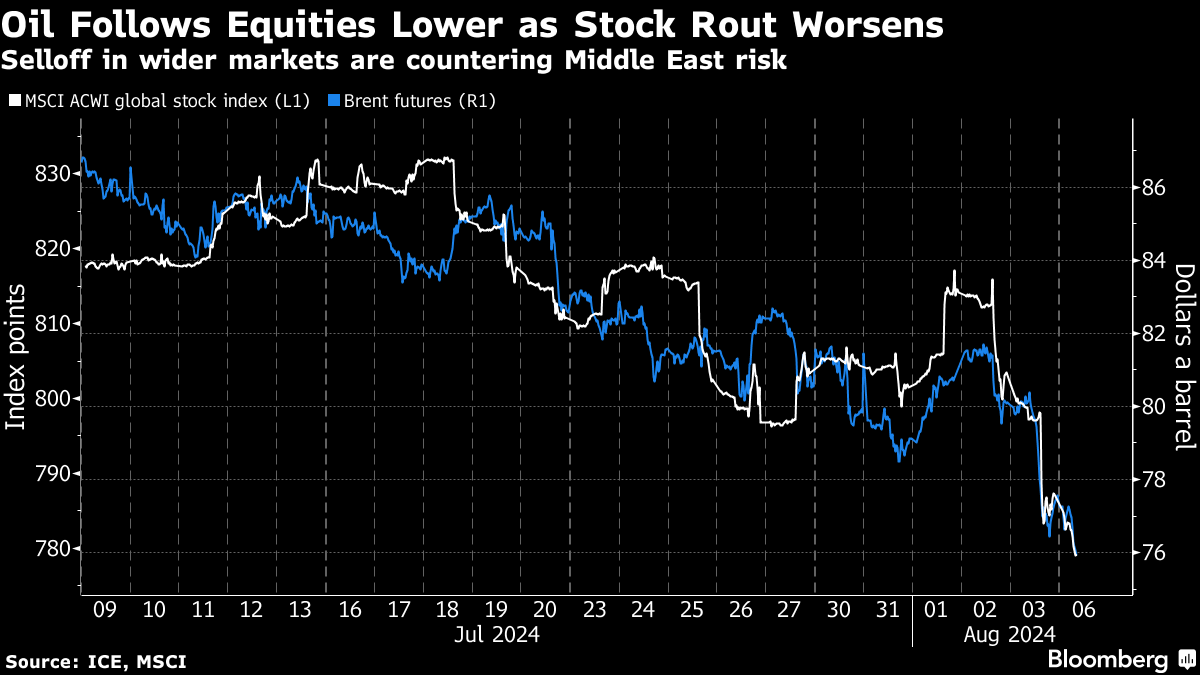
Oil has notched four weeks of declines on signals of faltering demand in the US and China, with the Asian nation rolling out plans to spur domestic consumption over the weekend. OPEC+ supply cuts and concerns the conflict in the Middle East could impact production from the region had supported prices. “While there are growing demand concerns, geopolitical risks continue to hang over the oil market,” Warren Patterson, head of commodities strategy at ING Groep NV in Singapore, said in a note. He added that an escalation in the Middle East may lead to short-term volatility, but a disruption to crude supply is needed to see sustained price strength. US Secretary of State Antony Blinken told his G-7 counterparts on Sunday that an attack on Israel by Iran and Hezbollah could begin as early as Monday, Axios reported, citing three unidentified sources briefed on the call. The US doesn’t know the exact timing, Blinken said but sees the strikes starting in the next 24 to 48 hours, according to the report.
Saudi Arabia raised the price of its flagship crude to Asia for the first time in three months, a tentative sign that the kingdom remains confident about demand in the region. It made significant cuts for Europe and the US.
Libya’s internationally recognized government alleged “political blackmail” as production began to be cut at the OPEC nation’s largest oil field. Production at Sharara has dropped by at least 50,000 barrels a day to 210,000 since employees received orders to trim the southern field’s output on Saturday night, according to people familiar with the matter. They asked not to be identified as they aren’t authorized to speak to the media. The North African nation is split between dueling administrations in the capital in the west, Tripoli, and a rival in the east. It wasn’t immediately clear what prompted the decision or whether output would be further curtailed. NN: The great oil giveaway. Make sure you get some.
Israeli military: 30 rockets launches from Lebanon overnight…….Biden ‘hopes’ Iran won’t launch revenge attack on Israel…… American Lefties NOW Selling Out Israel
The Israeli Defense Forces (IDF) shared on Sunday that 30 rockets were launched from the Lebanese territory at the Israeli border town of Beit Hillel. According to the Israeli military, most of the rockets were intercepted by air defenses, with one hitting the Beit Hillel and some falling in the open areas. The Israeli forces also launched retaliatory airstrikes targeting the positions used by Hezbollah militants in southern Lebanon. No casualties have been reported so far.
Biden ‘hopes’ Iran won’t launch revenge attack on Israel
United States President Joe Biden expressed hope that Iran will refrain from responding to Israel’s attack which killed Hamas political leader Ismail Haniyeh in Tehran. In response to a journalist’s question about whether Iran would stand down from seeking revenge for Haniyeh’s killing, Biden said, “I hope so. I don’t know.” Meanwhile, top officials from the United States and Israel have indicated that they expect Iran to launch a retaliatory attack on Israel as soon as Monday in response to the deaths of Hezbollah senior commander Fuad Shukr and the Hamas political leader. NN Audio file:
Lefty Liberals WOK, LGBT, fagots, HOMO, COMMIES, Selling OUT Israel and you
US allegedly looking to send more fighter jets to Middle East……US The USS Abraham Lincoln Carrier Strike Group
The United States is planning to send more combat aircraft to the Middle East amid rising tensions, the New York Times reported on Friday citing American officials. One military official revealed that the country’s forces located in the aforementioned region are taking “necessary measures” to boost combat readiness and defend both the US and its partners from potential attacks Iran and its proxies might conduct. Another source shared that the number of additional planes is yet to be decided. Furthermore, Defense Secretary Lloyd Austin is yet to give his final blessing for the motion. Meanwhile, Department of Defense Deputy Press Secretary Sabrina Singh said that the US plans to bolster “force protection” in the Middle East.
USS Lincoln Carrier Strike Group to deploy to the Middle East
West Coast carrier USS Abraham Lincoln (CVN-72) is setting sail to the Middle East from the Pacific to relieve the carrier USS Theodore Roosevelt (CVN-71) and its strike group. Meanwhile, the Navy is sending additional ships to the region following threats from Iran, Pentagon officials announced on Friday evening. “To maintain a carrier strike group presence in the Middle East, the Secretary has ordered the Lincoln Carrier Strike Group to replace the Theodore Roosevelt Carrier Strike Group, currently on deployment in the Central Command area of responsibility,” reads the Pentagon statement. Secretary of Defense Lloyd Austin, “has ordered additional ballistic missile defense-capable cruisers and destroyers to the U.S. European Command and U.S. Central Command regions. The Department is also taking steps to increase our readiness to deploy additional land-based ballistic missile defense.” The U.S. moves to bolster military presence in the Eastern Mediterranean and the Middle East follows reports that Iranian military officials and proxy forces in Lebanon, Iraq and Yemen will meet to discuss options to retaliate against Israel following the killing of Hamas leader Ismail Haniyeh in Tehran. “Iran and the resistance members will conduct a thorough assessment after the meeting in Tehran to find the best and most effective way to retaliate against [Israel],” a senior Iranian official told newswire Reuters. The Pentagon also announced the deployment of unspecified fighter squadrons headed to the region.“The Secretary of Defense has reiterated that the United States will protect our personnel and interests in the region, including our ironclad commitment to the defense of Israel,” reads the statement from the Pentagon.
Oil May Hit $200 on Broader Middle East Conflict
Michael Rubin, a Senior Fellow at the American Enterprise Institute (AEI), outlined that a broader conflict in the Middle East “is growing likelier”. “Look, the collective policy of the United States, Europe, and the UN has for decades been to kick the can down the road,” he said.
“Eventually the road runs out. Did anyone really think that Hezbollah, Hamas, and the Houthis were arming themselves with ever-more sophisticated missiles and drones because they wanted them as backdrops for a parade?” he added.
And what would a broader conflict in the Middle East mean for oil prices?
“There would be a spike,” Rubin sid, “perhaps as high as $200 per barrel,” he added.
“Throw civil war in Venezuela into the mix, and maybe $250 per barrel,” he continued. “But markets adjust. Demand reduces. Plus, the Middle East no longer has the monopoly over oil and gas it once did. There’s fracking, Nigeria, Alberta. offshore U.S., and many more locations that can help blunt the impact, even in the short-term, should governments choose to allow them to do so,” Rubin went on to state.
Maritime intelligence company Dryad Global advised its clients that the past two weeks have seen an unprecedented sequence of escalatory events that have the potential to lead to a major flare-up in the Middle East.“This sequence of escalatory events will likely lead to retaliatory attacks on Israeli territory and assets in the coming days,” Dryad warned.
“It is assessed that these are highly likely to impact commercial shipping through increased Houthi airstrikes on merchant vessels in the Red Sea, Gulf of Aden, and Arabian Sea, as well as IRGCN seizures of merchant vessels in the Persian Gulf and Gulf of Oman,” it added.
The company noted that “in line with this heightened risk”, it advises against “all transit of Israeli-linked vessels within the Red Sea, Gulf of Aden, Gulf of Oman, and the Persian Gulf until further notice”.
Matthey Bey, a senior analyst at RANE, told Rigzone that Iran and Hezbollah “will almost certainly retaliate in some form to the two … assassinations in recent days” and added that the scale could approach the size of Iran’s attack on Israel in April.
“The scale and manner of any Israeli retaliation will likely be dependent on the scale of Iran and its allies’ attack on Israel and whether or not there is significant damage or casualties.”
Bey said any escalation in the conflict would add a few dollars to oil prices as a risk premium, a conflict in Lebanon would not necessarily directly affect the Middle East’s oil and gas production located in countries like Iraq and Saudi Arabia, which he said means there may not be a change in the long-term oil supply and demand balance.
“However, if the United States gets involved and does so through deploying military assets based in Gulf Cooperation Council countries, Iran and its proxies could return to targeting GCC oil and gas infrastructure, which may have a more significant impact on the physical supply of oil if a crucial node is hit as was the case in the 2019 attack on the Abqaiq oil processing facility,” he said.
“With the exception of potential Hezbollah strikes targeting Israeli gas production and processing facilities, Iran and its allies’ initial round of retaliation is unlikely to target oil and gas production throughout the region,” he added.
“Prices would initially rise sharply if this conflict occurred, and then move towards a level that retains a higher risk premium but nearer the level that reflected actual (if any) changes in oil production or flows,” he said.
Josephine Mills, an Analyst at Enverus Intelligence Research confirmed that the Middle East produces over 20 percent of the world’s oil production and warned that any disruption to this production and/or ability to export crude to market would result in an increase to oil prices. “Iran alone contributes ~3.4 million barrels per day. If even just 15 percent of their production was impacted it would increase our 2H24 price forecast by ~$3,” Mills added.
OPEC+ to Reevaluate Production Cuts as Brent Crude Prices Falter
OPEC maintained steady oil production in July, averaging 26.99 million barrels per day—a slight decrease of 60,000 bpd from June levels, according to a Bloomberg survey. Venezuela and Iran accounted for most of the 60,000 bpd dip, with both countries experiencing decreased demand from China. OPEC and its allies held a monitoring meeting earlier this week as the group hopes to gradually unwind its production cuts starting in Q4. OPEC has cautioned, however, that any changes to its planned supply increases will depend on market conditions.Despite escalating geopolitical tensions in the Middle East, crude futures have declined, leaving Brent crude below $80 a barrel. This drop poses challenges for OPEC+ nations, with Saudi Arabia in particular facing a four-quarter growth slump, forcing it to slash investments in key economic projects. In July, Saudi Arabia maintained its output at 9 million bpd, largely in line with its OPEC+ quota. Algeria and Kuwait also stayed within their targets. Iraq and the UAE, however, continued to exceed their production limits. Iraq increased its output by 30,000 bpd to 4.28 million bpd, Bloomberg’s survey showed. Russia and Kazakhstan, along with Iraq, have pledged additional cuts to compensate for their chronic overproduction throughout the duration of the production cut agreement. Venezuela and Iran, exempt from the current OPEC+ agreement, saw the largest declines in July. Venezuela’s output dropped by 60,000 bpd to 830,000 bpd, and Iran’s production fell by 50,000 bpd to 3.26 million bpd. Both countries rely heavily on sales to China, which is expected to reduce imports amid slowing economic growth. Bloomberg’s analysis is based on ship-tracking data, information from officials, and estimates from consultants, including FGE, Kpler Ltd., and Rapidan Energy Group.
Israel tests LRAD long-range defense system
Israel’s navy tested on Friday the LRAD long-range defense system, carrying out the operations “successfully,” the country’s military said in a statement. The military detailed that the interceptor is meant to guard against numerous threats, among which are cruise missiles and rockets. defense The test comes amid heightened tensions between Israel and other Middle East countries, after the recent events, in which high Hamas and Hezbollah officials were eliminated.
Iran reportedly to strike at Israeli targets from Syria
Iran plans to launch drone attacks against Israeli targets from Syrian territory, the United Kingdom-based Syrian Observatory for Human Rights reported on Friday citing Syrian sources working with Iranian militias. Iran has vowed to respond to the killing of Hamas leader Ismail Haniyeh in Tehran earlier this week. According to the report, the attacks are likely to be directed at Israeli targets inside the Israeli-occupied Palestinian territories and Golan Heights. The sources added the Iranian militias will be under orders not to attack United States military bases if Washington does not “participate in repelling the attack on Israel.”
US reportedly to send more combat aircraft to Middle East……Biden, Netanyahu discuss efforts to support Israel’s defense
https://youtu.be/GzzvYVruySc
The United States is making plans to send more combat aircraft to the Middle East amid ever-rising tensions between Israel and other countries in the region, the New York Times reported on Friday. Anonymous military officials said the US is working on “calibrating” its measures to “send enough of the right types of aircraft as quickly as possible to help defend Israel without appearing to escalate the conflict.”
The latest escalation happened earlier this week when Hamas leader Ismail Haniyeh was killed during his visit to Iran. Tehran placed responsibility on Israel and said it has a “duty” to avenge his death. Hezbollah leader Hassan Nasrallah also said the militant group will respond to Israel’s killing of its senior commander Fuad Shukr.
Biden, Netanyahu discuss efforts to support Israel’s defense
United States President Joe Biden spoke with Israeli Prime Minister Benjamin Netanyahu on Thursday, the White House said. Biden reaffirmed his commitment to Israel’s security “against all threats from Iran, including its proxy terrorist groups Hamas, Hezbollah, and the Houthis.” Biden went on to discuss ways to support Israel’s defense against ballistic missiles and drones, saying that these efforts are “to include new defensive US military deployments,” according to the readout of their call. Along with this commitment to the Israeli defense, Biden stressed “the importance of ongoing efforts to de-escalate broader tensions in the region.” US Vice President Kamala Harris also joined in on the call, the readout says, providing no further details of her participation. NN:
BUY THE SHIT OUT OF OIL
Moody’s Report Reveals Oil Price Is More Susceptible to Geopolitical Events
Compared to other asset classes, the oil price has been more susceptible to geopolitical events.
That’s what analysts at Moody’s Ratings said in a new Moody’s report which looked at the short and long-term reaction of financial markets to “different shocks” since 2001, “to better understand some of the credit effects of geopolitical events”.
The analysts pointed out in the report that the oil price has been more susceptible to geopolitical events “because of, among other reasons: one, the global economy’s dependence on oil; and two, concentrated proven oil reserves in regions that are often subject to political instability, conflicts, or sanctions (such as Russia, Venezuela, or Middle Eastern nations)”.
Moody’s analysts highlighted in the report that 11 out of 15 shocks in their study involved major oil-producing regions.
The analysts also noted in the report that the direction and size of impact varied depending upon the event’s influence on underlying fundamentals.
“The direction depends on whether markets perceive events as potentially disrupting supply (driving prices upwards) or casting a shadow on global economic activity and oil demand (driving them down),” they added.
“It is possible that these drivers are triggered at the same time, and sometimes with one as the dominant influence,” they continued.
“For example, tension between U.S.-Iran in the early-2020 raised oil supply concerns, which should have pushed prices higher. But it coincided with the pandemic that ruptured global demand for oil, leaving prices to drop by almost 40 percent during the first half of 2020,” they went on to state.
The analysts outlined in the report that the countries involved in a conflict, and their share in global oil supply and demand, “influence the size of the impact”.
“For example, events affecting large oil producers such as Russia or Middle Eastern nations have caused significant oil price increases due to supply worries,” the analysts said.
“By contrast, events involving major oil consumers, like the U.S. and Europe, oil prices trended down on account of future demand concerns (e.g., fall in prices after the 9/11 terrorist attacks),” they added.
“Similarly, oil price volatility spiked higher during the first 30 days of geopolitical events involving major oil producers or consumers,” they continued.
Moody’s analysts revealed in the report that, “like other asset classes, the impact on oil price gradually settled down from its peak impact in most cases over the short-term”.
“Considering the … example of [the] Russia-Ukraine war – which drove oil prices to high levels in early-2022 – prices normalized back to pre-event levels by mid-2022,” they said.
“The correction occurred as the anticipated disruption to the supply of Russian crude did not materialize. Russian crude exports post-sanctions were just rerouted maintaining its share of global supply. Also, rising supply from non-OPEC countries (mainly the U.S.) and a slowdown in global economic growth from the post-pandemic recovery weighed on oil prices,” they added.
Lately, changing dynamics in the oil industry – such as rising share of non-OPEC in global production, excess production capacity with OPEC, availability of global oil inventories – has somewhat toned down the severity of impact during shocks, Moody’s analysts stated in the report.
The analysts warned in the report that any further escalation in the Middle East or the Russia-Ukraine war, or a major disruption to key trade routes (e.g., the Strait of Hormuz or the Red Sea), poses risks of higher oil prices.
Conversely, the escalation of tensions between Mainland China and Taiwan into a full-blown conflict or structural threats to Chinese economic growth pose risks of falling prices, the analysts noted.