OPEC’s crude oil production fell in April, according to a new Reuters survey, with news of the fall likely to add support to falling oil prices. According to the survey, the results of which were released on Tuesday, OPEC’s crude oil production fell to 26.49 million barrels per day—that’s a 114,000 bpd drop from the levels OPEC produced in March, according to OPEC’s official March figure. According to revised Reuters figures for March production, the group’s ouput sagged by 99,000 bpd in April. The survey is based on shipping data and “information from industry sources,” according to Reuters. In March, Iraq, Nigeria, Venezuela, the UAE, and Libya all saw production decreases, according to OPEC’s secondary sources, with Nigeria seeing the biggest dip. Saudi Arabia and Iran saw the largest production increases. OPEC’s official Monthly Oil Market Report covering the month of April will be released on May 14, according to OPEC’s published schedule. The OPEC+ coalition, spearheaded by the largest producers in the group, Saudi Arabia and Russia, had initiated additional production cuts at the beginning of 2024 to mitigate the risk of a global oil surplus, and in March, the group agreed to extend those cuts until the end of June. Iraq and Kazakhstan had previously pledged to “achieve full conformity” and compensate for their overproduction. They submitted detailed plans today to do just that. The next JMMC meeting is scheduled for June 1. Saudi Arabia previously referred to the decision to extend output cuts into the end of June as “precautionary,” aimed at “supporting the stability and balance of oil markets.” Saudi Arabia has said that when it is time to roll back the production cuts, it will be done gradually “subject to market conditions.”
Blinken says US wants ceasefire deal ‘now’….. Want and Get are 2 Different Things
TEL AVIV, Israel (AP) — U.S. Secretary of State Antony Blinken was meeting with Israeli leaders on Wednesday in his push for a cease-fire deal between Israel and Hamas, saying “the time is now” for an agreement that would free hostages and bring a pause in the nearly seven months of war in Gaza. He has said Hamas would bear the blame for any failure to get a deal off the ground. Blinken is on his seventh visit to the region since the war erupted in October in his bid to secure what’s been an elusive deal between Israel and Hamas that could avert an Israeli incursion into the southern Gaza city of Rafah, where hundreds of thousands of Palestinians are sheltering. The current round of talks appears to be serious, but the sides remain far apart on one key issue — whether the war should end as part of an emerging deal. “We are determined to get a cease-fire that brings the hostages home and to get it now, and the only reason that that wouldn’t be achieved is because of Hamas,” Blinken told Israel’s ceremonial President Isaac Herzog at a meeting in Tel Aviv. “There is a proposal on the table, and as we’ve said, no delays, no excuses,” he said. The deal would also allow much needed food, medicine and water to get into Gaza, Blinken said.As part of his visit, Blinken will meet Israeli Prime Minister Benjamin Netanyahu. According to the State Department, he will also meet with the families of hostages and visit an Israeli port where aid for Gaza is entering. Blinken’s comments came on the last leg of his regional visit, with previous stops in Saudi Arabia and Jordan, where he urged Hamas to accept the latest proposal, calling it “extraordinarily generous” on Israel’s part. But the United States has also criticized Israel for its plan to invade Rafah, Gaza’s southernmost city where some 1.5 million Palestinians are sheltering from fighting elsewhere, saying that any major offensive there would bring potential harm to civilians and should be avoided.
Netanyahu has repeatedly vowed to invade Rafah, which he says is Hamas’ last stronghold, and on Tuesday’s pledged to do so “with or without” a cease-fire deal.
The current deal that is being discussed — with brokering by the U.S., Egypt and Qatar — would see the release of dozens of hostages in exchange for a six-week halt in fighting as part of an initial phase, according to an Egyptian official and Israeli media. Hundreds of Palestinian prisoners held by Israel would also be released, including some serving long sentences. But a sticking point remains over what happens next. Hamas has demanded assurances that an eventual release of all hostages will bring a complete end to Israel’s nearly seven-month assault in Gaza and a withdrawal of its troops from the devastated territory.
Israel has offered only an extended pause, vowing to resume its offensive once the first phase of the deal is over. The issue has repeatedly obstructed efforts by the mediators during months of talks.
NN: I am betting their will be o deal1!!
Israel Won’t Join Truce Talks Until Hamas Responds, Kan Says
- Hamas is believed to be weighing fresh proposal: state media
- Israel remains committed to invasion of Rafah, Netanyahu says
Israel will consider joining cease-fire talks with Hamas only when the militant group responds to the latest internationally mediated proposal for a temporary truce and hostage release, state-run Kan News reported. Citing an unidentified political official, Kan said the Israeli government is expecting an answer from the Iran-backed militant group on Wednesday evening. Under the latest terms for a pause in hostilities, Israeli forces have agreed to withdraw from parts of Gaza, according to Kan. Israel has been waging a military campaign against Hamas in response to the Oct. 7 invasion by militants on southern communities, in which more than 1,200 people were killed and some 250 were taken hostage. Israeli forces have laid waste to much of Gaza during the near seven-month conflict, with the ultimate aim of destroying Hamas and preventing a repeat attack. More than 34,000 Palestinians have been killed since the beginning of Israel’s air and ground assault on the strip, according to the Hamas-led health ministry, while many more are struggling for food and health care. Hamas released about 105 hostages during a November cease-fire, and it’s not known how many of the rest are still alive. Israel has said it needs to invade the southern Gaza city of Rafah to complete the job of eliminating Hamas militants, a prospect that’s raised concern internationally due to the more than 1 million Palestinians taking refuge there. The plan remains in place regardless of whether a truce deal is agreed, Prime Minister Benjamin Netanyahu said Tuesday. “The idea that we will halt the war before achieving all of its goals is out of the question,” he told the families of hostages and those of soldiers killed in the fighting. “We will enter Rafah and we will eliminate the Hamas battalions there – with or without a deal, in order to achieve the total victory.” The US and its allies are concerned that truce efforts could be scuppered by the International Criminal Court, which people familiar with the matter have said may issue arrest warrants for Israeli officials, including Netanyahu, for their war conduct. Netanyahu said he wants “leaders of the free world” to intervene in the ICC’s decision and make sure the warrants aren’t issued, according to a statement from his office. Under the latest cease-fire proposal, displaced Palestinians who need to return to their homes in northern Gaza after being forced to take refuge in the south won’t be inspected by Israeli forces, Kan said. Only Egypt and other countries will carry out that task. Israel will still be allowed to “track” Palestinians returning to northern Gaza using “other tools,” Kan said, without giving more details. On Monday, US Secretary of State Antony Blinken urged leaders of Hamas, which is designated a terrorist group by the US and European Union, to quickly reach a decision on Israeli conditions for a temporary cease-fire. Israel has been “extraordinarily generous” with proposals made during talks mediated by Qatar and Egypt, Blinken said in Riyadh. He wasn’t more specific about the offer on the table. Israeli Finance Minister Bezalel Smotrich, who’s also leader of the right-wing Religious Zionism party that is part of Netanyahu’s coalition, said he would oppose the deal currently on the table. “A government that submits to international pressure, stops the war in the middle, avoids immediate entry into Rafah and returns to Egyptian mediation proposals that leave Hamas existing in any configuration, will at that moment lose its right to exist,” Smotrich said.
Israel to reportedly invade Rafah if no deal is reached………..Netanyahu: Rafah op coming soon
Israel will be launching an operation in Rafah should there be no progress made on the hostage deal in the coming days, GLZ Radio reported on Tuesday citing security officials. Previously, Ynet News reported that Israel’s Defense Forces Chief of Staff General Herzi Halevi greenlighted the final plans for the military operation. According to the news outlet, numerous Israeli tanks have lined up on the Gaza border and are waiting for an order to begin the action should the hostage negotiations fall through yet again. The order could be given in the next 48 to 72 hours, as per Ynet.
Netanyahu: Rafah op coming soon
Israeli Prime Minister Benjamin Netanyahu reiterated on Tuesday that the goals of the war remain unchanged, Sky News Arabia cited him as saying.
Netanyahu stressed that the Rafah military operation “will be taking place soon,” insisting that “it is out of the question” to stop until Hamas brigades in the area are eliminated. He repeated that Israel wouldn’t be surrendering to the militant group and added that the order would be given regardless of what happens in hostage negotiations.
The prime minister also remarked that the process of evacuating Rafah commenced. Earlier, Israeli military radio shared that the invasion of the region could happen in the next 48 to 72 hours, should there be no progress on hostage talks.
NN: Audio File
Hamas: No ceasefire if Israel fails to meet demands
The Palestinian militant group Hamas spokesman Abd al-Latif al-Qanou emphasized on Monday that unless Israel fulfills the demands of the group, there will be no agreement for a ceasefire or the release of hostages. “Without fulfilling the just demands of our people for a permanent ceasefire, withdrawal of forces, and the return of displaced persons, no agreement with the occupation will succeed,” he added. According to a previous report by AFP, the militia is set to provide its response to the Israeli counterproposal today. The group had previously indicated its readiness to disarm on the condition that a Palestinian state is established. Israeli Foreign Minister Israel Katz said that if a deal is reached, Israel will “suspend” the Rafah operation.
UK’s Cameron calls on Hamas to accept ceasefire deal
United Kingdom Foreign Secretary David Cameron on Monday expressed hope that the Palestinian militant group Hamas will agree to the Israeli proposal that would secure the potential 40-day ceasefire in the Gaza Strip in exchange for the release of hostages.
Speaking at the World Economic Forum in Riyadh, Cameron stated that it is crucial to establish a political future in the Gaza Strip without Hamas in order to build the ground for a two-state solution. “I don’t believe that even if there was a Palestinian state created tomorrow, that Iran and its leaders would say: “That’s all fine now”,” Cameron stated, highlighting that Tehran believes in the “destruction” of Israel as a state and that attempting to do so through Hamas, Hezbollah, and Houthis.
The British foreign secretary noted that Iran’s support for the militant groups in the region is “deeply troubling” and “destabilizing” for the region.
Oil prices fall 1% amid Israel-Hamas peace talks…….Oil Drops as Progress on Cease-Fire in Gaza Shrinks Risk Premium
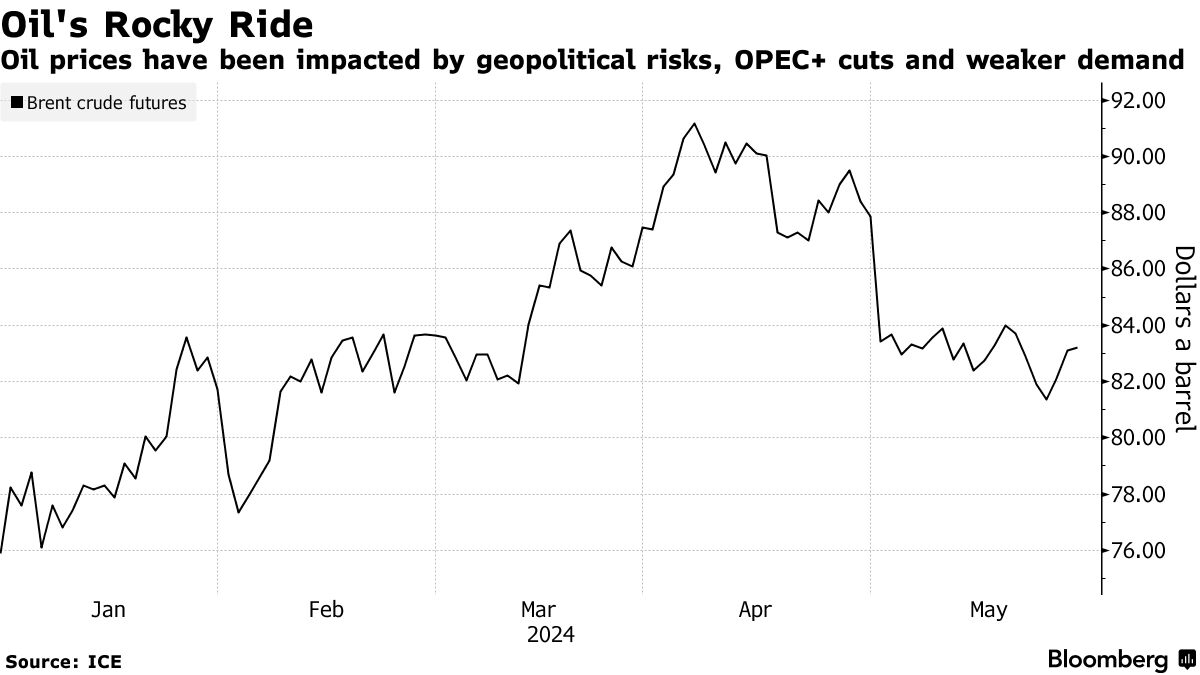
Prices of crude oil for front-month contracts decreased on Monday amid the ongoing Israeli-Hamas negotiations that could de-escalate the crisis in the Middle East by potentially securing a temporary ceasefire in the Gaza Strip and the release of hostages held by the militant group in the enclave. European Union High Representative for Foreign Affairs and Security Policy Josep Borrell previously shared that several member states in the bloc plan to formally recognize Palestinian statehood by the end of May. West Texas Intermediate (WTI) for June deliveries fell 1.28% to sell at $82.68 per barrel at 10:41 am ET. For the same month’s settlements, Brent declined 1.20% to trade at $88.28 a barrel.
Oil Drops as Progress on Cease-Fire in Gaza Shrinks Risk Premium
Momentum toward a cease-fire has been building, with US Secretary of State Antony Blinken saying he will step up his push to secure a truce in Gaza during a visit to the region. The White House said Israel has agreed to hear out its concerns and hold off invading Rafah until meeting with the Americans. Still, the gap between the two nearest Brent contracts was about $1 a barrel in backwardation, a bulllish indicator that signals tight near-term supply. Benchmark North Sea crudes have also seen a spate of buying in recent days. Crude has risen this year on OPEC+ supply cuts and heightened tensions in the Middle East.
Biden Strategy to Tame Gas Prices Is in Peril as Iran Sanctions Pressure Mounts
Recent oil price easing could perhaps be seen as a sign of greater maturity in the oil market when it comes to geopolitics, analysts at Standard Chartered said in a report sent to Rigzone last week. “After jumping at geopolitical shadows and overreacting in 2022, the market has been more stoic in 2024 so far,” they noted. Alternatively, the fall in prices could be seen as a sign of increasing immaturity in relation to geopolitics, the analysts stated in the report. “This is a market that does not price geopolitical risk unless there is something observably on fire and on fire right now,” they added.In the report, the Standard Chartered analysts revealed that they think “the truth is probably somewhere in the middle of those two interpretations”. “It may be unwise to attempt to extract a convincing geopolitical narrative from recent oil market reaction; we think it has always had difficulty in pricing any relatively slow-moving geopolitical narrative correctly,” they said. “We think it is reasonable to conclude from the price fall that traders are less concerned than before about short-term supply risks; however, we do not think anything can be concluded about the market’s view of any permanent shifts in geopolitics or on whether longer-term risk has been elevated,” they added. “In short, geopolitical risk is still both large and intact, in our view,” they went on to state. The analysts highlighted in the report that their view is that longer-term supply risk has become elevated by the events of the past seven months.
“The long-running dispute between Iran and Israel has, up to now, been largely covert, hardly acknowledged by either side and often carried out through proxies,” they said. “That confrontation is now more explicit and direct; Iranian red lines have been redrawn in a way that will likely make the diffusion of future tension harder, and there is no likely resolution of the tension in sight,” they noted.
“Further, we do not think U.S. policy towards Iran oil exports will remain quite as circumspect as it currently is, regardless of the result of November’s presidential election,” they added.The analysts stated in the report that the election may influence the timing of the next swing down in Iranian exports but added that they think increased pressure on Iran is highly likely in any event. “The latest additions to U.S. secondary sanctions on Iranian oil exports may add to the instruments available, although we note that existing U.S. policy instruments were enough to drive Iranian exports down to close to zero in late 2020 before the international context, and the associated implementation policies, changed,” the analysts said. The reduced market focus on Middle East developments is likely to bring fundamentals back to the fore, the Standard Chartered analysts said in the report. “Short-term spreads, which were key to price progression in Q1, are likely to remain so in Q2,” they added. “Our balances imply that April will show the typical shoulder-season characteristics, with a tendency towards inventory builds before demand picks up for the rest of the quarter,” they continued. “Our model shows a small 74,000 barrel per days global inventory build in April, significantly less than the 2.2 million barrels per day build in April 2023 and the 1.4 million barrel per day build in April 2022,” they said. “Nevertheless, it is likely to feel like a significant relaxation in the physical market after the strong counter-seasonal Q1 inventory draws.
However, we forecast global oil demand will pick up strongly in May and June, exceeding 103 million barrels per day for the first time in May (at 103.15 million barrels per day) and then surpassing that record with 103.82 million barrels per day in June,” they went on to state.
The analysts highlighted in the report that they expect global inventory draws of 1.53 million barrels per day next month and 1.69 million barrels per day in June, which they said should tighten physical spreads significantly. “While our balances indicate there is room for at least one million barrels per day of extra OPEC output in Q3 without increasing inventories, we think the latest pull-back in prices re-opens the question of the timing of any output increases,” they analysts noted. “The next key ministerial meeting is just six weeks away; we think that if the market is still trading weakly then and market concerns about demand and the macroeconomic environment persist, ministers are very unlikely to want to add oil back onto the market immediately,” they added. The analysts said in the report that they think the next few weeks will be key in determining how tight Q3 will be.
Standard Chartered projected in the report that the ICE Brent nearby future crude oil price will average $94 per barrel in the second quarter of this year, $98 per barrel in the third quarter, $106 per barrel in the fourth quarter, $107 per barrel in the first quarter of 2025, $103 per barrel in the second quarter, and $111 per barrel in the third quarter.
The company expects the commodity to average $109 per barrel overall in 2025, $128 per barrel overall in 2026, and $115 per barrel overall in 2027, according to the report.
In a separate report sent to Rigzone last week, Ole R. Hvalbye, a Commodities Analyst at Skandinaviska Enskilda Banken AB (SEB), said, “fundamentals predominantly influence global oil price developments at present”. “Geopolitical ‘risk premiums’ have decreased from last week, although concerns persist, highlighted by Ukraine’s strikes on two Russian oil depots in western Russia and Houthis’ claims of targeting shipping off the Yemeni coast,” Hvalbey said in that report. “With a relatively calmer geopolitical landscape, the market carefully evaluates data and fundamentals. While the supply picture appears clear, demand remains the predominant uncertainty that the market attempts to decode,” he added. In a report sent to Rigzone on April 20, analysts at J.P. Morgan said their base case for oil “remains a $90 Brent through May and $85 in 2H24”.
Oil Declines as US Steps Up Efforts to Secure a Truce in Gaza
Oil slipped as the US pushed to broker a peace deal between Israel and Hamas that would reduce geopolitical tensions in the Middle East.Brent crude traded below $89 a barrel after gaining 2.5% last week, while West Texas Intermediate dropped toward $83. US Secretary of State Antony Blinken will step up efforts to secure a truce in Gaza during a visit to the region. The White House said Israel has agreed to hear out its concerns and hold off invading Rafah until meeting with the Americans. Crude has risen this year on OPEC+ supply cuts and heightened tensions in the Middle East — the source of about a third of the world’s oil. Meanwhile, shifting expectations for US monetary policy are weighing on the demand outlook, and traders will look to a Federal Reserve meeting on Wednesday to gauge the prospects for rate cuts this year. Despite the uncertain outlook, timespreads continue to signal bullishness. The gap between the two nearest Brent contracts was still more than $1 a barrel in backwardation. While the figure has come off slightly from last week’s highs, it’s still more than double what it was a month ago.“Geopolitical risks have eased considerably,” said Warren Patterson, head of commodities strategy for ING Groep NV in Singapore. While the bank still expects a “deep deficit” this quarter, “the outlook for the second half of the year is less clear with it largely depending on OPEC+ policy,” he said. Russia attacked Ukraine over the weekend with heavy missile barrage aimed at natural gas infrastructure and other targets. Kyiv struck back with drones targeting an oil refinery in the Krasnodar region, with state-run news agency Tass reporting that the Slavyansk plant had partially suspended operations because of a fire.
Washington’s Pleas Fall on Deaf Ears as Ukraine Strikes Russian Refineries
- Biden’s top officials have pleaded with Kyiv to stop attacks on Russia’s energy infrastructure.
- A source in the Ukrainian defense sector confirmed to AFP on Wednesday that Ukrainian drones had carried out attacks on oil infrastructure in the Smolensk region.
- The Financial Times, citing unnamed US officials, recently said long-range drones have hit at least 20 energy facilities deep within Russia so far this year.

Just days after the Biden administration signed a new military aid package worth billions of dollars to Ukraine, Kyiv launched a series of suicide drone attacks on Russian oil refineries. Biden’s top officials have pleaded with Kyiv to stop attacks on Russia’s energy infrastructure because of the fears that turmoil in crude markets would send pump prices in the US higher ahead of the presidential elections in November.
“Our region is again under attack by Ukrainian UAVs,” Smolensk Governor Vasily Anokhin wrote in a post on Telegram on Wednesday. Kamikaze drones damaged oil facilities in western Russia. Another drone attack hit the Lipetsk region further south, which is home to steel production plants and pharmaceutical sites, Governor Igor Artamonov said. “The Kyiv criminal regime tried to hit infrastructure in Lipetsk industrial zone,” Artamonov said.
The Moscow Times pointed out:
A source in the Ukrainian defense sector confirmed to AFP on Wednesday that drones in the service of the Security Service of Ukraine (SBU) had carried out the attacks.
The source made no mention of the attack on Lipetsk but claimed two oil depots were destroyed in the Smolensk region.
“Rosneft lost two storage and pumping bases for fuels and lubricants in the towns of Yartsevo and Rozdorovo,” the source said, referring to the Russian state-controlled energy giant.
The Financial Times, citing unnamed US officials, recently said long-range drones have hit at least 20 energy facilities deep within Russia so far this year. Kyiv’s drone attacks on Russia’s energy complex have been frightening for the Biden administration, as Brent prices have risen to the $90/bbl level on higher war risk premiums. Higher energy costs feed into inflation as stagflation concerns mount in the US. Also, gasoline pump prices in the US are inching closer to the politically sensitive $4 level. According to AAA data, the average cost of gas at the pump across the US was $3.66 as of Thursday, up from $3.10 in mid-January.
“The recent uptick in US consumer price inflation, driven by services, housing and fuel, is already of concern to the Biden administration, which is hoping to secure a second term in the November election,” Markus Korhonen, senior associate at geopolitical risk consultancy S-RM, told Newsweek. In recent weeks, Brent prices jumped to the $90bbl to $92bbl range on a higher war risk premium as Israel and Iran volleyed missiles and drones at each other. Prices sank to as low as the $85bbl handle as the market saw the Middle East conflict was just theatrics. However, prices have increased from $85bbl earlier this week, to $89.50 on Friday morning – perhaps on new fears of tighter Russia supplies.
The latest Bloomberg data shows Russian seaborne crude exports hit a multi-month high in the four weeks to April 21. Refineries in the country have struggled to be repaired from the series of drone attacks as oil processing sinks to lows last seen in May 2023 when floods forced the Orsk refinery offline. So far, Ukraine has only attacked oil-processing facilities deep within Russia, avoiding crude and crude product export ports. “Should Ukraine begin also targeting crude oil facilities, this could threaten Russia’s overall production and exports and, more meaningfully, global oil prices would tick up, driving up inflation and cost-of-living pressures in the US and elsewhere,” said Korhonen, adding, “It would also raise the prospects of Russia retaliating, for example, targeting energy infrastructure that the West relies on.” The ultimate goal of Ukraine’s drone attacks is to reduce Moscow’s oil revenues that finance the war. This means that Russia’s crude export ports will be targeted at some point. And we’re 100% sure the Biden administration is terrified about this ahead of the elections. If that happens, “it would not only bring up the price of oil, it would put a lot of pressure on inflation because of the impact on prices,” said O’Donnell. The question becomes when Kyiv begins hitting Russia’s crude export terminals.
Israel okays Southern Command ‘continuation of war’ plans…… Abbas: Israel may launch Rafah operation ‘in coming days’
Israel Defense Forces (IDF) Chief of the General Staff Lieutenant General Herzi Halevi (pictured) approved “continuation of the war” plans with Southern Command Chief Major General Yaron Finkelman on Sunday, the military shared in the statement. The meeting was also attended by all division and brigade commanders, the IDF added. Halevi’s greenlight on battle plans comes amid the growing concern that the Israeli military could launch an operation into Gaza’s southernmost city of Rafah, where an estimated 1.5 million Palestinians are seeking refuge. Namely, Hamas is expected to respond to the latest proposal regarding the release of hostages from the Gaza Strip.
Abbas: Israel may launch Rafah operation ‘in coming days’
Palestinian National Authority (PNA) President Mahmoud Abbas said on Sunday that the Israeli Defense Forces are expected to launch a ground invasion on Gaza’s southernmost city of Rafah “in the coming days.” Speaking at the conference in Riyadh, Abbas called on the United States to prevent Israel from committing the “greatest disaster in the history of the Palestinian people” and stressed that Washington is the only country “capable” of stopping “this crime.” Israeli Foreign Minister Israel Katz previously stated that plans for the military ground operation in Rafah could be scrapped were the two warring parties to agree on the exchange of hostages.