The TRUE inflation rate is ~13%, if using the Bureau for Labor Statistics’ original calculation method.
The CPI-U (consumer price index) is the broadest measure of consumer price inflation for goods and services published by the Bureau of Labor Statistics (BLS). While the headline number usually is the seasonally-adjusted month-to-month change, the formal CPI is reported on a not-seasonally-adjusted basis, with annual inflation measured in terms of year-to-year percent change in the price index.In the charts we show two SGS-Alternate CPI estimates: One based on the pre-1990 official methodology for computing the CPI-U, and the other based on the methodology which was employed prior to 1980.
They changed this method in 1980, to deliberately downplay inflation risks and manipulate public opinion. The last time it was at current levels was in 2008, just before the crash…
Markedly higher inflation precipitates recessions and stock market crashes. The three major crashes of the last 40 years (Black Monday in 1987, Dot Com Bubble Bursting in 2000, and the Lehman Shock in 2008) all had periods of sharply rising inflation just prior to them. The fourth one which will be the biggest crash yet is starting right now. For the record I predicted all these crashes and for a fact made my clients/subscribers millions…..
United States Defense Secretary Lloyd Austin said on Thursday that he and Israeli Prime Minister Benjamin Netanyahu agreed that the two countries should raise the level of cooperation to “confront Iranian aggression,” according to a press release by the Pentagon.
Speaking in Tel Aviv with Netanyahu, Austin also warned that Russia could decide to provide “technology to Iran in exchange for its assistance” in the conflict in eastern Europe.Concerning issues in the Middle East, the American official pointed out that Israel has the “right to defend itself” against “terrorism” and called for de-escalation and a “halt in unilateral actions that undermine” the work with Palestinians and Israelis toward a two-state solution. NN: Every major stock market wipeout the bubble burst has a trigger. A event that surprises the markets. Two triggers i look at are for example a Chinese land invasion of Taiwan. But the most likely one is a joint Israel US attack on Iran’s nuclear weapons production facilities… Included in the multi target attack the ones deep underground. The US is deeply concerned about the huge arms shipments including ammunition, rockets and drones from Iran to Russia. And Israel is concerned that soon Tel Alive will be glowing in the dark. I can tell you for a fact that US and Israeli top gun types are in intensive training and Bunker buster munitions have been staged in Israel.
Zaporizhzhia nuclear power plant (ZNPP) lost power following the onslaught of missile strikes across Ukraine, the country’s Energy Minister Herman Halushchenko stated on Thursday. “As a result of shelling, the last line that fed the ZNPP was damaged. Now the station works on diesel generators,” the minister wrote in his Telegram channel. He went on to accuse Moscow of putting the world on the “brink of a nuclear catastrophe.” International Atomic Energy Agency (IAEA) has been working with Kiev and Moscow toward establishing a safety zone surrounding the power plant.
The UN gives urgent warning as Ukrainian power plant loses power
In a statement this morning about the situation at the Zaporizhzhia nuclear power plant, Rafael Grossi, the head of the UN’s nuclear watchdog, told his board of governors that urgent action was needed to protect the site’s safety and security. He said: “This is the sixth time – let me say it again sixth time, that ZNPP has lost all off-site power and has had to operate in this emergency mode. Let me remind you – this is the largest nuclear power station in Europe.” He added: “What are we doing? How can we sit here in this room this morning and allow this to happen? This cannot go on. I am astonished by the complacency. What are we doing to prevent this from happening? Each time we are rolling a dice, and if we allow this to continue then one day our luck will run out”. NN: This is a accident sure to happen. If you go into the casino often enough you lose. Another Chernobyl is in the making and this time in a war zone….. It will be far far worse this time.
Disconnect between market and Fed is ‘ongoing,’ says fmr. Fed Vice Chair Roger Ferguson
America’s top central banker has warned that the Federal Reserve is prepared to switch back to bigger interest rate rises to fight inflation, if necessary. Fed chair Jerome Powell told the Senate Banking Committee that the central bank has “more work to do”, even though the full effects of its tightening have not been felt yet. Powell told senators that interest rates are likely to peak higher than previously thought, given the strength of the US economy.
Powell says:
The latest economic data have come in stronger than expected, which suggests that the ultimate level of interest rates is likely to be higher than previously anticipated.
If the totality of the data were to indicate that faster tightening is warranted, we would be prepared to increase the pace of rate hikes.
The markets now estimate there is over a 50% chance that the Fed lifts interest rates by half a percentage point later month, having slowed to quarter-point rises in its last two meetings.
And the probability of 50bp at the next meeting is now above 50 percent. That is about where it should be now–and we’ll see what’s in the jobs report, CPI, and other data. pic.twitter.com/sWAIRHvVLU
NN: The Fed is still getting it wrong. They are not even close to beating inflation out of the system. They need to get on it and stay on it until they get the 2% inflation rate goal they set. It will not be easy. And i am now predicting a FED FUNDS rate of 8 to 10%.. Not the 6% Wall Street finally is pricing in.
The Federal Reserve released its latest Beige Book on Wednesday, providing a new summary of commentaries on current economic conditions in the United States. The report revealed that half of the US Districts reported a slight expansion of economic activity in the first months of 2023 while supply chain disruptions continued to ease. The Beige Book also noted that consumer spending mostly held steady while noting that some Districts warned of the negative effects of rising inflation and interest rates on consumers’ income and purchasing power. “Inflationary pressures remained widespread, though price increases moderated in many Districts,” the report said. However, New York stood as an exception, reporting persistent inflationary pressures. In this District, business contacts argued the pace of input price hikes rebounded in the past weeks.
US 2-year yield exceeds 10-year by a full percentage point
Upside-down bond market anticipates Fed policy doing damage
The bond market is doubling down on the prospect of a US recession after Federal Reserve Chair Jerome Powell warned of a return to bigger interest-rate hikes to cool inflation and the economy. As swaps traders priced in around a full percentage point of Fed hikes over the next four meetings, the yield on two-year Treasury notes touched 5.08% on Wednesday, its highest level since 2007. Critically, longer-dated yields remained in check, with the 10-year rate under 4% and the yield on 30-year bonds lower.
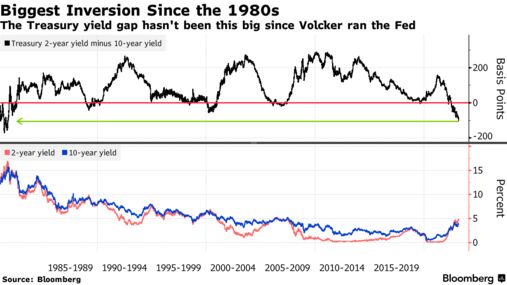
As a result, the closely-watched spread between 2- and 10-year yields this week showed a discount larger than a percentage point for the first time since 1981, when then-Fed Chair Paul Volcker was engineering hikes that broke the back of double-digit inflation at the cost of a lengthy recession
. A similar dynamic is unfolding now, according to Ken Griffin, the chief executive officer and founder of hedge fund giant Citadel. “We have the setup for a recession unfolding” as the Fed responds to inflation, Griffin said in an interview in Palm Beach, Florida. Longer-dated Treasury yields have failed to keep pace with the surging two-year benchmark since July, creating a curve inversion that over the decades has amassed a record of anticipating recessions in the wake of aggressive Fed-tightening campaigns.
In general, such inversions preceded economic downturns by 12 to 18 months. The odds of another occurrence are intensifying after Powell’s comments indicate he is open to reverting to half-point rate hikes in response to resilient economic data. The Fed’s quarter-point hike on Feb. 1 was the smallest since the early days of the current cycle. “Rate volatility will be with us until the Fed is really done,” said George Goncalves, head of US macro strategy at MUFG. “Higher vol means you have to derisk and put more of a risk premium back into credit and equities.” US stocks extended the decline they’ve suffered over the past month, with the S&P 500 Index notching a 1.5% drop on Tuesday, its biggest in two weeks. It regained some ground in Wednesday trading. Hopes that the Fed might be near the end of its tightening cycle had boosted the gauge by over 6% in January “It is hard to deny the hawkishness of the statement and the message that markets took away,” strategists at NatWest Markets wrote in a note to clients Tuesday. Powell “firmly opened the door” for a return to 50-basis-point moves, although he emphasized the importance of upcoming data releases, which are “likely to be high vol events,” according to strategists Jan Nevruzi, John Briggs and Brian Daingerfield. Powell told members of Congress on Tuesday that there are “two or three more very important data releases to analyze” ahead of the March deliberations, and “all of that will go into making the decision.” On Wednesday, testifying before lawmakers again, he stressed that “no decision has been made.” NN: I guarantee you unless their is a surprise on Fridays jobs report or Tuesdays CPI the FED will be raising rates by 50 bases points.
Oil prices fell over 1% on Wednesday after fears of more aggressive rate hikes by the U.S. Federal Reserve continued to compound, with losses extending. On Tuesday, Federal Reserve Chairman Jerome Powell said the Fed would most likely find it necessary to raise interest more than expected to control inflation as a result of strong U.S. economic data. Fed funds futures traders interviewed by Reuters now see a 66% probability that the Fed will raise interest rates by 50 basis points at the next meeting on March 21-22. Prior to Powell’s Tuesday testimony before the U.S. Senate, traders put the probability of such a move at only 22%. The Fed’s hawkishness was putting downward pressure on crude oil prices on Tuesday and Wednesday. Oil markets are now concerned that the Fed’s policy may be to raise interest rates higher and for longer, which would stifle economic growth and oil demand. Also weighing on oil prices on Wednesday was a mixed inventory report from the Energy Information Administration (EIA). The markets initially appeared to interview the weekly inventory report as positive, with a 1.7 million-barrel draw on crude inventory for the week to March 3, compared with a 1.2-million-barrel build the previous week. However, Fed hawkishness has continued to be the strongest driver of prices today. As prices extended their losses from Tuesday to Wednesday, Barclays slashed its Brent crude oil forecast for 2022 to $92, shaving $6 off its earlier forecast, citing Russian resilience amid sanctions. Barclays also cut its 2023 WTI forecast by $7 to $87 per barrel. NN: F.ed rates are increasing because the economy and inflation is NOT slowing..
Crude oil prices started this week with a loss. The reason for that initial weekly loss came down to overall global economic growth pessimism and expectations that the U.S. Federal Reserve will continue raising interest rates, making the dollar more expensive and sapping demand for dollar-priced crude. But by the end of Monday, oil prices had rebounded and were trading higher, extending the rally into morning Asian trade on Tuesday. The reason—comments from attendees at the CERAWeeek industry conference—suggested that supply will tighten before too long. Just another week in oil, some would say, and indeed, oil prices fluctuate constantly, to such an extent it is extremely difficult to predict them with any accuracy, especially over a shorter period of time. Yet it does bear pointing out that most forecasters seem to expect higher prices for oil later this year. There appears to be broad consensus on this. Some, such as Forbes’ Bill Sarubbi, note the technical data of oil trading to suggest prices are going to go higher. In a recent story, Sarubbi said that historical data shows oil prices tend to rise between March and May most of the time, so it makes sense to expect them to rise this year as well. Others, such as Refinitiv, the data analytics firm, single out two factors that will drive prices on the supply and demand sides, respectively: Russia and China. And Refinitiv expects Brent crude to rise above $100 per barrel by the end of the year and average $90 for the full year 2023. Oil demand this year will surge by 2 million barrels daily, Refinitiv said at a recent industry event, and China will account for half of that. On the other hand, Russia’s supply will tighten this month and maybe remain tight, adding upward pressure to prices. That’s despite prices shaking off the initial shock and surge after the G7/EU price cap on Russian crude and declining more or less consistently since then, stuck in a narrow range around $80. Then there is Goldman Sachs, whose senior energy economist recently reiterated the bank’s forecast for higher oil prices, explaining it with the lag between an oil market shock—especially a supply shock—and the effect of the shock manifesting in futures prices. Spot market shocks, according to Daan Struyven, as quoted by the Financial Times, have an immediate impact on prices, as one would expect. Futures market shocks, on the other hand, take months to manifest and affect prices. Struyven concluded this after looking at data for spot demand shocks, such as disappointing economic data from China or the United States, spot supply shocks, such as natural disasters, future demand shocks, such as fiscal stimulus announcements, and future supply shocks, such as OPEC’s announcements to cut production. Indeed, just this week, there was a spot demand shock when China said it would aim for 5-percent economic growth this year, and the figure was taken to be disappointing, driving oil prices down. That was before CERAWeek delegates such as Chevron’s Mike Wirth and Gunvor’s Torbjorn Tornqvist warned supply is tight—a potential future supply shock—which drove prices higher.
“There’s not a lot of swing capacity, there’s not a lot of inventory capacity,” Wirth said, as quoted by Reuters. “There’s now a lot of constraints … an unexpected event today would create a different balance.”
The stage seems set for higher prices. Oil demand globally will hit a record high, according to the International Energy Agency. OPEC is sticking to its limited production agreement. Russia has announced a 500,000-bpd cut to its crude oil output this month. U.S. oil producers have repeatedly signaled they will not be prioritizing production growth. In the end, it’s all about the balance between supply and demand. When the former tightens, and the latter remains robust, prices inevitably rise.
One of the bond market’s most reliable gauges of impending U.S. recessions plunged further below zero into triple-digit negative territory on Tuesday after Federal Reserve Chairman Jerome Powell pointed to the need for higher interest rates and a possible reacceleration in the pace of hikes.
The widely followed spread between 2- and 10-year Treasury yields finished the New York session at minus 103.7 basis points — a level not seen since Sept. 22, 1981, when it reached minus 121.4 basis points and the fed funds rate was 19% under then-Federal Reserve Chairman Paul Volcker.
Powell surprised financial markets on Tuesday with more hawkish comments than many expected, which sent the policy-sensitive 2-year rate above 5%, all three major stock indexes DJIA, -1.72% SPX, -1.53% COMP, -1.25% to lower finishes, and the ICE U.S. Dollar Index up by 1.2% to its highest level since January. Meanwhile, traders boosted the odds of a half-of-a-percentage point rate hike on March 22, to 70.5% from 31.4% a day ago, and saw a growing chance that the fed funds rate will end the year between 5.5% and 5.75% or higher, according to the CME FedWatch Tool. “Every time the Fed gets more hawkish, the curve gets more inverted, which is the market’s way of saying there will be Fed rate cuts later because of a slowdown in growth and/or a recession,” said Tom Graff, head of investments for Facet in Baltimore, which manages more than $1 billion. “It tells you what the market thinks about the sustainability of keeping rates this high for a long time, and the market still thinks a recession is pretty likely but not necessarily imminent.” An inverted 2s/10s spread simply means that the policy-sensitive 2-year rate TMUBMUSD02Y, 5.044% is trading far above the benchmark 10-year yield TMUBMUSD10Y, 3.974%, as traders and investors factor in higher interest rates in the near term and some combination of slower economic growth, lower inflation, and possible interest-rate cuts over the longer term. Tuesday’s triple-digit inversion was largely driven by the rise in the 2-year rate, which ended the New York session above 5% for the first time since June 18, 2007, according to Tradeweb and Dow Jones Market Data. The 2s/10s spread first went below zero last April, only to un-invert again for a few months before dropping further into negative territory since June and July. It is just one of more than 40 Treasury-market spreads that were below zero as of Tuesday, but is regarded as one of the few with a reasonably reliable track record of predicting recessions, albeit with a one-year lag on average and at least one false signal in the past.
Via phone, Graff said that “I don’t think the power of yield-curve inversion as a signal has changed at all. Every slowdown and every cycle is a little different so how it plays out is a little different. But that signal is just as powerful and accurate as ever. I think the economy is going to slow meaningfully in the second half of this year, but not fall into recession until 2024.” Meanwhile, Facet has been overweight on healthcare and established technology companies with higher profit margins, lower debt levels and less variability in their earnings than in the past, he said. As a result of Powell’s testimony, the 1-year T-bill rate jumped by more than any other rate, to 5.27%, while the 6-month T-bill rate went up to 5.21% on Tuesday. The Fed chairman’s focus on the need for higher rates came as lawmakers repeatedly asked him whether interest rates are the only tool available to policy makers for controlling inflation. Powell replied that interest rates are the main tool, demurring from an opportunity to discuss the Fed’s quantitative tightening process — or shrinking of the central bank’s $8.34 trillion balance sheet — in more detail. NN: I want THERE to be no misunderstanding here. Real Estate will wipe out. The stock market is about to have a 100 year event and the economy will be in a no shit full blown depression… Prepare for ugly. As you are seeing the WallStreet talking heads are not at a 6% Fed Fund rates….. As usual late for the party. I see Fed Funds going to 8% and if things continue on this track I am looking for a 10% FED FUND RATE..
Crude oil inventories in the United States decreased by 3.84 million barrels in the week that ended March 3, private data from the American Petroleum Institute (API) reportedly showed on Tuesday. Reserves in Cushing, Oklahoma, allegedly rose by 240,000 barrels. Meanwhile, gasoline stockpiles surged by 1.84 million barrels, ( NB: this is the lowest gasoline demand time of the year… Refineries build inventories in anticipation of the coming driving season) and distillate inventories increased by 1.97 million barrels, according to the report.
US EIA revises up oil demand outlook for 2023
The United States Energy Information Administration (EIA) on Tuesday revised up global oil demand outlook for the next two years, forecasting total consumption to reach 100.9 million barrels per day (bpd) in 2023 and 102.69 million bpd in 2024. The agency’s Short-Term Energy Outlook (STEO) for March revealed that China will be the key driver behind the demand growth as the country shifts away from its zero-COVID policy. Additionally, EIA projected global crude output to increase by 1.5 million bpd to a total of 101.5 million bpd in 2023. The agency forecasted additional 1.8 million bpd increase in oil production in 2024, bringing the total volume to 103 million bpd. In the United States alone, the total crude output volume is expected to hit 12.44 million bpd in 2023, and 12.63 million bpd in 2024.
WTI drops 3% on monetary policy worries
Prices of oil futures extended losses on Tuesday as traders assessed comments United States Federal Reserve Chair Jerome Powell made during his testimony before Congress. He reaffirmed the Fed’s commitment to pushing inflation down, stating that a higher terminal interest rate, the point where the US central bank is expected to stop hiking rates and reanalyze the impact of its restrictive monetary policy, could be more elevated than what the previous projections have shown. West Texas Intermediate (WTI) for settlements in April declined 2.97% to $78.07 per barrel at 12:18 pm ET. Brent for deliveries in May was down 2.59% to $83.96 per barrel at the same time. NN BlackMask Blog: