Tight production capacity for liquefied natural gas could lead to shortages next winter, the head of the International Energy Agency, Fatih Birol, has warned. As gas demand from China begins to recover, competition for LNG supply will increase, creating the risk of shortages, Birol told Reuters on the sidelines of the Munich Security Conference. The head of the IEA praised European governments for making “many correct decisions” last year to secure supply, including the construction of more LNG import terminals. He noted, however, that the mild winter had been a stroke of luck for Europe, combined with the demand drop in China amid last year’s lockdowns. “For this winter it is right to say that we are off the hook. If there are no last minute surprises, we should get through…maybe with some bruises here and there,” Birol told Reuters. “But the question is…what happens next winter?” The official noted that some 23 billion cubic meters of natural gas are expected to be added to the global LNG supply this year, which would be equal to some 16.8 million tons. Yet even a moderate recovery in China’s economic activity would absorb 80 percent of that additional supply. Birol then went on to say that this meant Europe may end up short of gas for next winter, saying “Even though we have enough LNG import terminals, there may not be enough gas to import and therefore it will not be easy this coming winter for Europe,” adding that “It is not right to be relaxed, it is not right now to celebrate”. Europe is about to end winter 2022/23 with record high levels of gas in storage, which theoretically means it would need to buy less for the next heating season. Still, last year’s refill purchases featured a solid amount of Russian gas that will not be available this year and will need to be replaced. NN: Politicians are the first ones to break out the Champaign,,, especially since some one else is paying for it. Reality is Europe was saved by dumb luck. China was in lock down and winter was exceptionally mild. Details the politicians patting themselves on the back ignore. They will not be so lucky this coming winter. Did i mention its a binary trade… China consumption is all you have to look at to make potentially millions….. Yes as a matter of fact i did mention a time or two the binary thing!!
U.S. December oil demand hits highest since before pandemic -EIA IEF: GLOBAL Oil demand hit all-time high in December 2022
Feb 28 (Reuters) – U.S. oil demand rose in December to its highest level since before the coronavirus pandemic began, the U.S. Energy Information Administration (EIA) said on Monday, with product supplied nearing 21 million barrels per day (bpd). Overall fuel demand was up 10% year-on-year in December at 20.8 million bpd, its highest since August 2019. Product supplied is a proxy for consumer demand since it mostly reflects fuels processed from U.S. crude oil for consumption and export. The rapid increase in U.S. oil demand while output remains slow to return to record highs, has forced energy firms to pull massive amount of crude from storage over the past year and helped boost oil futures to their highest since 2014. Crude oil output slipped by about 206,000 bpd to 11.57 million bpd in December, the EIA said in its Petroleum Supply Monthly report. That is about 9% below the 12.83 million bpd produced before the pandemic in February 2020.
IEF: GLOBAL Oil demand hit all-time high in December 2022
Global oil demand jumped by 1.3 million barrels per day in December 2022 “to a new record high,” the International Energy Forum (IEF) stated on Monday citing the Joint Organizations Data Initiative (JODI). The rise in demand was primarily driven “by gains in Japan, Indonesia, and Korea.” Meanwhile, global crude output declined by 274,000 barrels per day in the reported month, hitting its lowest point in five months as the United States and the United Kingdom led the losses. “While markets tightened compared to November, global inventories of crude and refined products climbed counter seasonally by 5.46 mb [million barrels]. Inventories remain 354 mb below the five-year average,” IEF shared. NN: Are you going to let them make an asshole out of you. Stick to your guns. Do not let them punk you….
Iran Nuclear Inspectors Find Uranium Enriched to 84% Purity……. Will Israel Attack Iran to Stop its Nuclear Program? Do they have any choice
International atomic monitors in Iran last week detected uranium enriched to levels just below that needed for a nuclear weapon, according to two senior diplomats, underscoring the risk that the country’s unrestrained atomic activities could prompt a new crisis. International Atomic Energy Agency is trying to clarify how Iran accumulated uranium enriched to 84% purity — the highest level found by inspectors in the country to date, and a concentration just 6% below what’s needed for a weapon. Iran had previously told the IAEA that its centrifuges were configured to enrich uranium to a 60% level of purity. Inspectors need to determine whether Iran intentionally produced the material, or whether the concentration was an unintended accumulation within the network of pipes connecting the hundreds of fast-spinning centrifuges used to separate the isotopes. It’s the second time this month that monitors have detected suspicious enrichment-related activities. A senior Iranian nuclear official denied Iran had enriched uranium beyond 60% purity “so far” and dismissed the development as “a smear and a distortion of the facts.” “The existence of uranium particles above 60% does not mean the same thing as enrichment above 60%,” Behrouz Kamalvandi, spokesman for the Atomic Energy Organization of Iran told the state-run Islamic Republic News Agency. The IAEA responded on Sunday and said it is discussing with Iran the results of the agency’s recent verification activities and will inform its board of directors as appropriate, according to a tweet citing IAEA Director General Rafael Mariano Grossi. The development comes as Iran is increasingly isolated from the West and nuclear talks with world powers remain stalled. The country has also faced widespread condemnation for its deadly crackdown on major protests and the US and European Union have tightened sanctions on Iran over its military support for Russia’s war on Ukraine. US Focus on Iran Is Thwarting Weapons Aid to Russia, Envoy Says Earlier on Sunday, Israel blamed Iran for a Feb. 10 attack on an oil tanker in the Arabian Sea. The incident came about a fortnight after a drone strike on a weapons depot near Iran’s city of Isfahan that Tehran blamed on Israel. The IAEA is preparing its quarterly Iran safeguards report ahead of a March 6 Board of Governors meeting in Vienna, where the Persian Gulf nation’s nuclear work will figure prominently on the agenda. Iran hasn’t submitted required forms declaring its intention to raise uranium enrichment levels at two facilities near the towns of Natanz and Fordow, according to one diplomat. Even if the detected material was mistakenly accumulated because of technical difficulties in operating the centrifuge cascades — something that has happened before — it underscores the danger of Iran’s decision to produce highly enriched uranium, the other diplomat said.
The IAEA has repeatedly said levels even at just 60% are technically indistinguishable from the level needed for a nuclear weapon. Most nuclear power reactors use material enriched to 5% purity.
A nuclear deal between Iran and world powers unraveled after then-President Donald Trump withdrew the US in 2018 and reimposed sanctions. In response, Iranian officials expanded the country’s nuclear program. Tehran denies it’s seeking to build atomic warheads but concerns it might develop the technology to do so propelled years of diplomacy that led to the deal with world powers. Grossi called the atomic deal an “empty shell” last month and said Iran has sufficient nuclear material for several weapons, should it make the political decision to move forward.
NN: What will the price of oil be under 2 scenarios.
- Israel with US deniability takes out Iran’s Nuclear weapons sightsss
- Or Iran Nukes Tel Aviv for Islamic fun and turns it into down town Hiroshima like it was on 9 August 1945
Europe is short of Russian oil, and we’ll see more U.S. crude there
HOUSTON, Feb 17 (Reuters) – U.S. crude oil exports that have been boosted by a trade flow reshuffle in the aftermath of Russia’s invasion of Ukraine will remain elevated this year as Europe and Asia search for supplies, company officials and analysts said. Western sanctions on Russia’s crude and oil products have opened the door to rising demand for U.S. crude grades as many European countries have become thirsty for alternative supplies. This year, Russia’s oil is expected to continue flowing to India and China, while heightened volumes of U.S. crude will go to European and Asian customers.”A key change in flow is U.S. crude going to Europe,” Colin Parfitt, Vice President of Midstream for Chevron Corp (CVX.N), told Reuters on the sidelines of the Argus Americas Crude Summit. “For this year, I’m pretty confident Europe is short of Russian oil, and we’ll see more U.S. crude there.” Exports of U.S. crude to Europe reached nearly 1.69 million barrels per day (bpd) in December, the highest in at least two years, according to data and analytics firm Kpler. It has since eased to about 1.42 million bpd in February. NN: the US is already releasing oil from the strategic reserve. Bottom line with China demand soaring and the stupid shit Russian sanctions… the leaders of the world are taking turns shooting each other in the dick and or tit….
Tight U.S. Jet Fuel Market……. Wait to see What China is going to do
A surge in the number of passengers looking to travel via air is creating a tight jet fuel market that is pushing up costs for airlines and those looking to purchase flights, according to Reuters. Behind the U.S. jet fuel squeeze is a hoard of willing airline passengers who are looking to travel post-pandemic, after movements were restricted. According to the latest data from the Energy Information Administration (EIA), there were 36.532 million barrels of kerosene-type jet fuel in the United States as of February 10—the lowest for this time of year since 1985, but up 7114,000 barrels from the week prior. A distillate jet fuel competes with refinery time with other stretched class members such as diesel. The tight market has sent jet fuel prices to $3.37 per gallon, or $142 per barrel last year. Reuters lists the 2019 average price for a gallon of jet fuel at just $2. This means that in 2022, airlines spend $56 billion on jet fuel alone—up from $36 billion in 2019.
Now that China is backing away from its strict zero-covid policy, global airline traffic is set to see at least some level of increase, sucking up even more jet fuel and tightening the global jet fuel market even more.
The United States has an ambitious plan to meet 100% of its jet fuel demand with sustainable fuel by the year 2050.NB: i can’t wait.. why hurry?
But to achieve this goal, renewable jet fuel costs must come down substantially. Renewable jet fuel currently accounts for just 0.1% of all aviation fuel. NN: Their is no viable alternative to Jet A . And their will not be enough soon enough to advert the coming shortages
China’s reopening will be the gamechanger for oil prices this year….. Its a Binary trade!!!
International Energy Agency (IEA) Executive Director Fatih Birol told CNBC on Friday, while attending the Munich Security Conference, that the rebound in China’s economy is currently the biggest uncertainty for the oil markets. He explained that although the crude markets are “balanced” at present, producers are focusing on the demand signals that will be coming from China. “How strong this advantage [China’s recovery] will be will decide the oil and gas market dynamics. If it’s a very strong rebound, there may be a need that oil producers will increase their production,” Birol noted. Previously, Chinese officials proclaimed that the country has managed to reach a “major and decisive victory” in preventing and controlling the COVID-19 pandemic. NN BaclkMask Blog:
Oil is a binary trade
Crude drops 2% as fears over Fed’s monetary policy grow
Crude oil prices for future contracts dropped 2% on Friday, with demand concerns weighing on the global markets as investors feared that Federal Reserve could lean towards further monetary tightening following key data releases this week.The Federal Reserve may be able to raise rates again, as the latest reading on retail sales in the United States revealed that consumer demand was pushing stronger against high interest rates. Producer prices in the country also went up by 0.7%, potentially signaling that the inflation could be higher-than-expected, therefore raising concerns that policymakers may push for additional rate hikes. For deliveries in March, West Texas Intermediate (WTI) declined 2.01% to go for $76.91 per barrel at 3:35 am ET. Brent for settlements in April went down by 1.96% to sell at $83.48 per barrel at 3:45 am CET. NN: BlackMask Blog:
the games they play
Fed officials say more rate hikes key to reducing inflation
Two Federal Reserve officials said on Thursday the U.S. central bank likely should have lifted interest rates more than it did early this month, and warned that additional hikes in borrowing costs are essential to lower inflation back to desired levels. The Fed “has come an appreciable way in bringing policy from a very accommodative stance to a restrictive one, but I believe we have more work to do,” Cleveland Fed President Loretta Mester said in a virtual speech to a Global Interdependence Center conference. “The incoming data have not changed my view that we will need to bring the fed funds rate above 5% and hold it there for some time” in a bid to get inflation back to the central bank’s 2% target. At its Jan. 31-Feb. 1 policy meeting, the Fed opted to moderate the pace of what had been a torrid barrage of rate hikes and lifted its benchmark overnight interest rate by a quarter of a percentage point to the 4.50%-4.75% range. The central bank also signaled more rate hikes are coming to help lower overly high inflation levels back to the 2% target. But in the wake of that gathering, data showed unexpectedly strong job gains for January that raised questions as to whether the labor market has slowed to the degree Fed officials believe is necessary. Earlier this week, the government reported the consumer price index in January did not moderate as much as economists had forecast, keeping pressure on the central bank to act further to tighten monetary policy. Mester, who does not have a vote on the policy-setting Federal Open Market Committee this year, said she thought even before the release of the jobs and CPI data that her colleagues were not being aggressive enough with their most recent rate hike. “I saw a compelling economic case for a 50-basis-point increase,” she said. In a separate conversation with reporters, St. Louis Fed President James Bullard, who also does not hold a vote on the FOMC this year, agreed there was a good case for the Fed to have been more aggressive with its recent rates decision. “I was an advocate for a 50-basis-point hike and I argued that we should get to the level of rates the committee viewed as sufficiently restrictive as soon as we could.” Both policymakers have on balance been on the more hawkish side of the policy debate. Bullard was also one of the Fed’s earliest advocates for rolling back the massive amount of stimulus the central bank pumped into the economy to tackle the impact of the COVID pandemic. Mester told reporters after her remarks that she’s not ready to say how big a rate hike the central bank should deliver at its March 21-22 meeting. The central bank is due to release updated forecasts at next month’s meeting, amid expectations the projected rate will climb to a higher level. In comments on Tuesday, New York Fed President John Williams, who is vice chair of the FOMC, said it appeared reasonable to him for the federal funds rate to be between 5.00% and 5.50% by the end of this year. In his presentation to a business group in Tennessee, Bullard said “inflation remains too high but has declined,” adding that “continued policy rate increases can help lock in a disinflationary trend during 2023, even with ongoing growth and strong labor markets.” NN: I have seen a lot less interest rate hikes bring on massive recessions. How the market can get anyone to believe this time it different is beyond me.

Mester, who does not have a vote on the policy-setting Federal Open Market Committee this year, said she thought even before the release of the jobs and CPI data that her colleagues were not being aggressive enough with their most recent rate hike. “I saw a compelling economic case for a 50-basis-point increase,” she said.
In a separate conversation with reporters, St. Louis Fed President James Bullard, who also does not hold a vote on the FOMC this year, agreed there was a good case for the Fed to have been more aggressive with its recent rates decision. “I was an advocate for a 50-basis-point hike and I argued that we should get to the level of rates the committee viewed as sufficiently restrictive as soon as we could.”
Advertisement · Scroll to continue
Both policymakers have on balance been on the more hawkish side of the policy debate. Bullard was also one of the Fed’s earliest advocates for rolling back the massive amount of stimulus the central bank pumped into the economy to tackle the impact of the COVID pandemic.
Mester told reporters after her remarks that she’s not ready to say how big a rate hike the central bank should deliver at its March 21-22 meeting. Futures markets are currently eyeing another quarter-percentage-point increase on March 22 and are split as to whether the federal funds rate will hit the 5.00%-5.25% or 5.25%-5.50% range by June.
In December, Fed policymakers penciled in a 5.1% stopping point for that rate this year. The central bank is due to release updated forecasts at next month’s meeting, amid expectations the projected rate will climb to a higher level.
In comments on Tuesday, New York Fed President John Williams, who is vice chair of the FOMC, said it appeared reasonable to him for the federal funds rate to be between 5.00% and 5.50% by the end of this year.
Fed’s Mester doesn’t rule out possibility of recession…. Soft landing my ass try crash landing with massive fatalities
Cleveland Federal Reserve Bank President Loretta Mester said a recession could still be triggered in the United States by the central bank’s attempt to cool high inflation. Mester said the high-interest rates are already slowing the economy and noted that when growth is already “well below trend” a recession wouldn’t have that much of a negative shock. “I don’t think that’s necessarily a positive thing,” she admitted. The official went on to say that a meaningful downturn in the American economy is not what she estimated at the outset and that it’s not what the Fed is “engineering to do.” NN: What bullshit. The Fed has never ever raised rate raised unemployment without triggering a recession. The more they raise rates the bigger the recession and more people lose jobs. It will be no different this time… Despite spin deigned to foo the fools.
PPI UP 6.4% Core up 5.6 far above expectations
/
US consumer prices rose briskly at the start of the year, a sign of persistent inflationary pressures that could push the Federal Reserve to raise interest rates even higher than previously expected. The overall consumer price index climbed 0.5% in January, the most in three months and bolstered by energy and shelter costs, according to data out Tuesday from the Bureau of Labor Statistics. The measure was up 6.4% from a year earlier.
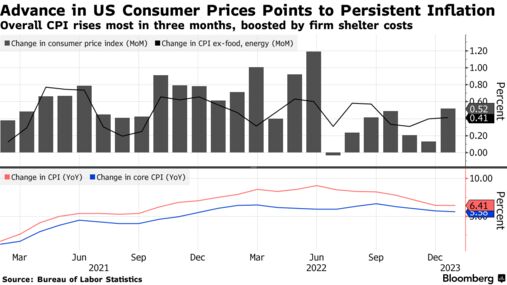
Excluding food and energy, the so-called core CPI advanced 0.4% last month and was up 5.6% from a year earlier. Economists see the gauge as a better indicator of underlying inflation than the headline measure.
Both annual measures came in higher than expected and showed a much slower deceleration than in recent months. The figures remain far higher than the Fed’s 2% target, which is based on a separate Commerce Department index.
“It’s going to be tough to get inflation down anywhere close to where the Fed would like to see it.”
The data support officials’ recent assertions that they need to hike rates further and keep them elevated for some time, and possibly to a higher peak level than previously expected. The path to stable prices will likely be both long and bumpter The details of the report showed shelterwas “by far” the largest contributor to the monthly advance, accounting for almost half of the rise. Used car prices — a key driver of disinflation in recent months — fell for a seventh month. Energy prices rose for the first time in three months.y. The goods disinflation that has driven the slide in overall inflation in recent months appears to be losing steam, and the strength of the labor market continues to pose upside risks to wage growth and service prices. NN: Inflation is alive and well and the FED is going to raise the shit out of rates. And the country is going into depression and the stock market will crash.