Powell pivoted away from the Fed’s dovish message

Fed chair wants everyone to know that he’s going to fight inflation until it cries uncle

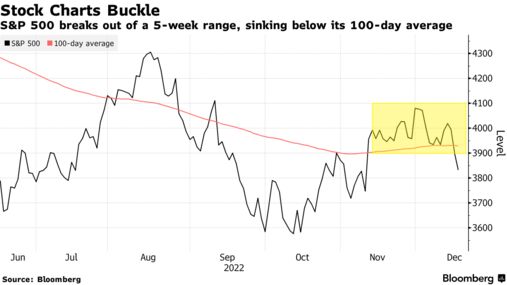
Fed Chair Jerome Powell is learning on the job. He didn’t repeat the mistake he made in his July press conference, when he said some things that markets interpreted as signs that the Fed was wavering in its commitment to fighting inflation. The stock market SPX, -0.91% took the same interpretation from the statement released by the Fed today, but Powell quickly corrected the record. Here’s the key sentence from the statement that the market bulls seized on before Powell spoke: “In determining the pace of future increases in the target range, the Committee will take into account the cumulative tightening of monetary policy, the lags with which monetary policy affects economic activity and inflation, and economic and financial developments.” Markets initially rallied on the idea that the Fed was signaling the long-anticipated pivot in monetary policy. The Dow DJIA, -0.42% was up about 300 points.

But Powell immediately quashed those hopes in his press conference, announcing that the Fed “had a long ways to go” on interest rates and declaring that it was premature to talk about a pause in rate hikes. Furthermore, he said that it was quite likely that they would have to raise interest rates to a higher level than they had expected just six weeks ago because the inflation picture had gotten “more and more challenging.”

Powell pivoted, but in the hawkish direction. Markets COMP, -1.41% tanked. Powell recognized that the dovish language in the statement was a necessary sop to the doves on the committee, showing that the Fed is aware that its rate hikes are beginning to bite or that inflation measures such as the consumer price index (CPI) and the personal consumption expenditures (PCE) price index will be slow to adjust to the collapse of the housing market. But Powell knew he had to balance that sweet dovishness with some hawkish heat to put the bulls back in their place. He doesn’t want the market to start celebrating the victory before it’s won. Powell knows he has to prove to everybody that he’s serious about taking away the punch bowl. He wants us to believe with every fiber that the Fed is going to fight inflation until it cries uncle. NN: Their could be bigger problems brewing then they are letting on.

U.S. payrolls rose 239,000 in October ADP reports

ADP Private Payrolls Rose by 239,000 in October, Defying Slowdown Forecasts

The U.S. private sector picked up the pace of hiring again in October, defying expectations of a slowdown and potentially crimping the Federal Reserve’s ability to ease up on the pace of its interest rate hikes. Payrolls processor ADP said private-sector employment had risen by 239,000 through the middle of the month, from 192,000 a month earlier. September’s figure was revised down from an originally reported 208,000. Analysts had expected a figure of around 195,000. However, ADP said the broad trend across the labor market appears to be weakening, noting that the three-month average gain was slowing, and also noting a slowdown in earnings growth, which slowed to 15.2% from 15.7% for those who switched jobs in the last year. For workers who stayed, annual earnings growth was unchanged at 7.7%.

“This is a really strong number given the maturity of the economic recovery, but the hiring was not broad-based,” ADP’s chief economist Nela Richardson said in a statement. “Goods producers, which are sensitive to interest rates, are pulling back, and job changers are commanding smaller pay gains.”

Almost all of the gains in employment were down to the leisure and hospitality sector, which continues to extend its recovery from the pandemic. It added 210,000 jobs during the month. By contrast, construction employment was almost unchanged and manufacturing payrolls shrank by 20,000. As with the Labor Department’s Job Openings and Labor Turnover survey for September, which was released on Tuesday, the numbers appear to suggest that the labor market is still – at least in certain sectors – red hot, despite the Fed’s attempts to cool demand by raising interest rates sharply this year. The Fed is expected to announce another 75 basis point increase in the target range for Fed Funds later Wednesday, taking its upper limit to 4.0%. “While we’re seeing early signs of Fed-driven demand destruction, it’s affecting only certain sectors of the labor market,” Richardson said. Analysts have said the sectoral pattern of job gains is consistent with the Fed’s strategy of trying to achieve a ‘soft landing’ for the economy, in that those workers who are losing their jobs still seem easily able to find work in leisure and hospitality, which has historically tended to absorb surplus labor from other sectors. The 239,000 job gain is also bigger than the 200,000 consensus forecast for nonfarm payrolls in the government’s labor market report, which is due on Friday. NN: Higher longer, any hope the Fed is going to back off slaming on the breaks was laid to rest this week by the latest batch of economic reports. In fact they are proable feeling pretty frustated about how resiliant the economy and inflation is. They can’t kill the beast

Crude inventories plunged 6.53 million barrels last week

What went wrong?

The American Petroleum Institute (API) reported a huge draw this week for crude oil of 6.53 million barrels. U.S. crude inventories have grown by roughly 25 million barrels so far this year, according to API data, while the U.S. Strategic Petroleum Reserves fell by more than seven times that figure, at 194 million barrels. The draw in crude oil inventories was despite the Department of Energy’s release of 1.9 million barrels from the Strategic Petroleum Reserves in the week ending October 28, leaving the SPR with 399.8 million barrels.

U.S. crude oil production has remained flat for months. For the week ending October 21, U.S. crude oil production stayed at 12 million bpd, according to the latest weekly EIA data, within the same 11.9-12.1 million bpd range it has been in since the beginning of summer. At 12 million bpd, U.S. crude production is just a 300,000 bpd rise from the levels seen at the start of the year, and still a 1.1 million bpd shortfall from the levels seen at the start of the pandemic.

The API reported a draw in gasoline inventories this week of 2.64 million barrels for the week ending October 21, compared to the previous week’s 2.278 million-barrel draw. Distillate stocks saw a build this week of 865,000 barrels, compared to last week’s 635,000-barrel increase. Cushing inventories rose 883,000 barrels in the week to October 28. In the week prior, the API saw a Cushing increase of 70,000 barrels. NN: New math.. you release 200 million barrels from the emergency stock pile. At the same time your anti oil polices reduce production by 300 million barrels… Question what happens when your emergency reserves used for price manipulation runs out?

Hospitalizations on the rise in New York City as new COVID strains spread rapidly

Hospitalizations are rising again in New York City with the spread of new COVID-19 subvariants that are better at evading immunity. Cases of flu and respiratory syncytial virus, or RSV, are also increasing. State data show about 1,100 patients hospitalized with COVID as of Oct. 24, up from 750 in mid-September, as the New York Times reported. Case numbers have held steady, although with many people testing at home where data are not being collected, those numbers are not reliable. Data from the Centers for Disease Control and Prevention show that the omicron sublineages named BQ.1 and BQ.1.1 accounted for 42.5% of all cases in the New York region in the week through Oct. 29, up from 37% the previous week. That was more than the BA.5 omicron subvariant, which accounted for 35.7% of new cases in the New York region in the latest week. The two sublineages were not even registering as recently as three weeks ago, demonstrating just how fast they are spreading. Experts are also concerned about a nationwide surge in RSV, which can cause breathing difficulties in small children and older adults and for which there is currently no vaccine. There was good news from Pfizer Inc., however, which said Tuesday that data from a late-stage trial of an RSV vaccine had proved effective in preventing severe illness in children up to 6 months old. The Phase 3 trial found that the vaccine, given to pregnant mothers, achieved vaccine efficacy of 81.8% in infants from birth through the first 90 days of life. The trial found efficacy of 69.4% through the first 6 months of life. Pfizer PFE, 3.13% said it expects to make its first U.S. regulatory application for the vaccine by the end of 2022 and to follow on with other regulatory bodies. It will also submit the results of the trial for peer review in a scientific journal. The daily U.S. average for new COVID cases stood at 37,665 on Monday, according to a New York Times tracker, which was flat as compared with two weeks ago. The daily average for hospitalizations was up 2% to 27,184, while the daily average for deaths was down 3% to 348.  NN: Do not be lulled to sleep. Their is the sound of breaking glass coming from the back porch. Time to break out the hammer (lefties do not have guns) because no one is watching the video cameras…. I get my 5th shot next week…

Sometimes i wonder wbout things. Here is a picture of the back porch where the “right wing mage conserative crazy” broke in

U.S. House Speaker Pelosi's husband violently assaulted during break-in at their house in San Francisco

You can see where the lower right window is missing. I was wondering if it was a break IN why is the broken glass and debris on the outside?

Saudis warn US about ‘imminent’ attack by Iran – report

Saudis warn US about ‘imminent’ attack by Iran – report

Saudi Arabia recently warned the US of an imminent attack by Iran on targets in the kingdom and in Erbil, Iraq, the Wall Street Journal reported on Tues The US military and other militaries in the Middle East have raised their alert level in response to the warnings, according to the report. The planned attacks are aimed at distracting from the protests that have swept Iran in recent weeks. The White House National Security Council said it was concerned about the warnings and was ready to respond.

“We will not hesitate to act in the defense of our interests and partners in the region.”

NSC spokesperson

“We are concerned about the threat picture, and we remain in constant contact through military and intelligence channels with the Saudis,” said a National Security Council spokesperson, according to the Wall Street Journal. “We will not hesitate to act in the defense of our interests and partners in the region.”

Iran blames Saudi Arabia, US, Israel for protests

Iran has blamed the US, Saudi Arabia and Israel for the ongoing protests in the country. The IRGC launched a number of strikes against Kurdish militias in eastern Iraq shortly after the protests began, claiming that the militias were spreading unrest in Iran. NN: The regime is threatened. It would not take much for protests to become a revolution. The Ayatollahs are very concerned to say the least. It would not take much more for them to launch an attack on a enemy.  It does  things, takes the heat off and focuses attention elsewhere AND sends a warning,,,

US job openings up to 10.7 million in September in the closely watched JOLTS report

Job openings hit 10.7M despite Fed attempts to cool economy

WASHINGTON (AP) — U.S. job openings rose unexpectedly in September, suggesting that the American labor market is not cooling as fast as the inflation fighters at the Federal Reserve hoped. Employers posted 10.7 million job vacancies in September, up from 10.3 million in August, the Labor Department said Tuesday. Economists had expected the number of job openings to drop below 10 million for the first time since June 2021. For the past two years, as the economy rebounded from 2020’s COVID-19 recession, employers have complained they can’t find enough workers. With so many jobs available, workers can afford to resign and seek employment that pays more or offers better perks or flexibility. So companies have been forced to raise wages to attract and keep staff. Higher pay has contributed to inflation that has hit 40-year highs in 2022. In another sign the labor market remains tight and employers unwilling to let workers go, layoffs dropped in September to 1.3 million, fewest since April. But the number of people quitting their jobs slipped in September to just below 4.1 million, still high by historical standards. “By all the key metrics in this report, the labor market is resilient,” said Nick Bunker, head of economic research at the Indeed Hiring Lab. “Job openings still vastly outnumber unemployed workers, the quits rate remains elevated and layoffs are still well below pre-pandemic levels.” To combat higher prices, the Federal Reserve has hiked its benchmark interest rate five times this year and is expected to deliver another increase Wednesday and again at its meeting in December. The central bank is aiming for a so-called soft landing — raising rates just enough to slow economic growth and bring inflation down without causing a recession.  Fed Chair Jerome Powell has expressed hope that inflationary pressure can be relieved by employers cutting job openings, not jobs. NN:

OPEC chief: ‘Mixed messages’ impeding oil investment…… Biden Says Big Oil’s Windfall Profits Result Of ‘Brutal War’

OPEC Secretary General Haitham al-Ghais shared on Tuesday, writing for the Financial Times, that “mixed messages” are to blame for the lack of investment in oil, as countries are pushing oil and gas producers to ensure energy market stability and supply, while at the same time pledging to “end financing in fossil fuel projects.” Al-Ghais stressed that it is important for talks on energy, climate and sustainable development to be “inclusive, welcoming” rather than “emotive and forceful.” “We cannot return to a world that is limited by the question: are you for or against fossil fuels? It cannot be just one or the other,” the OPEC chief stressed. He further stated that such behavior “limits the options available to help the world meet the interwoven challenges of energy affordability and security that have emerged starkly in the past year.”

Biden Says Big Oil’s Windfall Profits Result Of ‘Brutal War’

In an address to the nation on Monday, President Joe Biden raised the specter of a windfall tax on energy companies that refuse to boost domestic production to bring down oil and gas prices which will weigh on midterm elections on November 8th.

With earnings season in full force, Biden was responding to a barrage of reports of America’s biggest oil companies bringing in record-high profits.

In his Monday statement, which aired at 4:30 p.m. EST, Biden said that oil companies were not earning windfall profits because of their innovation; rather, they were earning windfall profits on the back of a “brutal” war launched by Russia in Ukraine.  The U.S. president said he would work with Congress to impose tax penalties on oil company profits but offered no further details during the short briefing, and did not take questions from reporters.  Earlier in the day, a White House official had told the Associated Press that “The president will again call on oil and gas companies to invest their record profits in lowering costs for American families and increasing production”.  “And if they don’t, he will call on Congress to consider requiring oil companies to pay tax penalties and face other restrictions,” the unnamed official told AP ahead of the live briefing.  Gasoline prices at the pump have fallen for the third consecutive week; however, the White House maintains that prices have not fallen enough. National averages for a gallon of gasoline in the United States fell to $3.72 on Monday, according to GasBuddy data.  Also on Monday, government figures showed that U.S. oil output had risen to nearly 12 million barrels per day in August. That figure represents the highest level of oil production in the United States since before the COVID-19 pandemic, Reuters reported.

US not to ‘waste time’ on Iran nuclear deal at present – officials

If the US wont give them nukes their is always Russia

The Biden administration says it will not “waste time” on trying to revive talks with Iran regarding its dormant nuclear deal in light of Tehran’s brutal crackdown on antigovernment protesters and its support of Russia in its war against Ukraine.  While speaking at an event hosted by the Carnegie Endowment for International Peace on Monday, U.S. envoy for Iran Rob Malley said the administration “makes no apology” for “trying to do everything we can to prevent Iran from acquiring a nuclear weapon.”Malley’s comments were the closest a Biden administration official has come to admitting it was abandoning its efforts to resurrect the 2015 Iran nuclear deal. Over the summer, Iranian officials rejected an EU proposal and made more demands in late August and early September. The administration announced sanctions against Iranian officials for the brutal treatment of demonstrators. The administration has also hit Iran with sanctions for supplying drones and technical assistance to Russia and ordered U.S. military strikes in August against Iranian-backed militias in Syria in response to attacks on U.S. forces in the region. “I think people have to understand that we’re not tying our hands because of … this hope that someday maybe there’ll be a deal,” Malley said. “No, we are taking action. We’re not waiting. We’re taking the action that we think is consistent and necessary to promote our values and our national security interests.” The Iran nuclear deal already has been teetering toward collapse despite President Biden’s efforts to revive it since August, with his administration saying Tehran has sought to push extraneous issues into the indirect talks. Still, the administration has not given up all hope for a turnaround.

The pact, known as the Joint Comprehensive Plan of Action, or JCPOA, would provide Tehran with billions of dollars in sanctions relief in exchange for the country agreeing to roll back its nuclear program to the limits set by the 2015 deal.

The deal was brokered by the Obama administration before being abandoned by the Trump administration in 2018. It includes caps on enrichment and how much material Iran can stockpile and limits the operation of advanced centrifuges needed to enrich. NN: Let me tell you what really happened. The Biden administration knows things have gone to far. Nothing short of a military attack will stop Iran from building a missle launch nuclear arsenal. This was about the oil. Biden wanted oil and lots of it before the midterm elections. When the deal feel apart because Iran got a better offer from Russia the Biden administration spun it…..

JPMorgan Says Dovish Fed Could Spark 10% S&P Rally

While hopes for a less aggressive Federal Reserve helped US stocks overcome last week’s flurry of disappointing earnings from tech giants, JPMorgan Chase &. Co.’s trading desk now sees room for a massive rally should policy makers turn dovish when they announce their decision on Wednesday.  The S&P 500 could surge at least 10% in one day NB: Then again it could not read on!! if the central bank raises interest rates by a slower-than-expected half of a percentage point, and Chair Jerome Powell signals willingness at the press conference to tolerate elevated inflation and a tightening labor market, according to the bank’s sales team including Andrew Tyler. The scenario is the “least likely” to materialize, yet the “most bullish” outcome for equity investors, the team wrote in a note to clients on Monday. Laying out every possible scenario on Fed day, the JPMorgan team is embarking on a high-stakes task of predicting market moves based on an event that has largely been positive for stocks this year. Of the six prior meetings, the S&P 500 rose four times on Fed day and fell on the other two, according to Bloomberg data. To be sure, the bank’s economists expect the Fed to boost rates by another three-quarters of a percentage point, in line with the median forecast in a Bloomberg survey, and Tyler’s team views other scenarios as less likely. Still, the exercise offers a lens into the risks that investors are grappling with.  “These outcomes are skewed to the upside as our view is that last week the market had every reason to retest lows given the disappointment from megacap tech earnings and still moved higher,” noted Tyler and his colleagues. “Several client conversations have focused on trying to identify who is the incremental seller; we think the risk/reward is to the upside.”

FED MEETING POSSIBLE OUTCOMES

  • 50 basis point hike, with a dovish press conference: “It is difficult to conceive of a scenario where this outcome occurs given inflation levels and a tight labor market,” the team wrote. “Should this outcome occur, the immediate reaction could produce a double-digit one-day return for equities.” S&P 500 up 10% to 12%
  • 50 basis point hike and a hawkish press conference: An outcome that could stem from a Fed that is increasingly concerned about financial stabilities as it balances growth and inflation. S&P 500 up 4% to 5%
  • 75 basis point hike and a dovish press conference: A scenario viewed as having the second-highest probability of playing out. “If you saw the Fed give explicit guidance for the December meeting, then that is likely viewed as a dovish outcome.” S&P 500 up 2.5% to 3%
  • 75 basis point hike and a hawkish press conference: “This is the most likely outcome with Powell retaining optionality for December and 2023 meetings while emphasizing the current risks to inflation moving higher.”
  • 100 basis point hike and a dovish press conference: While this is seen as unlikely as a 50 basis point hike, it may mean the Fed both wants a higher terminal rate and wants to complete the tightening cycle this year. “Separately, the market may digest this move as the Fed having prior knowledge of where next week’s CPI prints.” S&P 500 down 4% to 5%
  • 100 basis point hike and a hawkish press conference: Considered the best outcome for equity bears waiting for this latest rally to dissipate. “Here this would seem to be a Fed reassessing its own inflation forecasts, which some investors feel is too optimistic.” S&P falls 6% to 8%, likely resting year-to-date lows. NN: I have no conviction either way. Its best to sit this one out. My gut tells me the FED is not done… And they are not going to back off raising rates until they see clear and persistent signs the inflation genie by Their measures is back in the bottle

OPEC publishes 2022 World Oil Outlook

https://youtu.be/6uidw9LsYNU

ABU DHABI (Reuters) – OPEC raised its forecasts for world oil demand in the medium-and longer-term in an annual outlook released on Monday and said $12.1 trillion of investment is needed to meet this demand despite the energy transition. The view from the Organization of the Petroleum Exporting Countries, in its 2022 World Oil Outlook, contrasts with that of other forecasters which see oil demand reaching a plateau before 2030 due to the rise of renewable energy and electric cars. Another decade of oil demand growth would be a boost for OPEC, whose 13 members depend on oil income. The group has been arguing that oil should be part of the energy transition and that focus by investors on economic, social and governance(ESG) issues has worsened an investment shortfall. “The overall investment number for the oil sector is $12.1 trillion out to 2045,” OPEC Secretary General Haitham Al Ghais wrote in the foreword to the report, which said the figure was up from last year’s estimate. “However, chronic underinvestment into the global oil industry in recent years, due to industry downturns, the COVID-19 pandemic, as well as policies centred on ending financing in fossil fuel projects, is a major cause of concern.” OPEC made a shift in 2020 when the pandemic hit demand, saying it would eventually slow after years of predicting ever-increasing consumption. In the report, OPEC maintained its view that world demand will plateau after 2035. Other predictions from companies and banks see oil demand peaking earlier. The International Energy Agency on Thursday for the first time in its history of modelling said demand for all fossil fuels was set to peak, with oil demand levelling off in the middle of the next decade. ENERGY SECURITY DEMAND BOOST The report said world oil demand will reach 103 million barrels per day in 2023, up 2.7 million bpd from 2022. The 2023 total demand is up 1.4 million bpd from last year’s prediction. OPEC also raised its demand forecasts for the medium term to 2027, saying the figure is up by almost 2 million bpd by the end of the period from last year. It said the upward revision reflects a more robust recovery now seen in 2022 and 2023 and a “strong focus on energy security issues” leading to a slower substitution of oil by other fuels such as natural gas, whose price has soared due to Russia’s invasion of Ukraine. By 2030, OPEC sees world demand averaging 108.3 million bpd, up from 2021, and lifted its 2045 figure to 109.8 million bpd from 108.2 million bpd in 2021. The group had lowered the 2045 projection over the last few years. OPEC and its allies, known as OPEC+, are again cutting supply to support the market. The report sees supply restraint continuing in the medium term, with OPEC output in 2027 lower than in 2022 as non-OPEC supply grows. Still, OPEC is upbeat about its later prospects, seeing its market share rising. U.S. tight crude supply is seen peaking after the late 2020s, rather than around 2030 last year. “Oil is expected to remain the number one fuel in the global primary energy mix,” the report said.