San Francisco Fed President Mary Daly (pictured) said Friday that inflation is not only “toxic,” but the risk of its persistence remains on the “upside.” There is a “long way to go” before the Fed can reach its 2% inflation and full employment targets, which means the Fed will continue until the “job is well and truly done,” Daly added at a virtual event at the American Enterprise Institute. Her assessment of the matter comes days after the Fed raised its key interest rate by 50 bps. The same day United States Federal Reserve Chair Jerome Powell stated that the full effects of the monetary policy tightening are yet to be felt and that there’s “more work to do.” NN: And hope the FED was about to ease off raising rates has been dashed. The Dove becomes a hawk, Daly and the board must have seen some data that scared the shit out of them. I think something is about to break.. As in a financial market shock. I can feel it in my bones.
New York to ban sale of cats, dogs, and rabbits
New York became the latest state to pass a law banning the sale of cats, dogs, and rabbits in pet stores, an effort to curb the use of commercial breeders denounced by critics as “puppy mills,” The Associated Press reports. Under the new law signed by Gov. Kathy Hochul (D), pet shops will work with animal shelters to find homes for rescued or abandoned animals. The law will also prohibit breeders from selling more than nine animals annually. The ban will not apply to at-home breeders who sell animals raised on their property. The ban is set to take effect in 2024. “This is a very big deal. New York tends to be a big purchaser and profiteer of these mills, and we are trying to cut off the demand at a retail level,” said state Sen. Michael Gianaris (D). Gianaris accused the puppy mill industry of treating animals “like commodities,” adding, “there is no pet store not affected.” Pet shop owners argue that the law unfairly discriminates against pet stores without targeting out-of-state breeders or improving the standard of care at puppy mills. They worry the ban will force dozens of New York pet stores to shut down, per AP. New York is the latest state to pass a ban on pet stores selling commercially bred animals. In 2017 California became the first state to ban such sales, though that law does not regulate sales by private breeders. Maryland followed suit in 2020, banning the sale of cats and dogs in stores, leading store owners and breeders to challenge the law in court. The following year, Illinois banned the sale of commercially raised puppies and kittens. NN: What can i say…Its NY and the lefties are in control.
The FED is at war with the Stock Market.. and it has a license to kill….. Who do you think will win?
“The FEd has the hammer all it has to do is keep going”: Fed official Bill Dudley yesterday.
8 months ago Billy Boy said a soft landing is very hard to achieve and the Fed Might Need to Force Stocks to Fall:
For the Fed to achieve its goal of 2% inflation guarantees a punishing recession next year. In order to do that Powell has to raise rates high enough to kill the economy and job market. Powell hammered home the strong job market and didn’t mince words when he said, “There’s an imbalance in the labor market between supply and demand,” noting that it will take a “substantial period” to get the labor market back in equilibrium.
Since 1960, every recession except the pandemic-induced downturn of 2020 kicked off with inflation running at 3.7% or hotter. And only in 1974 did the recession end with inflation higher than 2.7%.
Take Powell’s statements and the Fed’s forecasts together and it becomes clear the Fed is going to bring down inflation, and bring it down in a big way.
“Without price stability, the economy doesn’t work for anyone,” Powell said Wednesday.
And the path to that stability is 2% inflation and the only way to get their is kill the economy and labor market.
“There will be some softening in labor market conditions,” Powell said. “And I wish there were a completely painless way to restore price stability. There isn’t. And this is the best we can do.”
You have been warned.. Never Ever Bet against the FED
Equity Selloff Deepens as Recession Fears Grow
-
Central banks warned of more pain after hiking rates this week
-
Dollar erases weekly loss; Treasuries fall across curve
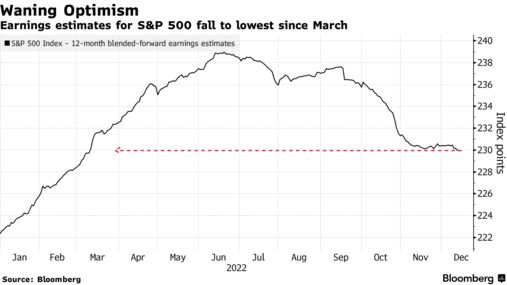
U.S. equity-index futures dropped with European stocks amid concern the resolve of central banks to continue their fight against inflation will tip the economy into a recession. Contracts on the S&P 500 and Nasdaq 100 fell at least 1.1% each after the underlying indexes posted their biggest declines since Nov. 2 on Thursday. Europe’s Stoxx 600 slid to a five-week low. The dollar erased a weekly loss and Treasuries dropped across the curve. Oil trimmed a weekly gain. Adobe Inc. rose in premarket New York trading after reporting better-than-estimated earnings. An index of global stocks headed for a weekly slide as the Federal Reserve and the European Central Bank reaffirmed rates will go higher for longer until inflation fell back to their targets. While that belied market expectations for a lower peak rate and potential rate cuts in 2023, it also clouded the growth outlook. Economists now see a 60% probability of recession in the US and an 80% chance in Europe. Equity analysts have cut 12-month earnings estimates for the regions to the lowest levels since March and July, respectively. “The worrying aspect for markets is the rate hike finishing lines are still unknown, and we have the two most dominant central banks in the world climbing the mountain into very restrictive territory,” Stephen Innes, managing partner at SPI Asset Management, wrote in a note. “Hiking interest rates into a dimming macro environment will undoubtedly trigger a recession. The question is just how profound.”
Europe’s equity benchmark fell for a third day, dragged by growth-sensitive sectors such as real estate, technology and financial services. The benchmark of Asian equities posted the first weekly decline since October. The MSCI ACWI Index, the global equities gauge, headed for a 1.4% retreat this week. Treasuries fell, with yield curves steepening. The two-year rate added 2 basis point, while the 10-year yield was 5 basis points higher. In Europe, both UK gilts and German bunds tumbled after ECB President Christine Lagarde delivered an unambiguously hawkish message, disabusing markets of any bets for a slowdown in rate hikes. Ann-Katrin Petersen, senior investment strategist at BlackRock Investment Institute, said on Bloomberg Television that central banks were starting to acknowledge they will have to crush growth and will likely engineer recessions to tame inflation. Traders were also digesting poor US retail sales and manufacturing data, even as the labor market remained strong. Meanwhile, the dollar edged higher, building on Thursday’s gains. Oil dropped on Friday, trimming the biggest weekly gain since early October on signs of tightening supply and the prospect for improved Chinese demand. NN: You can expect a lot of chop. BUT this market is doomed. It has not prices in yet a mild recession. Never mind the full blow depression the global deleveraging will cause.
CNBC 24 hour Infomercial For Stock Market Manipulators
15 hosts on Staff, 700 interviews a week. Its the go to place to pitch your deal….. They even have offices on the New York Stock Exchange. Owned by a Mega Wall Street Corporation, Its the furthest you can get from impartial news. Unfortunately we have to keep our enemy very close to us.. Same with Bloomberg, Fox and CNN. Talk about disinformation and manipulated news…
China Covid reversal ‘risks one million deaths’ in winter wave ….. China’s retail sales down 5.9% in November
One million Chinese people are at risk of dying from Covid-19 during the coming winter months if President Xi Jinping pursues his pivot to remove strict pandemic controls, new modelling shows. In a stunning reversal after protests against Xi’s zero-Covid policy, Chinese officials have begun dismantling the pandemic control system of lockdowns, mass testing, state quarantine and electronic contact tracing.On Wednesday, authorities for the first time announced that coronavirus patients who were either asymptomatic or had only mild symptoms could isolate at home rather than at hospitals or centralised quarantine facilities, while public venues in many cities would no longer have to check for negative Covid tests. Removal of the restrictions risks sparking an unparalleled “winter wave” of Covid infections that would rapidly overwhelm China’s healthcare system, according to projections by Wigram Capital Advisors, an Asia-focused macroeconomic advisory group that has provided modelling to governments during the pandemic. The models have been reviewed by the Financial Times. Under a scenario where China’s leadership continues to roll back zero-Covid – as it has been doing in Beijing, Shanghai and Guangzhou among other cities in recent days – daily fatalities may reach as high as 20,000 in mid-March. Demand for intensive care units would peak at 10 times higher than capacity by late March and daily hospitalisations would hit 70,000. The winter wave would be exacerbated by the likelihood of the lunar new year holiday, the world’s largest annual human migration, becoming a super spreader event. The projections highlight Beijing’s failure to administer full vaccine courses to tens of millions of elderly Chinese and address the country’s ICU shortage nearly three years since the first Covid cases emerged in Wuhan, central China, in late 2019. It also returns focus to the Xi administration’s refusal to import superior messenger RNA vaccine technology. That is despite months of warnings from health experts as well as modelling by researchers at Shanghai’s Fudan University, released in May, which estimated that an unchecked surge of the Omicron variant in the country of 1.4 billion people could lead to almost 1.6 million fatalities within about three months.
“The current propaganda messaging is that a reopening will be costless,” said Rodney Jones, principal at Wigram. “The risk is that they are underestimating just how much work – and cost – the rest of the world has done and borne to get to the point of living with Covid.”
The Wigram models use vaccination and age data, the effect of public health measures and the real-time effective “R value”, a measure of a disease’s ability to spread between people. It also uses the experiences of Singapore, Australia, New Zealand and Hong Kong. For China to also achieve hybrid immunity from infection and vaccinations, which would allow the economy to operate freely, 20 per cent of the population or 290 million people would have to be infected. Given the lack of reporting for positive cases, infections would in reality be 50 per cent higher, at about 30 per cent of the population or 435 million people. Under a scenario of a more gradual and controlled reopening, the process of reaching hybrid immunity would take until August next year, the Wigram modelling showed. This would help cap hospitalisations and deaths until mid-2023. “China has done nothing to prepare for this step, and Xi appears to be doing so on impulse as a reaction to the protests, rather than as part of a careful policy programme,” Mr Jones said. “It would be easier to have confidence in a reopening strategy if it was happening as part of a careful policy strategy, not on impulse, with no preparation.” Goldman Sachs’s baseline scenario is that Beijing will only meaningfully relax Covid controls from around the second quarter of next year, after completing medical preparations including vaccinating the elderly. NN: I stand on my analysis. This will end in tears. Their is no herd immunity, little vaccinations and 1.3 billion people packed tighter then sardines in a can.
China’s retail sales down 5.9% in November
China’s retail sales dropped 5.9% in November compared to the same month last year, the National Bureau of Statistics said on Thursday. Sales grew 0.1% compared to October. The fall from November 2021 was much bigger than expected, as analysts forecast a figure of 3.6%. Retail sales amounted to 3.9 trillion yuan. Sales of goods sank by 5.6% year-on-year, while services plunged 8.4%.
NNi: Talk about sucking shut. Bear in mind that they got the lunar new year supper spreader event coming. With no testing and no quarantines,,,, And for more COVID fun no vaccines…..
Oil Prices May Rally Next Year as Russian Exports Sink, IEA Says
-
Oil-demand growth in 2023 boosted to 1.7 million barrels a day
-
Russian output to fall 14% despite defying predictions so far
Oil prices could rally next year as sanctions squeeze Russian supplies and demand beats earlier expectations, the International Energy Agency said. Russia’s output — which defied the agency’s previous predictions of collapse this year — is poised to plunge 14% by the end of the first quarter, the Paris-based IEA said in a report on Wednesday. If that forecasts holds true, it could reverse the recent trend in oil futures, which have retreated to $80 a barrel in London after their worst weekly slump in four months. “While lower oil prices come as a welcome relief to consumers faced by surging inflation, the full impact of embargoes on Russian crude and product supplies remains to be seen,” the IEA said. “As we move through the winter months and toward a tighter oil balance in the second quarter, another price rally cannot be ruled out.” The IEA, which advises major economies, bolstered forecasts for global oil demand in 2023 by 300,000 barrels a day amid vigorous growth in India and surprising resilience in China. Consumption will grow by 1.7 million barrels a day next year to average 101.6 million a day. Still, it’s a softer warning on prices than recent messages from the agency, which a few weeks ago was highlighting the risk of a supply squeeze and urging the OPEC+ coalition to reverse its latest production cuts. The IEA acknowledged that Russian exports have continued to swell despite its repeated predictions that an international boycott would slash shipments. Moscow’s oil shipments climbed to a seven-month high of 8.1 million barrels a day in November, although revenue fell due to lower prices, according to the report. Russia’s resilience also contributed to shallower cutbacks than expected from OPEC+, the IEA said. The 23-nation group led by Saudi Arabia reduced supplies last month by just a quarter of the 2 million barrels-a-day it had announced, as many members were already pumping below their designated quotas.
But global markets are on track to tighten up in 2023, according to the IEA.
Russian output will finally begin to buckle this month as European Union sanctions over its invasion of Ukraine force the country to shut in about 400,000 barrels a day, the agency predicts. Production will tumble from current levels of about 11.2 million barrels a day to 9.6 million a day by the end of the first quarter, according to the report. President Vladimir Putin said last week that the country would reduce output rather than sell to buyers at the capped price level demanded by the G-7. Meanwhile, “buoyant” consumption of gasoil in emerging economies suggests that world oil demand will grow at a faster rate next year than previously estimated. India has led the expansion in recent months, but will be overtaken again by China next year as the Asian giant emerges from strict “Covid Zero” restrictions. the IEA said. “While restriction levels in the country remain high, the stage is now set for a progressive reopening in 2023,”according to the report.
NN BlackMask Pod Cast:
Sure its Confusing….. by Design!
China To Stop Reporting Comprehensive Covid Data….. Covid cases explode in Beijing leaving city streets empty
China will stop collecting and reporting comprehensive Covid case data after it ended mandatory testing for the virus. The move comes amid a general relaxation of Covid-related restrictions as Beijing adjusts its zero-Covid policy following a wave of protests against the restrictions in large Chinese cities. Bloomberg reports from now on the Chinese authorities will only report symptomatic cases of the viral infection as the non-symptomatic ones would be impossible to record without mandatory tests. The country’s reconsideration of its zero-Covid policy has been seen by most as a strong bullish factor for oil prices and benchmarks have been trending higher since China began relaxing the restrictions.
Covid cases explode in Beijing leaving city streets empty
Empty streets, deserted shopping centers, and residents staying away from one another are the new normal in Beijing – but not because the city, like many Chinese ones before it, is under a “zero-Covid” lockdown. On Wednesday, China’s National Health Commission (NHC) gave up trying to keep track of all the new Covid cases, announcing it would no longer include asymptomatic infections in its daily count. It had previously reported these cases, albeit in a separate category from “confirmed,” or symptomatic ones. “It is impossible to accurately grasp the actual number of asymptomatic infections,” the NHC said in a notice, citing reduced levels of official testing. Authorities on Wednesday morning reported 2,249 symptomatic Covid cases nationally for the previous day, 20% of which were detected in the capital. Those figures are also thought to be impacted by reduced testing. CNN reporting from Beijing indicates the case count overall in the Chinese capital could be many times higher than recorded. In a Twitter post, Beijing-based lawyer and former American Chamber of Commerce in China chairman James Zimmerman said about 90% of people in his office had Covid, up from around half a few days ago. “Our ‘work at home’ policy is now ‘work at home if you’re well e nough.’ This thing came on like a runaway freight train,” he wrote on Wednesday. Experts have said the relatively low number of previously infected Covid-19 patients in China and the lower effectiveness of its widely-used inactivated-virus vaccines against Omicron infection – as compared with previous strains and mRNA vaccines – could enable the virus to spread rapidly. “The current strains will spread faster in China than they have spread in other parts of the world because those other parts of the world have some immunity against infection from previous waves of earlier Omicron strains,” said University of Hong Kong chair professor of epidemiology Ben Cowling. The extent of severe disease or death in Covid-19 outbreaks typically takes time to become clear, but there are signs of an impact on the health care system – with authorities in Beijing urging patients who are not seriously ill not to seek the help of emergency services. The city’s major hospitals recorded 19,000 patients with flu symptoms from December 5 to 11 – more than six times that of the previous week, a health official said Monday.
The number of patients visiting fever clinics was 16 times greater on Sunday than a week prior. In China, where there isn’t a strong primary care system, visiting the hospital is common for minor illness.
So far, however, there were only 50 severe and critical cases in hospitals, most of whom had underlying health conditions, Sun Chunlan, China’s top official in charge of managing Covid, said during an inspection of Beijing’s epidemic response on Tuesday. “At present, the number of newly infected people in Beijing is increasing rapidly, but most of them are asymptomatic and mild cases,” said Sun, who also called for more fever clinics to be set up and made assurances that supply of medicines – which have been hit by a surge in purchases in recent days – was being increased. Prominent Shanghai physician Zhang Wenhong warned that hospitals should do everything they could to ensure that health workers were not getting infected as quickly as the people in the communities they serve. Such a situation could result in a shortage of medical staff and infections among patients, he said, according to local media reports. Concerns about scarcity and access to medicines and care have been palpable in public discussion, including on social media. There, a Beijing reporter’s account of her time in a temporary hospital for Covid-19 treatment triggered a firestorm on social media, with a related hashtag getting more than 93 million views on China’s Twitter-like platform Weibo since Monday. Social media users questioned why the reporter, who showed her two-bed room and access to fever medicine in a video interview posted by her employer Beijing Radio and Television Station on Sunday, received such treatment while others were struggling. “Awesome! A young reporter gets a space in a temporary hospital and takes liquid Ibuprofen for children that is hard-to-find for parents in Beijing,” read one sarcastic comment, which got thousands of likes. Another popular response complained that “ordinary people” stay at home with kids and elderly with high fevers. “Could you give (her) bed to me if I called (the hospital)?” the Weibo user asked. Amid fears of the virus, residents have rushed to buy canned peaches, following rumors the vitamin C-loaded snack could prevent or treat Covid. Chinese state media has since warned people the preserved fruit is not a Covid remedy nor a substitute for medicine. NN: My firm belief is China is shutting down. I an convinced as they TRY to open up COVID will cases soar. Consider golden week is coming, where a billion people come in close contact with each other. It is obvious to me a severe COVID crises is here and will get worse through January and February. And i believe their economy will suck shut.
BofA Says Don’t Bet on a Rise in Equities After Last Fed Hike
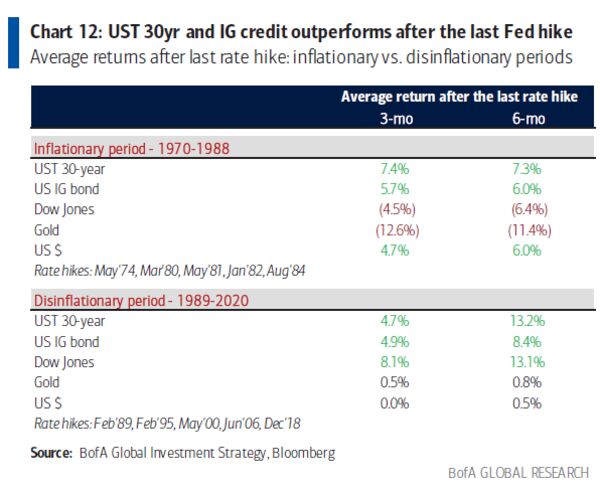
While investors are impatient for the Federal Reserve to deliver its last rate hike to pile back into equities, history shows they should be wary of doing so while inflation remains persistently high, according to Bank of America Corp. strategists. An analysis by Michael Hartnett and his team showed that stocks outperformed after the Fed stopped increasing rates during periods of disinflation in the past 30 years. However, during the era of persistently high inflation in the 1970s and 1980s, equities had fallen after the last hike, they wrote in a note. In the current cycle, they expect the Fed to raise rates for the last time in March 2023.
Source: Bloomberg
US stocks have already pulled back this week after rallying in the fourth quarter as signs of a resilient economy stoked fears the Fed would remain hawkish for longer, leading to the risk of a contraction next year. About $5.7 billion flowed out of global equity funds in the week through Dec. 7, Bank of America said, citing EPFR Global data. Citigroup Inc. strategists this week became the latest to warn about weaker returns in 2023, saying the recovery had left valuations looking expensive again. A Bloomberg News survey of global fund managers also highlighted stubborn inflation and a recession as the main risks to stocks in 2023. Still, the majority of respondents were optimistic about low double-digit gains after the worst year for equities since the global financial crisis. Bank of America’s Hartnett recommends buying assets that perform well against the backdrop of high, but stable, inflation, as well as dips in commodities, banks, small caps and value stocks, and European and emerging-market assets. Investors should avoid tech stocks, private equity and private credit, he said in the note. The flows data, meanwhile, showed European equity funds had outflows for a 43rd straight week. By style, US value funds had inflows, while small caps, large caps and growth funds saw redemptions.Among sectors, consumer and communication services had small inflows, while materials and tech had outflows of $300 million and $200 million, respectively. NN:
Putin: Russia could cut oil output in response to price cap…… OPEC Misses Production Quota By 310,000 Bpd
MOSCOW, Dec 9 (Reuters) – Russia, the world’s biggest exporter of energy, could cut oil production and will refuse to sell oil to any country that imposes the West’s “stupid” price cap on Russian oil, President Vladimir Putin said on Friday. The Group of Seven major powers, the European Union and Australia last week agreed to a $60 per barrel price cap on Russian seaborne crude oil after EU members overcame resistance from Poland. “As for our reaction, I have already said that we simply will not sell to those countries that make such decisions,” Putin told reporters in the Kyrgyz capital, Bishkek. “We will think, maybe, even about a possible, if necessary … reduction in production.” Putin, who rules the world’s second largest oil exporter after Saudi Arabia and the largest gas exporter, said Russia had a production agreement with other members of the OPEC+ oil producers’ club, so such a drastic step was still only a possibility. “We are thinking about this, there are no solutions yet. And concrete steps will be outlined in a decree from the president of Russia that will be released in the next few days,” Putin said. Selling oil and gas to Europe has been one of the main sources of Russia’sforeign currency earnings since Soviet geologists found oil and gas in the swamps of Siberia in the decades after World War Two. White House spokesman John Kirby said Putin’s threat was not unexpected but that it remains to be seen what action Moscow ultimately takes, telling reporters in a news briefing: “We’re not surprised by those comments. It’s actually not really new.” Putin dismissed the West’s attempt to squeeze Russian finances, saying the $60 price cap corresponded to the price at which Russia was selling oil. “It all boils down to about this figure,” Putin said. “So don’t worry about the budget.” The price for Urals blend crude on Friday was around $53 per barrel, according to Reuters data. The Kremlin chief cautioned that attempts by the West to impose a price cap would lead to the global collapse of the oil industry and then a catastrophic rise in prices. “This will lead to the collapse of the industry itself, because the consumer will always insist that the price be lower. The industry is already under-invested, under-funded, and if we listen only to consumers, then this investment will be reduced to zero,” Putin said. “All this will lead at some stage to a catastrophic surge in prices and to the collapse of the global energy sector. This is a stupid proposal, ill-conceived and poorly thought-out.” NN: I take the possibility of a Russian, Saudi and OPEC “reduction in production” very seriously. At $60 oil they will have no choice. In fact they are already producing under their reduced quota… See next story
OPEC Misses Production Quota By 310,000 Bpd
A new survey from Argus showed on Friday that OPEC+ production fell to 38.29 million bpd last month—1.81 million barrels per day short of its reduced quota. The 19 OPEC+ members subject to the quota produced 310,000 bpd fewer barrels in November when compared to the month prior. But that’s still 1.81 million barrels per day short of its quota for November. November’s quota was a reduction of 2 million barrels per day off October levels, although it was understood at the time that the group might not be able to reach even that reduced target. Non-OPEC members of the OPEC+ group faired better than the traditional OPEC members, raising the combined output by 460,000 bpd—an eight-month high, according to Argus. Most of those increases came from Kazakstan, which saw a 330,000 bpd production increase, and Russia’s production, which saw an increase of 190,000 bpdafter restarting Sakhalin 1. OPEC’s crude production was down 770,000 bpd for November, a six-month low. The production declines were led by Saudi Arabia, which saw its output reduced by 440,000 bpd. The biggest laggards among the broader OPEC+ group now, according to Argus, are Russia, producing 670,000 bpd under target; Nigeria, producing 530,000 bpd under target, Angola, producing 350,000 bpd under target, and Malaysia, producing 170,000 under target. The members of the group that met or exceeded their production target are Oman, Kazakhstan, Bahrain, Iraq, Kuwait, UAE, Algeria, and Gabon. Overall, Non-OPEC members under produced by 92,000 bpd, while OPEC members part of the quotas under produced by 90,000 bpd. Crude oil prices have fallen substantially this week, prompting some to forecast that the OPEC+ group could cut oil production to prop up crude prices. Brent crude was set to finish out the week more than $10 under this time last week—well below what most analysts suspect is OPEC’s price defense trigger. NN: AS stated above OPEC will cut production to defend price….. AND has already started!