133 units, switching off: Low demand behind half of thermal power plants shutting down
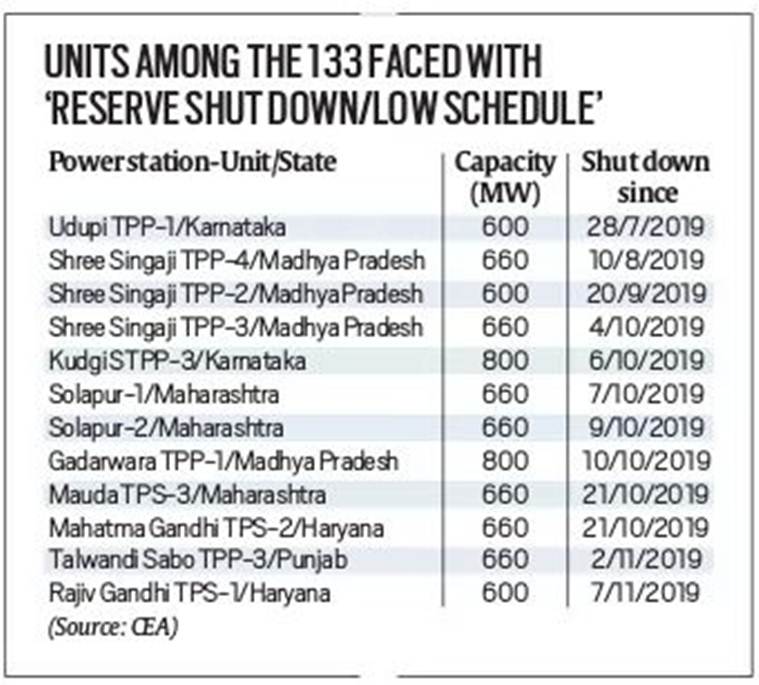
Of the country’s total installed generation capacity of 3,63,370 MW, the peak demand met was a little less than half at just around 1,88,072 MW on November 7, according to official data available with grid managers and analysed by The Indian Express. The electricity demand curve, a key indicator of industrial and domestic load trends, is on a downward spiral, with a mounting list of 133 thermal power units across the country reported as shut down due to lack of demand. As on November 11, of the 262 coal, lignite and nuclear units reported to be out-of-service for a variety of reasons, nearly half — or 133 units — were shut as operators were faced with low demand or were unable to ink pacts with distribution utilities for sale of power. Of the country’s total installed generation capacity of 3,63,370 MW, the peak demand met was a little less than half at just around 1,88,072 MW on November 7, according to official data available with grid managers and analysed by The Indian Express. A total of 119 thermal units across mostly India’s northern and western heartland were faced with “reserve shutdown,” a technical term for a unit shut down due to lack of demand, while another 14 units on account of developers not managing to ink power purchase agreements (PPAs — or commercial contracts) with electricity distribution utilities. Grid managers point to this being indicative of tepid industrial and commercial load. While the cumulative capacity of units under forced shutdown was over 65,133 MW, the worrying aspect is that most of these units have been shut for days, sometimes months, according to data of units monitored by the Central Electricity Authority’s (CEA) Operation Performance Monitoring Division updated till November 7. Additionally, there are well over a dozen thermal units that are down, according to official data, due to technical reasons, the most common being “water wall tube leakage.” According to an official in the CEA, this, normally, takes just days of repair. But the fact that these faults, in most cases, have stretched for days reinforces the belief that there’s general reluctance among developers to bring their units back on stream, presumably because demand is down.
Given that coal accounts for around 40 per cent of rail freight, analysts point to the downturn in thermal generation having a cascading impact on the driving down of railway volumes to the lowest this decade, spreading the stress to railway finances.